A food-grade hose is not hygienic simply because its tube material is approved for food contact. The complete assembly must be cleanable, drainable, chemically compatible, and maintained within validated process limits. Residue in a low point, damaged liner, incompatible gasket, or poorly controlled cleaning-in-place cycle can undermine the entire sanitation program.
Effective food-grade hose CIP cleaning begins before the hose is purchased. Engineers and quality teams should define product, cleaning chemistry, temperature, pressure, flow, microbial risk, and route geometry together.
Hygiene note: Cleaning limits and verification methods must come from the facility’s validated food-safety program, chemical supplier instructions, equipment guidance, and applicable regulatory requirements.
Start with the Product and Soil
Different foods leave different residues. Fats may require heat and alkaline chemistry; proteins can become difficult to remove if exposed to excessive heat before an effective pre-rinse; sugars may dissolve readily but collect in low-flow areas; mineral deposits can require an acid step.
Document:
- product composition and viscosity;
- fat, protein, sugar, starch, and mineral content;
- particles or inclusions;
- product temperature;
- allergen status;
- maximum hold time before cleaning;
- required transition to the next product.
Use a detailed food-grade hose guide to screen tube materials and constructions, then confirm the exact process and cleaning conditions with the manufacturer.
The Four Main CIP Variables
Cleaning effectiveness is often described through time, temperature, chemistry, and mechanical action. If one is reduced, another may need to increase—but only within equipment and material limits.
| Variable | What it influences | Hose-related risk if excessive |
|---|---|---|
| Time | Soil dissolution and contact | Swelling or accelerated aging |
| Temperature | Reaction and solubility | Softening, hardening, loss of adhesion |
| Chemistry | Soil removal and sanitation | Tube, seal, or fitting attack |
| Flow/turbulence | Mechanical removal | Pressure surge, abrasion, static or collapse |
These variables must be validated as a combination. A hose rated for a high temperature with water may have a lower limit with concentrated caustic or acid.
Define Temperature by Cleaning Stage
Do not specify one generic CIP temperature. Record the limits for pre-rinse, detergent wash, intermediate rinse, acid wash if used, sanitation, and final rinse. Include duration and frequency.
High temperature can improve cleaning but also accelerate chemical attack, permeation, and aging. Rapid transitions between hot and cold media may create thermal shock. A hot hose can be more flexible and more vulnerable to tight bends or coupling stress.
For demanding thermal cycles, PTFE hose for hygienic processing may be considered because of broad chemical and temperature capability. The complete construction, including reinforcement, cover, fittings, and seals, still requires verification.
Applications involving repeated hot product or sanitation should be reviewed against guidance for high-temperature food processing hoses. Never assume intermittent maximum temperature equals continuous service capability.
Check Every Cleaning Chemical
List chemical trade name, active ingredients, concentration range, temperature, contact time, and cycle frequency. Include alkaline detergents, acids, oxidizers, disinfectants, rinse aids, and any occasional recovery treatment.
Compatibility must cover:
- inner tube or liner;
- reinforcement and bonding layers;
- external cover exposed to spills;
- ferrules and fitting alloys;
- gaskets, O-rings, and seals;
- labels, sleeves, and external guards.
A cleaner diluted at the chemical station may concentrate through dosing error or evaporation. Define maximum credible exposure and the corrective action after an out-of-limit cycle.
Avoid mixing incompatible residues. The cleaning recipe should specify the rinse or neutral transition between chemical stages rather than relying on operator judgment.
Design for Complete Drainability
After cleaning, retained liquid can dilute product, support microbial growth, corrode fittings, or react with the next chemical. Hose flexibility makes drainability harder than in fixed sloped piping.
Route assemblies with a continuous fall to a drain point where practical. Avoid sags, loops, elevated connections that trap liquid, and long unsupported spans. Provide hangers or supports that preserve bore shape without creating tight bends.
Drainability should be evaluated in the hose’s actual operating position, not only on a drawing. A line that drains when empty may sag when filled. Movement, pump suction, and operator handling can also change the route.
Avoid Dead Legs and Restrictive Fittings
Hygienic fittings should provide a smooth flow path and suitable surface finish. Steps, gaps, exposed threads, damaged gaskets, and oversized crevices can retain soil. A hose liner that does not align correctly with the fitting may create a pocket.
Specify fitting standard, size, alloy, surface finish, gasket material, assembly method, and inspection criteria. Check that reducers, valves, tees, sample ports, and adapters do not defeat an otherwise hygienic design.
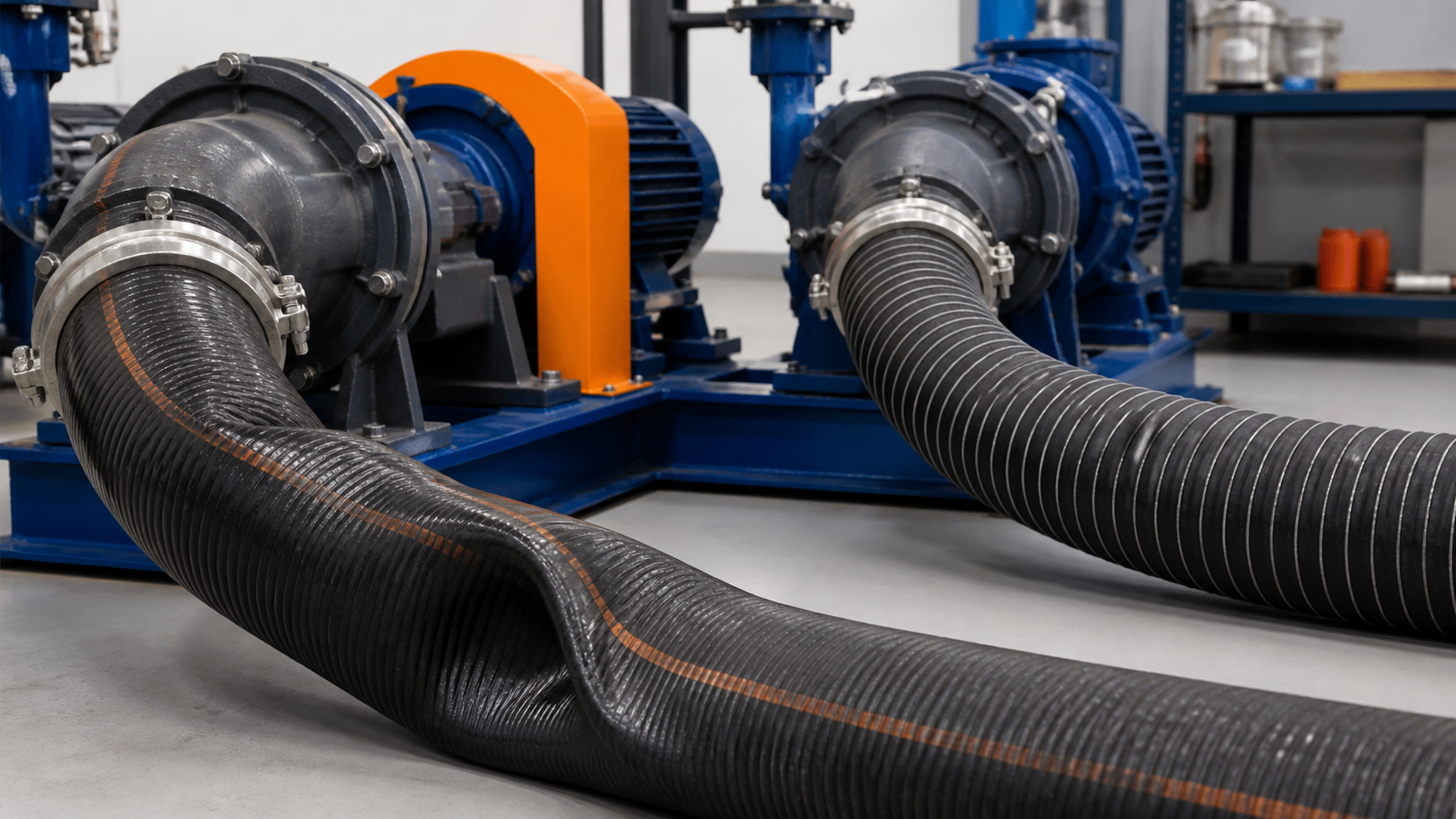
The hose bore should not collapse at bends or under pump suction. Reduced cross-section lowers cleaning velocity and can create a shadowed area.
Establish Adequate Flow
CIP needs sufficient movement to wet the entire bore and carry soil away. Required flow depends on diameter, fluid properties, circuit geometry, and the validated system. Do not copy a velocity target from rigid piping without reviewing hose limitations.
Measure or verify flow at the difficult point, not only at the pump. Long hose, small bore, fittings, and elevation create pressure loss. Parallel circuits may receive unequal flow.
Avoid deadheading and rapid valve changes. Pressure surge can damage the assembly even when steady pressure is acceptable. For suction-return CIP circuits, confirm vacuum capability and prevent liner collapse.
A Typical CIP Sequence Framework
The validated recipe will vary, but a controlled sequence may include:
- product recovery or push-out using an approved method;
- pre-rinse at defined temperature, flow, and endpoint;
- detergent circulation at controlled concentration and time;
- intermediate rinse to a measured endpoint;
- acid cleaning when required for mineral soil;
- another controlled rinse;
- chemical or thermal sanitation;
- final rinse where the process requires it;
- complete drainage and approved drying or storage state.
Define endpoints using measurable criteria such as conductivity, pH, concentration, temperature, turbidity, total organic carbon, ATP, allergen testing, or microbiological sampling as appropriate. Visual clarity alone may not confirm cleanliness.
Hose Selection Questions for CIP Service
When comparing food and beverage industrial hoses, provide suppliers with:
- food product and contact time;
- product and ambient temperatures;
- cleaning chemicals and maximum concentrations;
- each CIP stage temperature and duration;
- pressure, vacuum, and flow;
- number of cycles per day;
- bend radius and movement;
- fitting and gasket specification;
- drainability and storage arrangement;
- required certificates and traceability.
Ask whether stated limits apply simultaneously. A hose may tolerate the chemical, temperature, and pressure individually but not at their maximum values together.
Inspect Between Cleaning Cycles
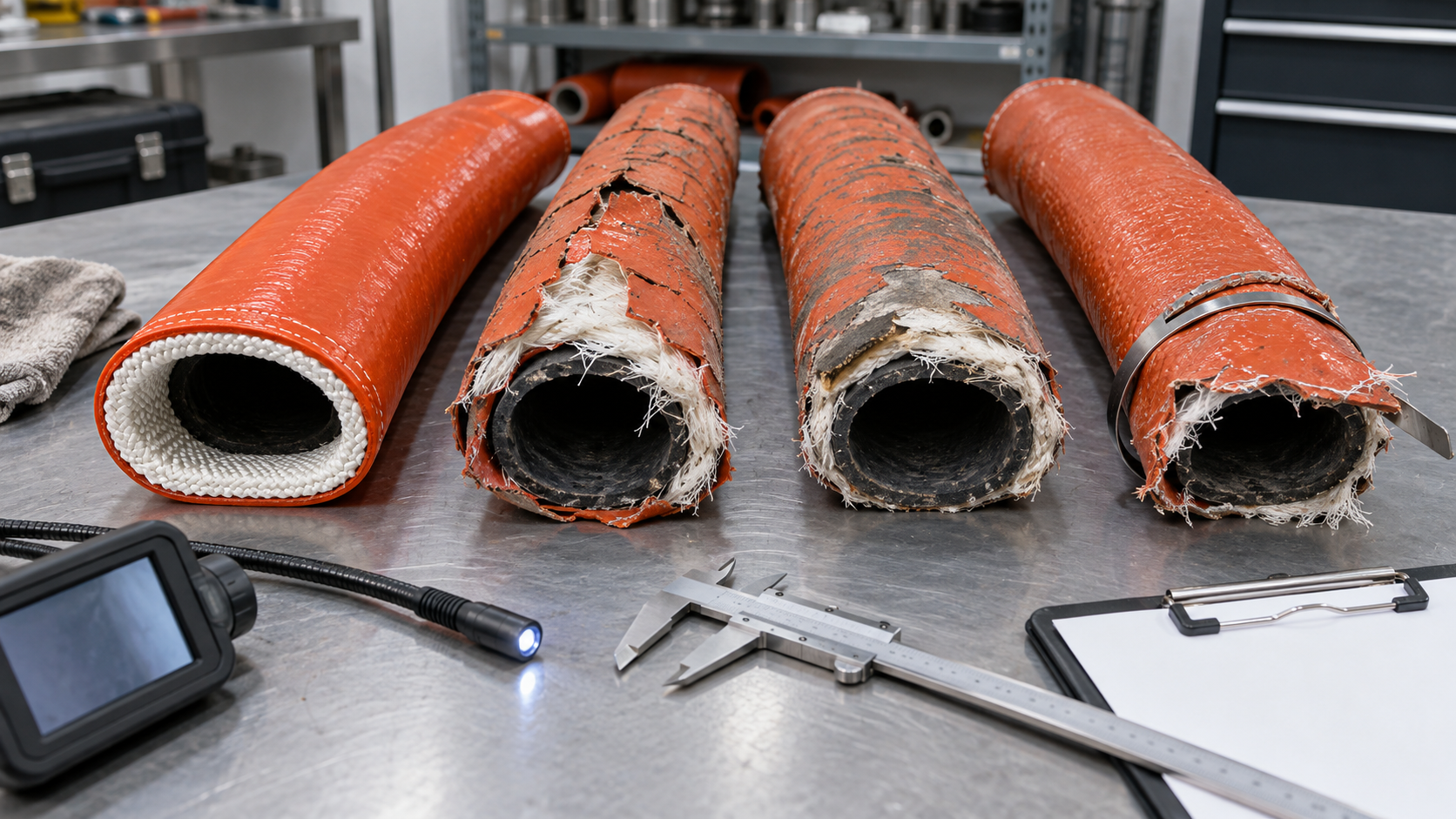
Routine external checks should look for cover cracks, cuts, blisters, exposed reinforcement, kinks, soft spots, coupling movement, and gasket damage. Internal inspection should check discoloration, swelling, scratches, pitting, delamination, residue, and changes in surface texture.
Inspect more frequently after a process deviation, chemical over-concentration, overheating, blocked flow, severe bend, or unexpected sanitation result. Quarantine the hose until its condition and cleanliness are established.
Replace scratched or damaged liners when the defect can retain product or cannot be reliably cleaned. A passing pressure test does not prove hygienic condition.
Verify the Cleaning Process
Validation demonstrates that the defined recipe can achieve the required sanitation result. Ongoing verification shows that each cycle remained within the validated window.
Record chemical concentration, temperature at critical points, time, flow or pressure, return condition, endpoint results, deviations, and operator or system identification. Trend results to detect gradual loss of heating, dosing accuracy, flow, or drainability.
If the hose is moved between lines, maintain clear status identification and prevent recontamination of cleaned ends. Use compatible clean caps and an appropriate storage rack.
Common CIP Mistakes
Frequent mistakes include selecting only by food-contact certification, ignoring cleaning chemicals, using the hose’s maximum temperature as the normal CIP setting, allowing low points, mixing gasket materials, and assuming a longer wash always compensates for weak flow.
Another error is changing the detergent or sanitizer without reviewing hose compatibility. A sanitation improvement in fixed equipment can shorten hose life or create extractables if flexible components are overlooked.
Final Hygienic Design Principle
A cleanable hose system combines suitable materials with controlled time, temperature, chemistry, flow, drainage, and verification. None of those elements can compensate permanently for a damaged liner or poor route.
Design the CIP process and hose assembly together, validate the worst credible cycle, and maintain evidence that each cleaning remained within limits. That approach protects product quality while extending predictable hose service life.