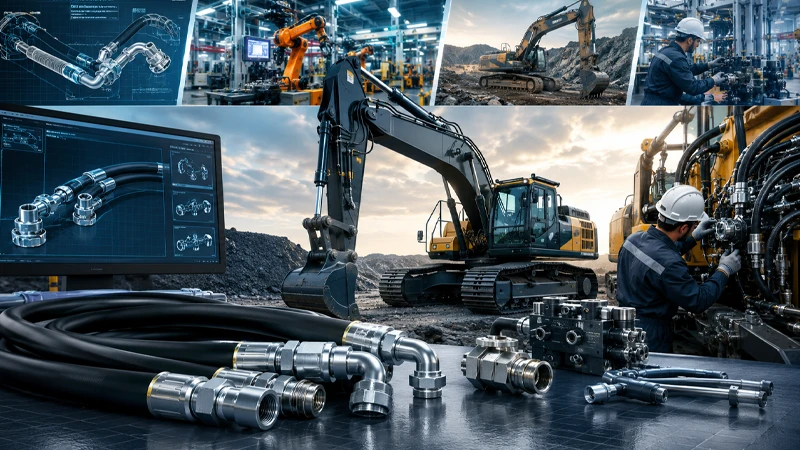
Hydraulic hose is often treated as a consumable — a component specified late in the design process and replaced reactively once it fails in the field. But for OEMs building equipment with a 10, 15, or even 20-year service life, hose and fitting decisions made at the design stage have a direct, compounding impact on total lifecycle cost, warranty exposure, and customer satisfaction long after the equipment leaves the factory floor.
This article looks at why hydraulic hose should be treated as a lifecycle design decision rather than a late-stage sourcing task, and how OEMs can integrate hose planning into broader equipment design, maintenance strategy, and total cost of ownership calculations.
Why Hose Decisions Made Early Affect Costs for Years
A hydraulic hose specified during initial equipment design will typically be replaced multiple times over the machine’s operating life — sometimes dozens of times on high-cycle equipment. Every one of those replacement events carries costs beyond the part price itself: labor, equipment downtime, potential warranty claims, and in some cases, safety risk if a failure happens unexpectedly in the field.
When hose specifications are chosen purely to meet minimum initial requirements — the lowest-cost hose that satisfies the stated pressure rating — the long-term costs of more frequent replacement, higher failure rates, and greater field service demand often outweigh the small upfront savings. Lifecycle-focused hose design instead asks: what combination of hose, fitting, and routing will minimize total cost and downtime across the equipment’s full operating life, not just at the point of manufacture.
Key Lifecycle Factors Hose Design Should Account For
Expected Service Life and Duty Cycle
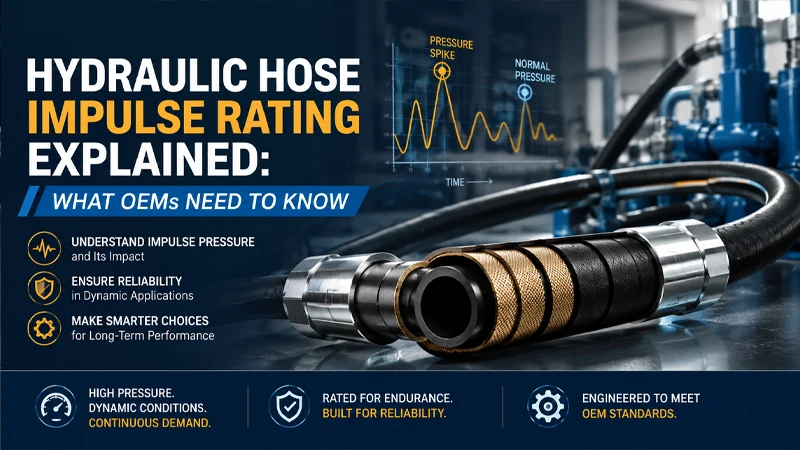
Equipment designed for continuous, high-cycle operation — such as recycling machinery or construction equipment used in rental fleets — needs hose and fitting combinations rated for realistic cycle counts, not just nominal working pressure. Specifying hose based on impulse rating and expected duty cycle, rather than pressure rating alone, is one of the most effective ways to align hose selection with actual equipment lifespan. This is covered in more depth in our article on hydraulic hose impulse rating.
Maintenance Accessibility
Hose routing decisions made during equipment design directly affect how easily hoses can be inspected and replaced in the field. Hoses buried deep within equipment structures or routed through hard-to-reach areas increase labor time and downtime for every future replacement — a cost that compounds many times over a machine’s operating life. Designing for maintenance accessibility from the start reduces total lifecycle labor cost significantly.
Environmental Exposure Across the Equipment’s Operating Regions
Equipment sold into multiple markets or climates needs hose specifications that account for the full range of conditions it may encounter — not just the conditions at the factory’s home region. A hose cover suited to a temperate climate may degrade faster in high-UV or high-humidity regions, leading to inconsistent field performance and higher warranty claims in certain markets.
Standardization Across Product Platforms
OEMs building multiple equipment models or platforms benefit from standardizing hose and fitting specifications where practical, rather than specifying unique components for each model variant. Standardization simplifies inventory for both the OEM and its dealer network, reduces the risk of incorrect replacement parts being installed in the field, and often improves purchasing leverage with suppliers.
Serviceability and Replacement Part Availability
Lifecycle planning should also consider how easily replacement hoses will be available over the equipment’s operating life, particularly for equipment expected to remain in service for a decade or more. Working with a manufacturer that can guarantee long-term specification consistency reduces the risk of hose and fitting obsolescence partway through the equipment’s lifecycle.
Total Cost of Ownership: Beyond the Initial Purchase Price
When evaluating hydraulic hose specifications, OEMs and equipment buyers benefit from thinking in terms of total cost of ownership rather than initial component cost alone. Key factors include:
- Replacement frequency — Higher-quality hose and fitting combinations with better impulse and abrasion performance typically require less frequent replacement, reducing cumulative parts and labor costs.
- Downtime cost — For revenue-generating equipment such as construction machinery, transport vehicles, or production-line equipment, the cost of downtime during hose replacement often far exceeds the cost of the hose itself.
- Warranty exposure — Premature hose or fitting failures within the warranty period create direct cost exposure for OEMs, in addition to reputational impact.
- Field service logistics — Equipment operating in remote locations or difficult-to-access sites incurs higher service costs per hose replacement, making hose longevity even more valuable in these applications.
A hose that costs slightly more upfront but doubles the interval between replacements can represent significant total savings once these factors are accounted for across the equipment’s full service life.
Building Hose Lifecycle Planning into the Design Process
Involve Hydraulic Component Suppliers Early
Bringing hose and fitting suppliers into the design conversation early — rather than after mechanical design is finalized — allows for better-informed decisions about routing, hose length, bend radius, and component selection based on the equipment’s actual operating profile.
Define Duty Cycle and Environmental Parameters Upfront
Clearly defining expected cycle rates, pressure profiles, temperature ranges, and environmental exposure at the start of the design process allows hose specifications to be matched to real conditions, rather than defaulting to generic industry norms that may not reflect the specific application.
Plan for Field Data Feedback
OEMs with strong field service or warranty tracking systems can use real-world failure data to refine hose specifications on future models or design revisions. Recurring failure patterns at specific fittings or hose runs often point to a specification issue that can be corrected in the next design cycle — a topic explored further in our article on why hydraulic hoses fail at fittings.
Document Specifications for Long-Term Consistency
Maintaining clear internal documentation of hose and fitting specifications — including standards compliance, impulse ratings, and approved supplier part numbers — helps ensure consistency across production runs and simplifies future sourcing decisions, particularly as equipment platforms evolve over time.
Lifecycle Thinking Benefits Both OEMs and End Users
Integrating hose design into lifecycle planning isn’t just a cost-control exercise for OEMs — it directly benefits the equipment’s end users through fewer unplanned failures, more predictable maintenance schedules, and lower total operating costs. For equipment operating in safety-sensitive or high-utilization applications, this lifecycle approach also supports better reliability and reduced risk over the equipment’s operating life.
OEMs that treat hydraulic hose as a lifecycle design element — rather than a late-stage commodity purchase — are generally better positioned to reduce warranty costs, strengthen customer relationships, and differentiate their equipment on reliability rather than just initial price.
Partnering with a Hydraulic Hose Manufacturer for Lifecycle Design
Effective lifecycle planning requires a hose and fitting supplier that can support more than just a spec sheet — one that understands duty cycle analysis, impulse performance, and long-term specification consistency across production runs.
At Kingdaflex, we work with OEMs to align hydraulic hose and fitting specifications with equipment duty cycles, environmental conditions, and long-term serviceability goals. From early design consultation through ongoing production supply, our team can help you build hose specifications that support total lifecycle performance rather than just initial cost targets.
Frequently Asked Questions
Why should hydraulic hose selection be part of equipment design rather than just procurement?
Hose and fitting decisions made during design directly affect replacement frequency, maintenance accessibility, and downtime costs over the equipment’s entire service life, making them a design consideration rather than a purely commercial one.
How does hose standardization benefit OEMs with multiple equipment models?
Standardizing hose and fitting specifications across product platforms simplifies inventory management, reduces the risk of incorrect replacement parts in the field, and can improve purchasing leverage with suppliers.
What role does duty cycle play in lifecycle hose planning?
Duty cycle determines how many pressure cycles a hose will experience over its service life, which is why impulse rating — not just working pressure — should be matched to the equipment’s expected usage pattern.
How early should hose suppliers be involved in equipment design?
Involving hose and fitting suppliers during the design phase, rather than after mechanical layout is finalized, allows routing, length, and component specifications to be optimized for the equipment’s real operating conditions.