In industrial environments, steam hoses are exposed to some of the most demanding operating conditions—extreme temperatures, high pressures, and constant thermal cycling. Whether used in chemical processing, food and beverage production, refineries, or steam cleaning systems, a steam hose plays a critical role in ensuring safe and reliable steam transfer.
However, selecting the wrong steam hose can result in serious consequences. Hose failures caused by improper construction or unsuitable materials may lead to leakage, hose rupture, safety hazards, unplanned downtime, and costly equipment damage. For procurement managers and engineers, steam hose selection is not just a purchasing decision—it is a risk management decision.
As an experienced industrial hose manufacturer, Kingdaflex shares industry-proven insights to help you choose the right steam hose solution for your specific application.
Understanding Steam Hose Construction Basics
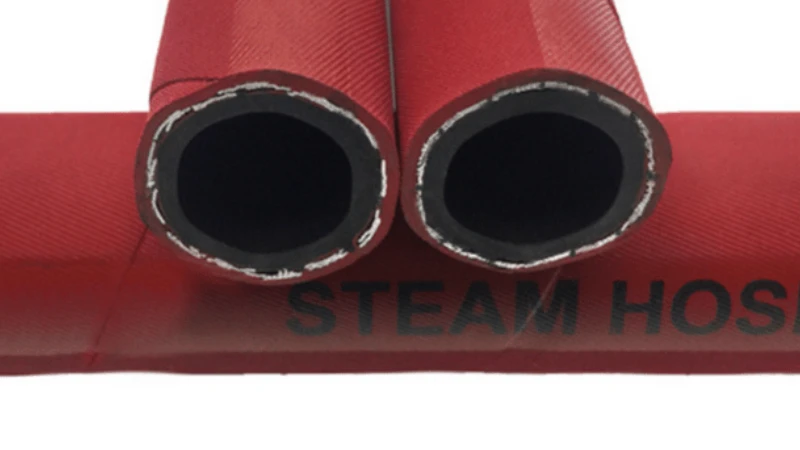
Before comparing single wire and double wire steam hoses, it is important to understand the basic construction of an industrial steam hose and the key factors that determine its performance. Steam hoses are engineered assemblies, not simple rubber tubes, and every layer plays a role in safety, durability, and pressure resistance.
What Is a Steam Hose?
A steam hose is a flexible industrial hose designed to safely convey saturated or superheated steam under high temperature and pressure conditions. Unlike standard hydraulic or water hoses, steam hoses must withstand:
- Continuous exposure to elevated temperatures
- Sudden pressure fluctuations
- Thermal expansion and contraction
- Moisture and condensate inside the hose
Because of these conditions, industrial steam hoses are typically constructed with heat-resistant inner tubes, steel wire reinforcement, and protective outer covers to ensure long service life and safe operation.
Steam hoses are widely used in industries such as chemical processing, oil and gas, food and beverage production, pharmaceuticals, power generation, and industrial cleaning systems, where reliability and safety are critical.
Basic Structure of an Industrial Steam Hose
Most industrial steam hoses share a similar multi-layer construction:
Inner Tube
The inner tube is in direct contact with steam and condensate. It must resist high temperatures, moisture penetration, and aging. EPDM rubber is the most commonly used inner tube material due to its excellent heat and steam resistance.
Reinforcement Layer
The reinforcement layer provides pressure resistance and structural strength. This is typically achieved using high-tensile steel wire braiding, which may be configured as:
The number of wire layers directly affects the hose’s working pressure, safety factor, and durability.
Outer Cover
The outer cover protects the hose from external damage such as abrasion, weather, ozone, and heat radiation. It also contributes to overall safety by reducing the risk of blistering or surface cracking in high-temperature environments.
Key Performance Factors That Affect Steam Hose Selection
When evaluating an industrial steam hose, buyers should focus on several critical performance factors rather than price alone:
- Maximum working pressure and safety factor
- Maximum operating temperature
- Type of steam (saturated or superheated)
- Reinforcement design (single wire vs double wire)
- Flexibility and minimum bending radius
- Compatibility with fittings and connectors
Understanding these construction fundamentals helps procurement managers and engineers make informed decisions when choosing between different steam hose designs. In the next section, we will take a closer look at the key differences between single wire (1W) and double wire (2W) steam hoses, and how each option performs in real industrial applications.
Single Wire (1W) vs Double Wire (2W) Steam Hose

One of the most important decisions when selecting an industrial steam hose is choosing between single wire (1W) and double wire (2W) reinforcement. While both designs are suitable for steam transfer, they are engineered for different pressure levels, operating conditions, and service expectations. Understanding these differences helps buyers balance flexibility, safety, and long-term cost.
What Do 1W and 2W Mean in Steam Hose Construction?
In steam hose terminology, 1W and 2W refer to the number of steel wire braid reinforcement layers inside the hose:
- 1W (Single Wire Steam Hose)
Constructed with one layer of high-tensile steel wire braid to provide pressure resistance. - 2W (Double Wire Steam Hose)
Reinforced with two layers of steel wire braid, offering significantly higher strength and pressure capacity.
The reinforcement layer is critical because steam systems often experience pressure spikes and temperature fluctuations, which place stress on the hose. Increasing the number of wire layers improves pressure resistance and safety margins but can reduce flexibility.
Single Wire (1W) Steam Hose: Features, Advantages, and Limitations
Single wire steam hoses are designed for applications where moderate pressure and improved flexibility are required.
Key advantages of 1W steam hoses:
- Greater flexibility and easier handling
- Smaller bending radius
- Faster installation in confined spaces
- Lower weight and reduced strain on fittings
- More cost-effective for standard applications
Limitations to consider:
- Lower maximum working pressure compared to 2W hoses
- Reduced safety margin under extreme pressure spikes
- Shorter service life in heavy-duty or continuous-use systems
Typical applications for 1W steam hoses:
- Mobile steam cleaning equipment
- Light to medium-duty industrial steam transfer
- Systems with limited installation space
- Intermittent steam use rather than continuous operation
For buyers prioritizing ease of installation and flexibility, a single wire steam hose can be a practical and economical solution—provided pressure and temperature requirements remain within safe limits.
Double Wire (2W) Steam Hose: Features, Advantages, and Limitations
Double wire steam hoses are engineered for high-pressure and demanding industrial environments, where safety and durability are top priorities.
Key advantages of 2W steam hoses:
- Higher working pressure capability
- Improved safety factor and burst resistance
- Longer service life under continuous operation
- Better resistance to pressure surges and thermal stress
Limitations to consider:
- Reduced flexibility compared to 1W hoses
- Larger bending radius
- Higher weight and material cost
Typical applications for 2W steam hoses:
- High-pressure steam lines
- Fixed industrial steam systems
- Chemical plants and refineries
- Boilers and power generation facilities
- Continuous steam transfer operations
In environments where steam is present at high pressure for extended periods, double wire steam hoses offer greater reliability and reduced risk of failure.
1W vs 2W Steam Hose: Side-by-Side Comparison
Below is a simplified comparison to help procurement managers quickly evaluate both options:
- Pressure Resistance:
1W – Moderate | 2W – High - Flexibility:
1W – Better | 2W – Reduced - Durability:
1W – Standard | 2W – Heavy-duty - Installation:
1W – Easier in tight spaces | 2W – Requires more planning - Cost:
1W – Lower | 2W – Higher initial investment
This comparison highlights that neither option is “better” in all cases—the right choice depends entirely on the application.
How to Choose Between 1W and 2W Steam Hoses
When deciding between single wire and double wire steam hoses, buyers should consider the following practical factors:
- Actual working pressure, not just nominal system pressure
- Frequency of pressure spikes
- Continuous versus intermittent steam use
- Installation space and bending requirements
- Safety regulations and risk tolerance
As a general guideline:
- Choose 1W steam hoses for flexibility-focused, moderate-pressure applications.
- Choose 2W steam hoses for high-pressure, safety-critical, or continuous-use systems.
Working with an experienced steam hose manufacturer such as Kingdaflex allows buyers to evaluate real operating conditions and select a steam hose that delivers long-term safety, performance, and value rather than short-term cost savings.
How to Choose the Right Steam Hose – Practical Selection Checklist
Selecting the right steam hose is not only about matching a product to a specification sheet. It requires a clear understanding of real operating conditions, potential risks, and long-term performance expectations. The following practical checklist is designed to help procurement managers and engineers make confident, informed decisions when sourcing industrial steam hoses.
Define the Actual Working Pressure (Not Just the System Rating)
One of the most common mistakes in steam hose selection is relying solely on the nominal system pressure. In real-world operations, steam systems often experience pressure spikes, especially during start-up or shut-down.
Checklist:
- Identify the maximum operating pressure
- Consider pressure surges and fluctuations
- Ensure the hose has an adequate safety factor
For high-pressure or safety-critical systems, a double wire (2W) steam hose is often the safer choice.
Confirm Maximum Operating Temperature and Steam Type
Not all steam is the same. Selecting a hose without confirming the type of steam can lead to premature failure.
Checklist:
- Determine whether the application uses saturated or superheated steam
- Verify maximum operating temperature
- Ensure the hose material is rated above actual temperature conditions
For most saturated steam applications, EPDM steam hoses perform well, while extreme temperatures may require stainless steel solutions.
Evaluate Flexibility and Installation Requirements
Installation conditions significantly influence hose performance and service life.
Checklist:
- Measure available installation space
- Check minimum bending radius requirements
- Consider whether the hose will be stationary or mobile
- Avoid excessive twisting or sharp bends
Applications with limited space or frequent movement may benefit from single wire (1W) or corrugated steam hose designs.
Assess Safety, Standards, and Compliance Requirements
Steam hoses operate in high-risk environments, making safety and compliance essential.
Checklist:
- Confirm applicable industrial standards and certifications
- Ensure hose construction meets safety factor requirements
- Verify compatibility with approved fittings and couplings
Working with an experienced steam hose manufacturer helps ensure products meet international safety and quality expectations.
Consider Service Life, Maintenance, and Total Cost of Ownership
The lowest-priced steam hose is rarely the most cost-effective solution over time.
Checklist:
- Estimate expected service life under real conditions
- Evaluate maintenance and inspection requirements
- Factor in downtime and replacement costs
Investing in a properly selected steam hose often results in lower total cost of ownership and reduced operational risk.
Partner with a Reliable Steam Hose Manufacturer
Beyond product specifications, supplier expertise plays a critical role in successful steam hose selection.
Checklist:
- Manufacturer experience with steam applications
- Ability to provide technical guidance
- Custom length and fitting options
- Consistent quality control and testing
Partnering with a trusted manufacturer such as Kingdaflex ensures your steam hose solution is optimized for safety, performance, and long-term reliability.
Conclusion
Choosing the right steam hose is a critical decision that directly affects operational safety, system reliability, and long-term cost control. As this guide has shown, there is no one-size-fits-all solution. The correct choice depends on a clear understanding of working pressure, operating temperature, installation conditions, reinforcement design, and material performance.
Single wire (1W) steam hoses offer greater flexibility and ease of installation for moderate-pressure applications, while double wire (2W) steam hoses provide higher strength and safety margins for demanding, high-pressure environments. Likewise, material selection—whether EPDM, corrugated designs, stainless steel, or alternatives—plays a decisive role in determining service life and resistance to thermal stress.
By evaluating real operating conditions rather than relying solely on nominal specifications, industrial buyers can significantly reduce the risk of hose failure, unplanned downtime, and safety incidents. A well-selected steam hose not only performs better but also delivers lower total cost of ownership over its lifecycle.