
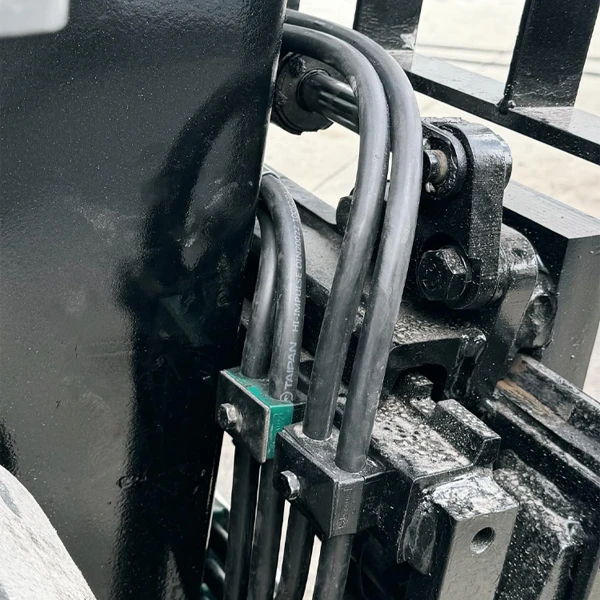
Not every forklift hose circuit is the same. Below are the hose types Kingdaflex recommends for each application on a forklift, selected for pressure rating, flexibility, and service life.
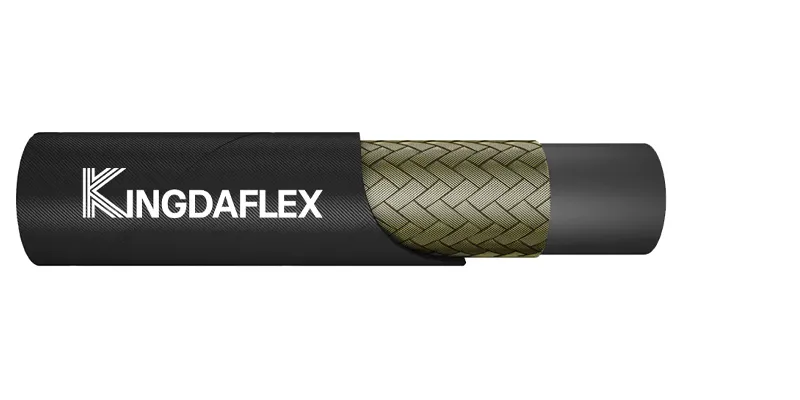
The go-to choice for the forklift mast hydraulic hose position. EN857’s compact-bend-radius design (up to 35% tighter than SAE 100R2AT) handles the constant flexing inside the mast channel, dramatically extending service life over standard hoses.
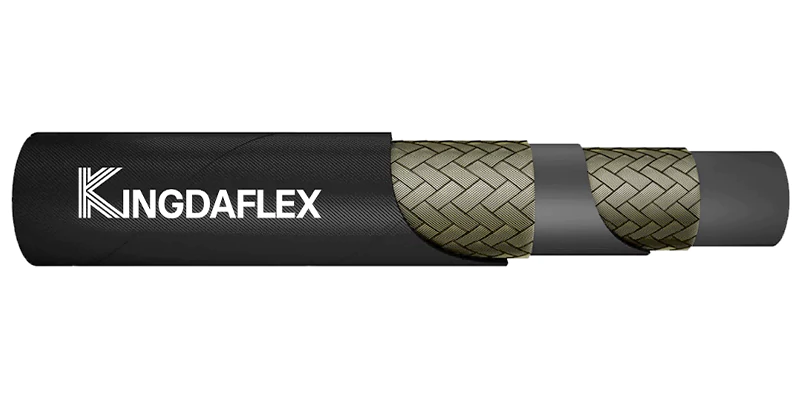
The workhorse of forklift hydraulics. Two-wire braided construction provides the burst strength needed for main lift cylinder pressure, while maintaining the flexibility to route through tight chassis areas.
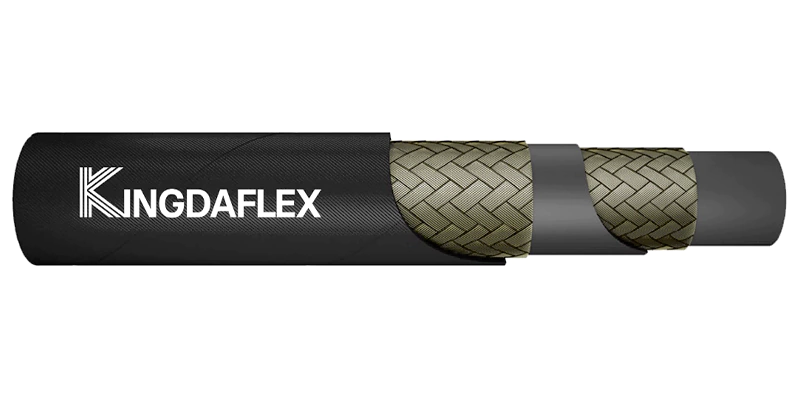
Constant-pressure hoses that maintain their rated pressure regardless of bore size — ideal for reach trucks and multi-stage mast forklifts where routing is complex and consistent performance is critical.

Wire-reinforced suction hose prevents collapse under vacuum on the pump inlet line. Essential for ensuring consistent fluid supply to the forklift’s hydraulic pump and preventing cavitation damage.
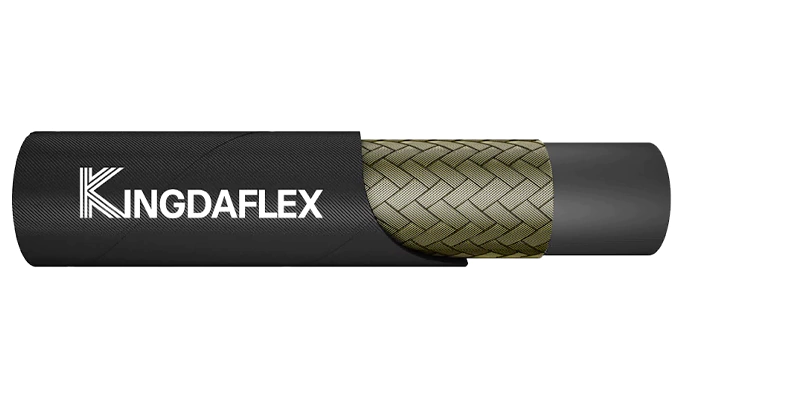
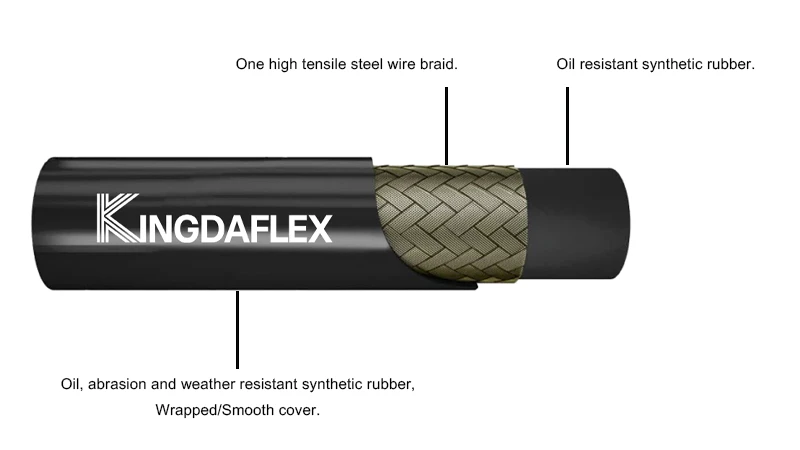
Single-wire braided hoses for lower-pressure auxiliary circuits powering side-shifters, rotators, clamps, and other forklift attachments. Lighter and more flexible than 2-wire alternatives.
Small-bore pilot hoses for proportional valve control signals and joystick pilot pressure circuits found on electric forklifts and advanced pneumatic-tire trucks with electronic controls.
| Circuit Position | Typical Pressure (PSI) | Typical Bore | Recommended Hose | Key Requirement |
|---|---|---|---|---|
| Forklift Mast Hydraulic Hose (Free-Lift Cylinder) | 2,000–3,500 | 3/8″ – 1/2″ | EN857 2SC / SAE 100R16 | Compact bend radius; high flex cycle life |
| Main Lift Cylinder (Full Mast Extend) | 2,500–4,000 | 1/2″ – 3/4″ | SAE 100R2AT / EN853 2SN | High burst strength; oil/abrasion resistance |
| Tilt Cylinder Lines | 2,000–3,200 | 3/8″ – 1/2″ | SAE 100R1AT / SAE 100R2AT | Flexibility; routing through carriage pivot |
| Side-Shifter / Attachment (Auxiliary 1) | 1,500–2,500 | 1/4″ – 3/8″ | SAE 100R1AT / EN853 1SN | Lightweight; tight attachment routing |
| Pump Suction Line | Vacuum / Low | 3/4″ – 1-1/4″ | SAE 100R4 | Full vacuum-rated; anti-collapse wire helix |
| Tank Return Line | Low (<150 PSI) | 1/2″ – 1″ | SAE 100R4 / SAE 100R3 | Large bore; low restriction; flexible |
| Pilot / Control Signal | 500–1,000 | 1/4″ (DN6) | Pilot Hose / SAE 100R7 | Ultra-flexible; minimal pressure drop |
The most common forklift type in warehouses and distribution centres. The hydraulic hoses on a counterbalance forklift typically run from a gear pump (on ICE trucks) or electric pump to the lift cylinder inside the mast, the two tilt cylinders behind the carriage, and one or two auxiliary lines at the carriage front face for attachments.
We recommend SAE 100R2AT for main lift and tilt lines, EN857 2SC for the mast internal routing, and SAE 100R1AT for auxiliary circuits. The compact package delivers a full OEM-replacement kit with consistent crimped fittings.

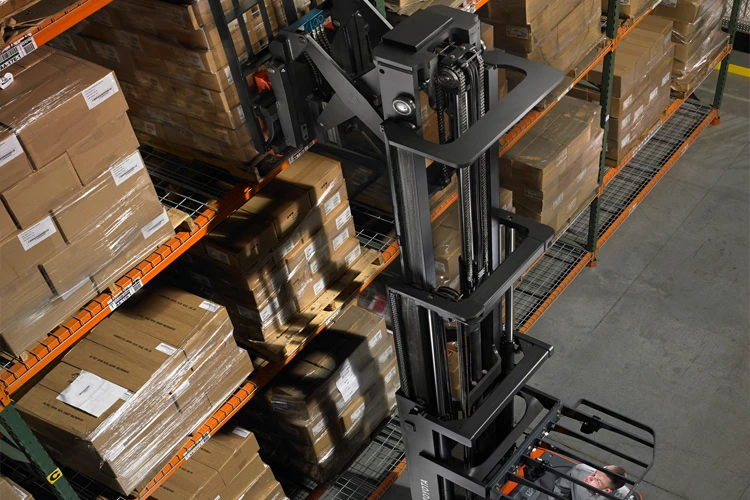
Reach trucks carry their hydraulics in a narrow chassis with a telescoping mast that can extend 10–12 metres. The forklift mast hydraulic hose on a reach truck must survive millions of flex cycles as the mast stages extend and retract under load. Any standard hose without a compact bend rating will crack prematurely.
SAE 100R16 constant-pressure hoses are our top recommendation for reach-truck mast assemblies. Their smaller outer diameter and superior flexibility allow clean routing through multi-stage mast channels while maintaining consistent pressure ratings across all bore sizes.
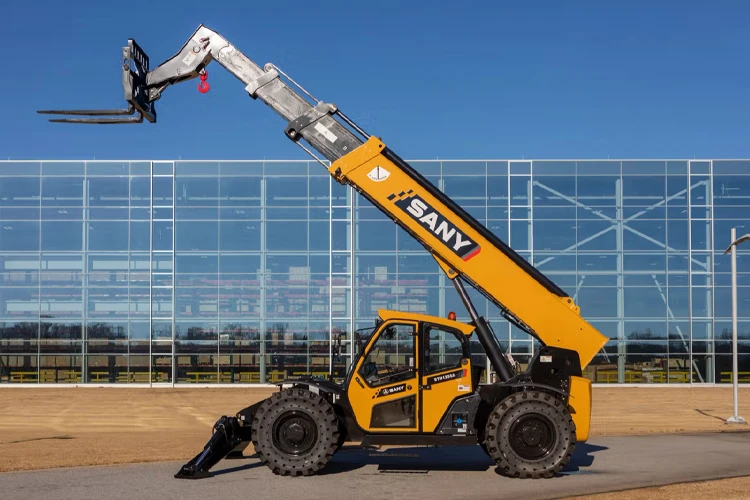
Outdoor rough-terrain forklifts and telehandler-style machines face the most severe conditions: extreme vibration from uneven surfaces, UV and weather exposure, and contact with abrasive dirt. The forklift hydraulic hoses on these machines must resist ozone cracking on the cover and withstand vibration-induced fatigue at the crimp interface.
We recommend SAE 100R2AT with our heavy-duty abrasion-resistant cover option for boom and tilt circuits. For main lift lines on telehandler booms, EN856 4SP spiral hose provides superior impulse fatigue resistance under the high-frequency pressure spikes of outdoor hydraulic operations.
Four reasons leading forklift OEMs, dealerships, and fleet operators source their hydraulic hoses from Kingdaflex.
Every forklift hydraulic hose assembly leaves our factory with a full hydrostatic proof test at twice the rated working pressure. No exceptions. Certificates available on request.
We manufacture both the hose and the fittings in-house, ensuring perfect dimensional compatibility. Our CNC crimp machines hold tolerances to ±0.05 mm for a leak-free seal at every connection point.
Our hoses are impulse-tested to over 1,000,000 cycles at 133% of working pressure — far exceeding SAE J517 requirements and matching the real-world demand of high-cycle forklift operations.
Of all the hydraulic hoses on a forklift, the mast hose is subject to the most mechanical stress. In a two-stage or three-stage mast, the hose must feed the free-lift cylinder while simultaneously flexing as the mast rails move. On a busy site, the mast may cycle 200–400 times per shift. Over a year, that is close to 100,000 flex cycles on the mast hose alone.
Using a standard SAE 100R2AT in the mast channel is a common maintenance mistake. The standard hose’s minimum bend radius is typically 90–100 mm for a 1/2-inch bore — but the mast channel often forces a bend of 50–60 mm. This over-bending fatigues the steel wire reinforcement rapidly, causing the hose to fail at the inner braid long before any visible outer damage appears.
The correct forklift mast hydraulic hose is a compact-bend-radius product such as EN857 2SC (minimum bend radius 55 mm for 1/2-inch bore) or SAE 100R16. Both are rated to the same working pressure as 100R2AT but are engineered for high-cycle flexing applications exactly like the forklift mast environment.
When specifying hydraulic hoses for a forklift, you need four key parameters from the original hose or the machine schematic:
Kingdaflex can supply forklift hydraulic hoses as bulk cut-length hose, or as fully assembled hose kits with crimped end fittings to match Toyota, Crown, Hyster, Yale, Linde, Jungheinrich, Mitsubishi, Komatsu, and most other forklift brands.
Explore Kingdaflex’s complete hydraulic hose range — or find the right solution for another application.
Forklifts typically use SAE 100R1AT or SAE 100R2AT wire-braided hydraulic hoses for lift cylinder and tilt cylinder circuits, operating at pressures between 2,000–3,500 PSI. The forklift mast hydraulic hose (which runs inside the mast rail) often uses a compact-bend-radius EN857 1SC or 2SC hose — or SAE 100R16 — to navigate the tight routing channel without fatiguing the reinforcement.
A standard counterbalance forklift has 3–6 hydraulic hoses: one or two lift cylinder hoses, one or two tilt cylinder hoses, and one or two auxiliary/attachment hoses (for side-shifters, rotators, etc.). Reach trucks and order pickers may have additional hoses for each telescoping mast stage. High-specification machines with multiple attachments can have 8 or more hydraulic hoses.
Most forklift hydraulic hoses range from 1/4 inch (DN6) to 1 inch (DN25) inner diameter. Lift cylinder lines commonly use 1/2″ or 3/4″ hose; tilt cylinder lines use 3/8″ or 1/2″; pilot/control signal lines use 1/4″. Always verify against the machine’s hydraulic schematic or the OEM hose part number before ordering replacement hoses.
The forklift mast hydraulic hose (also called the mast hose, carriage hose, or inner mast hose) runs along the inner mast rail from the base valve assembly to the free-lift cylinder and carriage. It must withstand continuous flexing as the mast extends and retracts under load. A compact-bend-radius hose such as EN857 2SC or SAE 100R16 is strongly recommended for this position instead of a standard braided hose.
Replace forklift hoses if you observe: oil leaks at fittings or along the hose body; outer cover cracking, blistering, or abrasion exposing the wire reinforcement; permanent kinks or deformation even when depressurised; sluggish or inconsistent lift/tilt response. As a preventive maintenance benchmark, most forklift manufacturers recommend replacing hydraulic hoses every 2–4 years or at 4,000 operating hours, whichever comes first.
Using a standard SAE 100R1AT in the mast channel is technically possible but not recommended. The mast channel forces the hose into a tighter bend than most standard hoses are rated for, rapidly fatiguing the wire reinforcement. A compact-bend EN857 2SC or SAE 100R16 hose — designed for 30–50% tighter bends at the same pressure rating — will last significantly longer and reduce maintenance costs.
Yes. Kingdaflex manufactures and assembles hydraulic hose kits compatible with Toyota 8-series, Hyster H-series, Crown FC/RC, Linde H/E-series, Jungheinrich EFG/TFG, Mitsubishi FB/FD, and many other models. Please provide the forklift model number and mast type when requesting a quote, and our technical team will specify the correct hose bore, length, and fitting configuration.