When engineers and buyers evaluate hydraulic hose, most of the attention goes to pressure rating, reinforcement type, and inner tube compatibility. But the hose cover — the outer layer protecting the reinforcement and tube from the outside environment — plays a bigger role in service life than many specifiers realize. The wrong cover material can lead to premature cracking, abrasion damage, or chemical degradation, even when the hose’s pressure rating and construction are otherwise perfectly suited to the application.
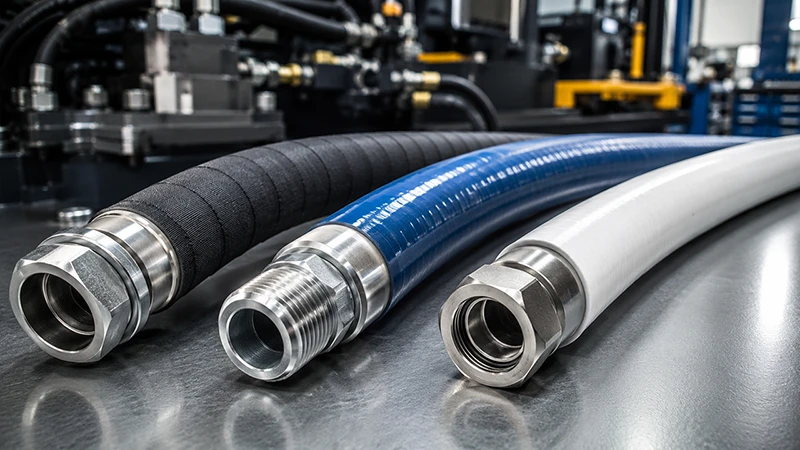
This guide compares the three most common hydraulic hose cover materials — synthetic rubber, polyurethane, and thermoplastic — explaining how each performs, where each is best suited, and how to choose the right cover for your specific operating environment.
Why the Hose Cover Matters More Than It Seems
The cover isn’t just a protective layer; it’s the first line of defense against everything the hose encounters in the field: abrasion from contact with equipment or terrain, UV and ozone exposure outdoors, chemical splash or immersion, and temperature extremes. If the cover fails — through cracking, abrasion wear-through, or chemical attack — the reinforcement layer beneath it is exposed, which dramatically accelerates hose failure even if the inner tube and reinforcement are otherwise intact.
Choosing the right cover material means matching its properties to the actual conditions the hose will face, not just defaulting to whatever is most common in your industry.
Synthetic Rubber Covers
Synthetic rubber (typically compounds like neoprene, chlorosulfonated polyethylene (CSM), or similar elastomers) has been the traditional standard for hydraulic hose covers for decades, and remains the most widely used option across general industrial and mobile equipment applications.
Strengths of Synthetic Rubber Covers
- Excellent flexibility, even in cold temperatures, making installation and routing easier in tight spaces
- Good abrasion resistance, particularly in compounds designed specifically for high-wear applications
- Strong ozone and weathering resistance in modern rubber formulations, suitable for long-term outdoor use
- Wide industry familiarity and availability, with well-established compatibility across most hose reinforcement types
- Cost-effective for general-purpose applications where extreme conditions aren’t a primary concern
Limitations of Synthetic Rubber Covers
- Generally less abrasion-resistant than premium polyurethane covers in extreme wear zones
- Can be more susceptible to certain aggressive chemicals compared to specialty thermoplastic covers
- Heavier than thermoplastic alternatives, which can matter in weight-sensitive mobile equipment designs
Best Applications for Synthetic Rubber Covers
Synthetic rubber remains the go-to choice for general construction, agricultural, and industrial equipment where hoses face moderate abrasion, typical outdoor exposure, and standard temperature ranges. It’s also the most common choice when cost efficiency and broad compatibility are priorities.
Polyurethane Covers
Polyurethane covers are engineered primarily for superior abrasion resistance, making them the preferred choice in applications where hoses are subject to constant friction, dragging, or contact with rough surfaces.
Strengths of Polyurethane Covers
- Outstanding abrasion resistance — often several times more resistant to wear than standard rubber covers in direct comparison testing
- High tensile strength and cut resistance, useful in applications where hoses may be dragged across abrasive surfaces
- Good resistance to oils and certain hydrocarbons, useful for hoses exposed to external oil contact
- Lighter weight than rubber in many constructions, beneficial for hoses handled frequently by operators
Limitations of Polyurethane Covers
- More expensive than standard synthetic rubber covers, which can impact large-scale procurement costs
- Lower flexibility in cold temperatures compared to rubber, which can make routing and coiling more difficult in cold climates
- More limited chemical resistance range than specialty thermoplastic covers for certain aggressive chemical environments
- Less heat resistance in some formulations compared to rubber, requiring careful matching to the application’s temperature range
Best Applications for Polyurethane Covers
Polyurethane covers are widely used in applications involving frequent hose dragging or contact with abrasive surfaces — such as mining equipment, demolition tools, and pressure washing or industrial cleaning equipment — where standard rubber covers would wear through quickly.
Thermoplastic Covers
Thermoplastic hose covers, often used on lightweight thermoplastic hydraulic hoses, offer a different set of trade-offs focused on chemical resistance, weight savings, and specific environmental performance.
Strengths of Thermoplastic Covers
- Excellent chemical resistance, particularly against a wide range of solvents, fuels, and industrial chemicals
- Lightweight construction, significantly reducing overall hose assembly weight compared to rubber or polyurethane
- Smooth, low-friction surface in many designs, which can reduce snagging and simplify routing in confined spaces
- Strong performance in cold-weather environments for many thermoplastic formulations, maintaining flexibility better than some rubber compounds at low temperatures
- Good resistance to certain fuels and hydraulic fluids that can degrade standard rubber covers over time
Limitations of Thermoplastic Covers
- Lower abrasion resistance in some formulations compared to polyurethane, depending on the specific compound used
- Can be less flexible than rubber in certain thermoplastic hose designs, affecting bend radius and installation in tight spaces
- Typically used on thermoplastic hose constructions, which may have different pressure and reinforcement characteristics than traditional rubber hydraulic hose
- More sensitive to specific temperature limits, requiring careful attention to manufacturer specifications for high-heat applications
Best Applications for Thermoplastic Covers
Thermoplastic-covered hoses are commonly specified for applications involving chemical exposure, fuel systems, lightweight mobile equipment, and environments where weight reduction matters — such as portable equipment, certain agricultural applications, and systems handling aggressive fluids externally.
Side-by-Side Comparison
| Property | Synthetic Rubber | Polyurethane | Thermoplastic |
|---|---|---|---|
| Abrasion resistance | Good | Excellent | Moderate to good |
| Chemical resistance | Moderate | Moderate to good | Excellent |
| Weight | Heavier | Moderate | Lightest |
| Cold-temperature flexibility | Excellent | Moderate | Good |
| Cost | Lower | Higher | Moderate to higher |
| UV/ozone resistance | Good (modern compounds) | Good | Good |
| Typical applications | General industrial, construction, agriculture | Mining, demolition, dragging/abrasive contact | Chemical exposure, lightweight/portable equipment |
How to Choose the Right Cover for Your Application
Selecting a hose cover comes down to identifying which environmental factor poses the greatest risk to hose life in your specific application:
- If abrasion is the primary concern — such as hoses dragged across rough surfaces or exposed to constant friction — polyurethane typically offers the longest service life.
- If chemical exposure is the primary concern — such as hoses used near solvents, fuels, or aggressive industrial chemicals — thermoplastic covers generally provide the best protection.
- If general-purpose durability and cost efficiency matter most — as in most standard construction, agricultural, and industrial equipment — synthetic rubber remains a reliable, well-proven choice.
- If weight reduction is a priority — particularly for portable or frequently repositioned equipment — thermoplastic hose assemblies offer a meaningful advantage over heavier rubber constructions.
It’s also worth noting that cover selection should be considered alongside reinforcement type and inner tube compatibility, since the three work together to determine overall hose performance. A hose with an ideal cover but the wrong reinforcement for the application’s pressure and impulse demands will still fail prematurely — a topic covered in our article on why hydraulic hoses fail at fittings.
Sourcing the Right Hose Cover from a Hydraulic Hose Manufacturer
Cover material is one of the most overlooked specifications in hydraulic hose selection, yet it often determines how long a hose actually lasts in real operating conditions — regardless of how well the pressure rating and reinforcement match the application. Working with a manufacturer that offers multiple cover options, and can advise based on your specific environmental exposure, helps avoid premature replacements and unplanned downtime.
At Kingdaflex, we manufacture hydraulic hoses with synthetic rubber, polyurethane, and thermoplastic cover options across our product range, allowing OEMs and distributors to match cover material to abrasion, chemical, and temperature conditions specific to their application. Our team can help you evaluate trade-offs between cover types to find the right balance of performance and cost for your equipment.
Frequently Asked Questions
Which hydraulic hose cover material lasts the longest?
There’s no single answer — it depends on the dominant stress factor. Polyurethane typically lasts longest under heavy abrasion, while thermoplastic covers often outperform in chemically aggressive environments, and quality synthetic rubber remains highly durable for general-purpose use.
Is polyurethane cover always better than rubber?
Not necessarily. Polyurethane offers superior abrasion resistance but is generally more expensive and less flexible in cold temperatures than rubber, making rubber the better choice for many standard applications.
Can thermoplastic-covered hoses handle the same pressure as rubber hoses?
It depends on the specific hose construction. Thermoplastic covers are often paired with thermoplastic hose bodies, which can have different pressure and reinforcement characteristics than traditional rubber hydraulic hose, so specifications should be compared directly rather than assumed equivalent.
Does hose cover material affect fitting compatibility?
Cover material itself generally doesn’t affect fitting compatibility, but overall hose construction (including cover thickness and hose outer diameter) should always be checked against the fitting manufacturer’s specifications.