Hydraulic systems are only as strong as their weakest link: the hose. Incorrect hydraulic hose selection is a primary cause of system failure, leading to costly downtime, environmental leaks, and serious safety risks. With hundreds of specifications available, the process of selecting hydraulic hose can be confusing.
Many operators find themselves asking, “How do I know what size hydraulic hose I need?” or wondering which material is compatible with their fluid. Guessing is not an option when high pressure is involved.
To eliminate errors, industry experts rely on the STAMPED method. This standardized framework covers the seven critical factors necessary for high quality hose selection. In this guide, we will break down the STAMPED acronym to help you choose the safest and most efficient hose for your application.
What is a S.T.A.M.P.E.D. Method?
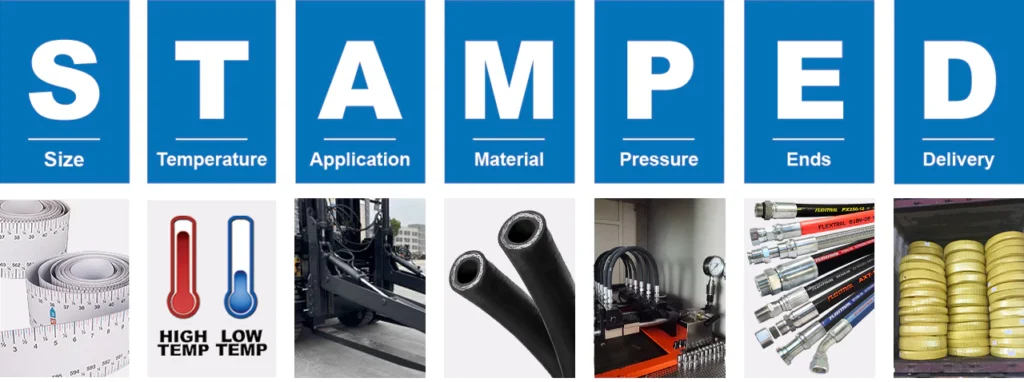
STAMPED is not a specific brand or product; rather, it is the industry-standard mnemonic device used globally for proper hose selection. Originally championed by organizations like NAHAD (The Association for Hose and Accessories Distribution), this acronym serves as a critical checklist for engineers and procurement managers.
The goal of using the STAMPED method is to establish a “common language” between the buyer and the manufacturer. It ensures that no vital specification is overlooked, effectively preventing the purchase of an incompatible or unsafe assembly.
A complete STAMPED inquiry covers the following seven characteristics:
- Size
- Temperature
- Application
- Material (Media)
- Pressure
- Ends
- Delivery
By systematically addressing each of these points, you move beyond guesswork. Whether you are replacing a worn assembly or designing a new system, applying this framework is the first step toward reliability and safety.
S = Size: The Foundation of Selection
The “S” in STAMPED stands for Size, and it is arguably the most critical factor in hydraulic hose size selection. When we talk about size, we are primarily concerned with the Inside Diameter (I.D.) of the hose, as this dictates the flow capability of the assembly.
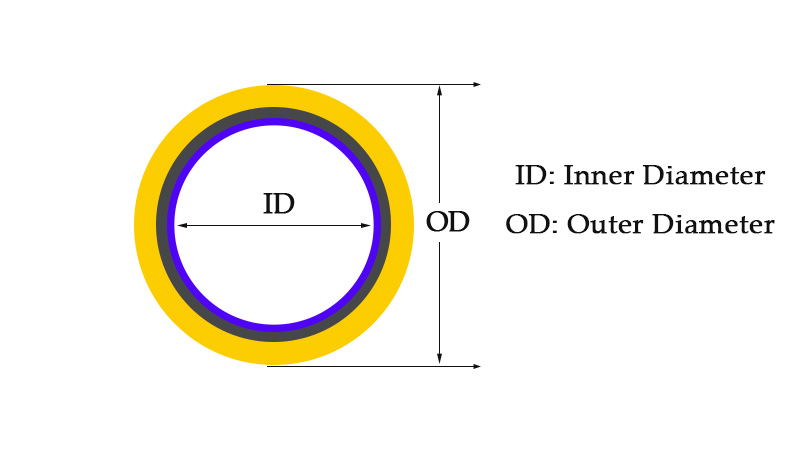
Inside Diameter (I.D.) and Dash Numbers
The I.D. must be adequate to minimize pressure loss and avoid excessive heat generation. If the hose I.D. is too small for the required flow, the fluid velocity increases, causing turbulence and overheating that can damage the inner tube and seals.
In the hydraulic industry, size is often measured in “Dash Numbers.” This system represents the I.D. in sixteenths of an inch.
- -4 (Dash 4): 4/16″ or 1/4″ I.D.
- -8 (Dash 8): 8/16″ or 1/2″ I.D.
- -32 (Dash 32): 32/16″ or 2″ I.D.
Outside Diameter (O.D.) and Length
While I.D. controls flow, the Outside Diameter (O.D.) is vital for installation. You must ensure the hose fits within the clamps and has clearance from nearby components to prevent abrasion. Additionally, precise length measurement is key. A hose that is too short will stretch and leak under pressure, while one that is too long may snag on machinery.
How to Select Hydraulic Hose Size Based on Flow
A common question we receive is: “How do I know what size hydraulic hose I need?” The answer relies on the relationship between flow rate (Gallons Per Minute or GPM) and fluid velocity.
According to industry standards, recommended velocity ranges are:
- Pressure Lines: 7 to 15 feet per second.
- Return Lines: 2 to 4 feet per second.
- Suction Lines: 2 to 4 feet per second.
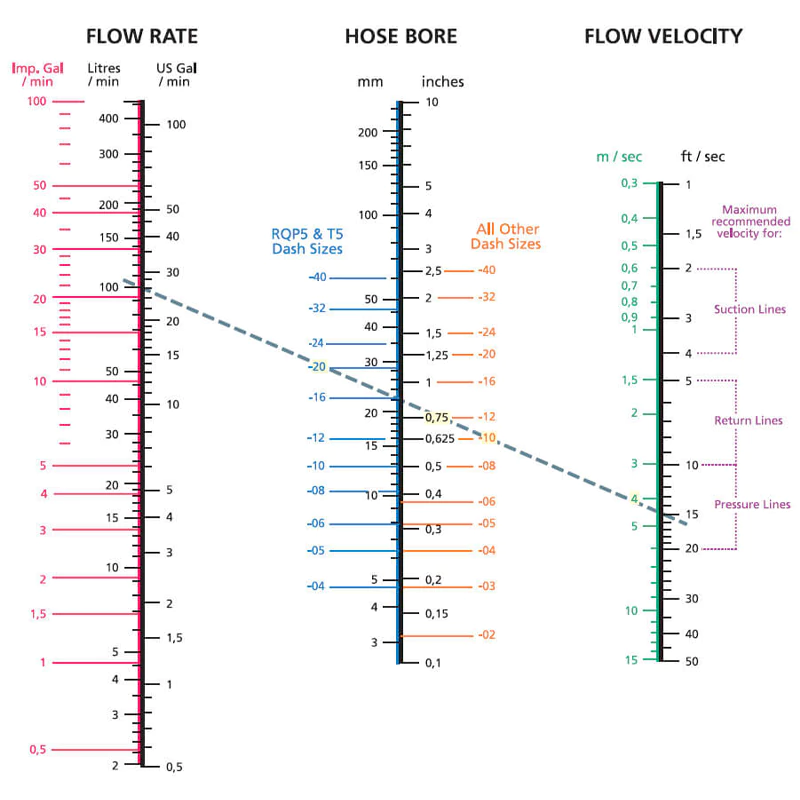
To simplify this calculation, engineers use a hydraulic hose selection chart, also known as a Nomogram. By marking your flow rate on one column and your desired velocity on another, a straight line drawn between them will intersect the required hose I.D. in the center column. Using this chart eliminates guesswork and ensures your system maintains optimal efficiency without overheating.
T = Temperature: Fluid and Ambient
When selecting hydraulic hose, temperature is often examined only in terms of the fluid inside, but a complete assessment requires looking at two distinct temperature ratings: fluid and ambient.
Fluid Temperature
This refers to the temperature of the media (oil, water, or hydraulic fluid) flowing through the hose. Every rubber compound has a maximum continuous operating temperature. If the system runs hotter than the hose’s rating—even by a few degrees—the inner tube will begin to harden and crack. This process, known as “heat aging,” causes the rubber to lose its flexibility, eventually leading to leaks or a complete blowout.
Ambient Temperature
The “T” in STAMPED also accounts for the environment outside the hose. Is the hose routed near a scorching exhaust manifold or a molten metal process? Or is the machinery operating in sub-zero arctic conditions? Extreme external heat can degrade the outer cover, exposing the reinforcement layers to corrosion. Conversely, extreme cold can make standard rubber brittle, causing it to crack the moment the hose flexes.
To ensure high quality hose selection, you must choose an assembly rated for the maximum temperature of the fluid and the minimum/maximum temperatures of the surrounding environment. If the two differ significantly, you may need a specialized hose with a heat shield or a low-temperature compound.
A = Application: Context is King
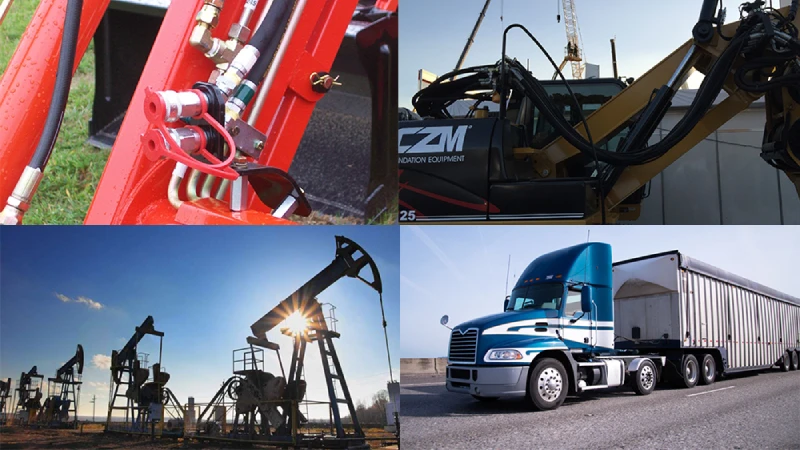
The “Application” factor looks at the bigger picture: where and how will this hose be used? Simply matching pressure and size isn’t enough if the physical environment destroys the assembly. Proper hose selection requires a thorough analysis of the specific operating conditions.
Bend Radius and Routing
One of the most common causes of failure is violating the minimum bend radius. Every hose has a limit on how tightly it can be bent before the reinforcement layers are compromised. Bending a hose too sharply creates excessive stress on the inner tube and wire braiding, reducing the assembly’s lifespan by up to 90%. If your application requires tight routing in compact spaces, you must select a hose specifically designed for high flexibility and a small bend radius.
External Conditions and Abrasion
Consider the physical hazards the hose will face. Will it rub against metal frames or other hoses? Abrasion is a leading killer of hydraulic assemblies. For applications involving significant movement or vibration, selecting hydraulic hose with a “tough cover” or adding protective sleeves (guards) is essential.
Impulse Duty
Is the pressure static, or does it cycle frequently? An elevator lift has different demands than a hydraulic hammer. Applications with high-frequency pressure cycles (high impulse) require hoses with higher fatigue resistance, typically reinforced with spiral wire rather than standard braiding. Understanding these environmental nuances is key to preventing premature failure.
M = Material: Compatibility
The “M” in STAMPED refers to the Material or Media being conveyed. This is fundamentally about chemical compatibility. While most hydraulic hoses are designed to handle standard petroleum-based hydraulic fluids, assuming universal compatibility is a dangerous mistake in hydraulic hose selection.
Inner Tube vs. Fluid
The inner tube of the hose is in constant contact with the fluid. If the rubber compound of the tube interacts poorly with the fluid’s chemical makeup, disastrous reactions can occur.
- Petroleum-based fluids: Generally compatible with standard synthetic rubber tubes (like NBR or Nitrile).
- Phosphate Esters: Often used in aviation or fire-resistant applications. These aggressive fluids will destroy standard rubber and require EPDM hoses.
- Biodegradable Fluids: Increasingly common in forestry and agriculture. These can break down certain standard hoses and require specific eco-compatible materials.
The Consequences of Incompatibility
Using the wrong material can cause the inner tube to swell, delaminate, or wash out. Swelling restricts flow and increases pressure, while delamination sends chunks of rubber downstream, clogging expensive valves, pumps, and cylinders. To ensure high quality hose selection, always consult a chemical compatibility chart for the specific fluid you are using before making a purchase.
P = Pressure: Handling the Power
When evaluating the “P” in STAMPED, many buyers make the mistake of looking only at the standard operating pressure of their pump. However, hydraulic hose selection requires a safety-critical understanding of dynamic pressure, spikes, and safety factors.
Working Pressure vs. System Pressure
The rule is simple but non-negotiable: the hose’s maximum recommended working pressure must be equal to or greater than the maximum system pressure. If your system operates at 3,000 PSI, a hose rated for 2,900 PSI is not “close enough”—it is a safety violation.
Pressure Spikes and Surges
Hydraulic systems are rarely static. When a valve closes suddenly or a cylinder hits a stop, the system experiences “pressure spikes” or surges that can far exceed the normal operating pressure. A system running at 2,000 PSI might see momentary spikes of 4,000 PSI.
If your hose is not rated to handle these impulse loads, the wire reinforcement will fatigue and fail prematurely. For systems with frequent surges, you need high quality hose selection that prioritizes spiral-wire reinforced hoses over standard braided ones, as they handle impulses better.
Burst Pressure and Safety Factors
Most industrial hydraulic hoses are manufactured with a 4:1 safety factor. This means a hose with a working pressure of 5,000 PSI will likely burst at 20,000 PSI.
- Critical Warning: Never use the burst pressure as your operating guide. The safety factor is there to handle unexpected spikes and momentary anomalies, not continuous load. Operating anywhere near the burst limit invites catastrophic failure.
Suction vs. Pressure
Finally, don’t forget the other side of the spectrum: vacuum. If the hose is on the intake side of the pump (suction line), it must be rated for negative pressure. Standard hydraulic hoses will collapse under vacuum, starving the pump and causing cavitation. Suction hoses require a helical wire reinforcement to hold their shape.
E = Ends: The Connection Points
The “E” in STAMPED stands for Ends (or couplings/fittings). Even the highest-rated hose is useless if it cannot be securely connected to your machine. The interface between the hose and the port is often the most common leak point in a hydraulic system.
Identify Your Threads
The most confusing part of selecting hydraulic hose assemblies is often identifying the thread type. The hydraulic world uses a mix of global standards, including:
- NPT/NPTF: American tapered pipe threads.
- JIC (37° Flare): Common in North American heavy equipment.
- BSPP/BSPT: British Standard Pipe (common in European machinery).
- ORFS (O-Ring Face Seal): The best choice for high-vibration and high-pressure applications due to its leak resistance.
- DIN (Metric): Standard for German and many Asian machines.
Since a JIC fitting will not seal with a BSPP port, precise identification using thread gauges and calipers is mandatory.
Orientation: Avoiding the Twist
Consider the routing path. If a hose needs to make a sharp turn immediately after the connection, using a straight fitting will force the hose to bend too tightly. In this case, choosing a bent tube fitting (45° or 90° elbow) is the correct solution.
- Tip: When using angled fittings on both ends, you must specify the “orientation angle” to ensure the elbows line up correctly. Installing a twisted hose reduces its pressure rating and lifespan.
Material and Durability
What environment will the fitting be exposed to?
- Carbon Steel: The industry standard for most oil-based applications.
- Stainless Steel: Required for corrosive environments like marine applications, chemical processing, or food production.
- Brass: Generally used for lower pressure lines.
Connection Style
Finally, decide between crimped fittings (permanently attached using a crimping machine) and field-attachable (reusable) fittings. While field-attachable fittings are great for emergency repairs in remote locations, crimped fittings are the standard for modern high quality hose selection because they offer superior holding power and safety at higher pressures.
D = Delivery: Testing and Quality Assurance
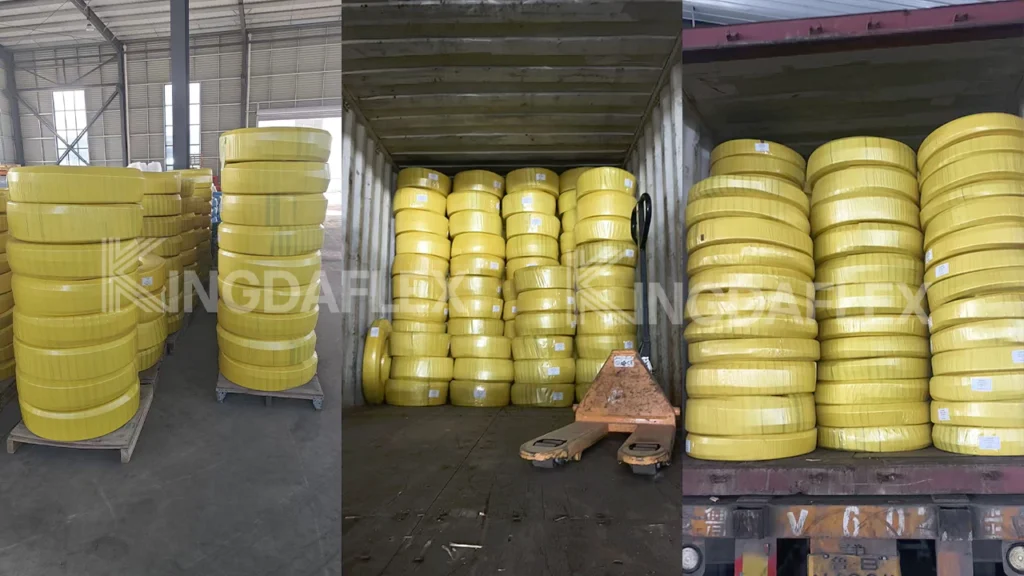
The final letter in the STAMPED acronym stands for Delivery. While this certainly includes logistics—getting the part to you when you need it—in the context of high quality hose selection, it refers primarily to the condition in which the hose is delivered. This is the Quality Assurance phase.
Testing and Certification
For critical applications, simply assembling the hose isn’t enough. You may need to specify if the assembly requires hydrostatic proof testing. This typically involves pressurizing the hose to 2x its working pressure for a set time to check for leaks or fitting detachment before it ever leaves the factory.
If you are working in regulated industries like mining or marine, you might also require specific certifications (such as MSHA or ABS approvals) or Material Test Reports (MTRs) to verify the pedigree of the components.
Cleanliness Standards
Hydraulic systems are incredibly sensitive to contamination. Cutting and crimping a hose generates rubber dust and metal shards. If these aren’t removed, they will be injected directly into your expensive hydraulic pump.
- Standard: Basic air blowing.
- High Purity: Projectile cleaning (shooting foam pellets through the hose) to remove fine particles, meeting specific ISO cleanliness codes.
Packaging and Identification
Finally, how is the hose packaged?
- Capping: All hose ends should be capped or plugged immediately after cleaning to prevent dust ingress during shipping.
- Tagging: A high-quality assembly should have a permanent tag (metal or label) listing the part number, pressure rating, and date of manufacture. This makes future replacement much easier, as you won’t have to guess the specifications next time.
Conclusion
Hydraulic systems are powerful, expensive, and potentially dangerous. Treating hydraulic hose selection as a generic purchase is a recipe for failure. By adopting the STAMPED method, you move from guesswork to a standardized, engineering-backed process.
Whether you are looking for a simple return line or a high-pressure spiral hose for an excavator, remembering these seven keys—Size, Temperature, Application, Material, Pressure, Ends, and Delivery—is your best defense against downtime.
Kingdaflex specializes in high quality hose selection and custom assemblies. Our team of experts is ready to walk you through the STAMPED process to ensure you get the perfect fit for your machine. Contact us today for a free consultation or to request our hydraulic hose selection chart.