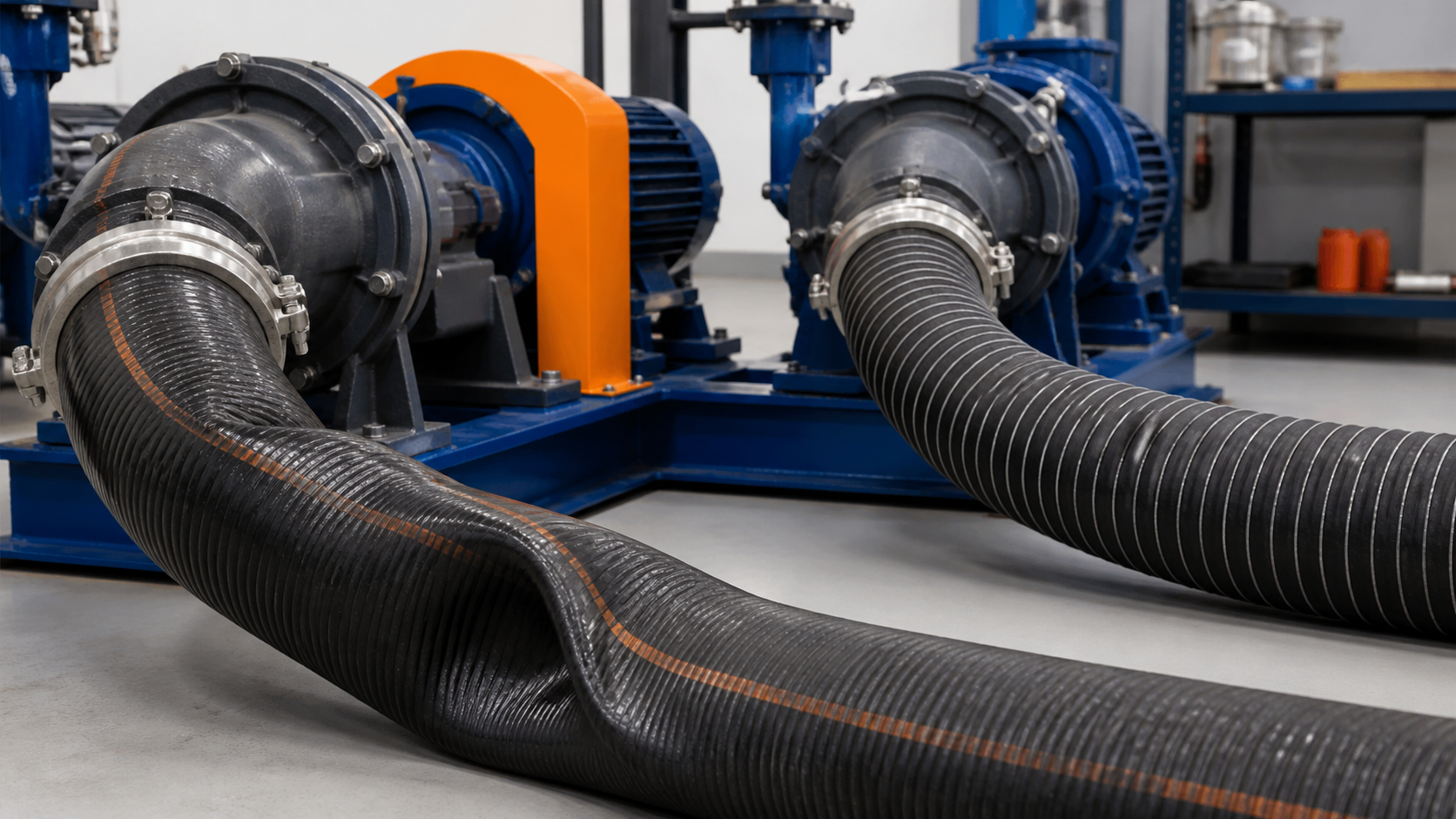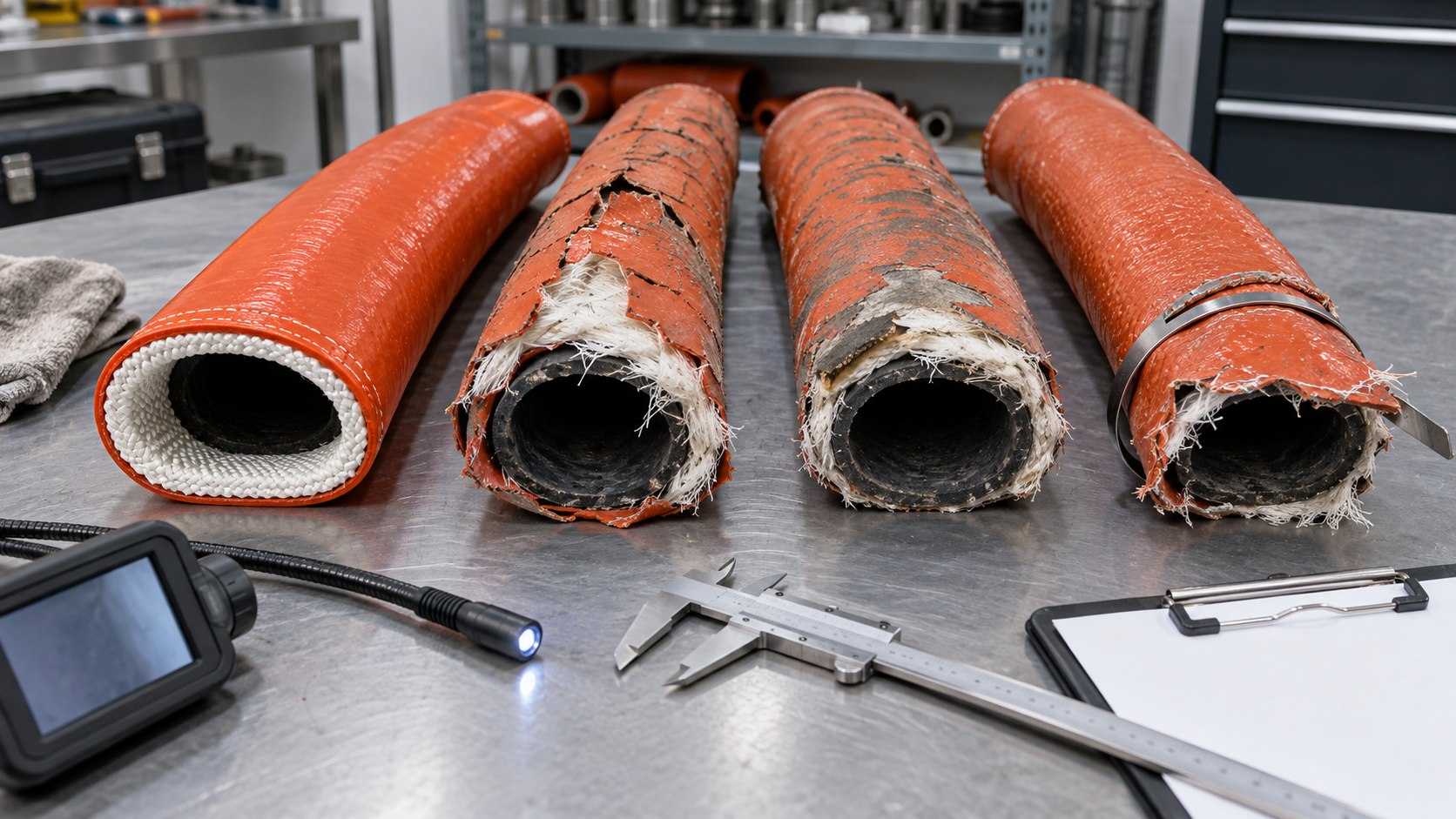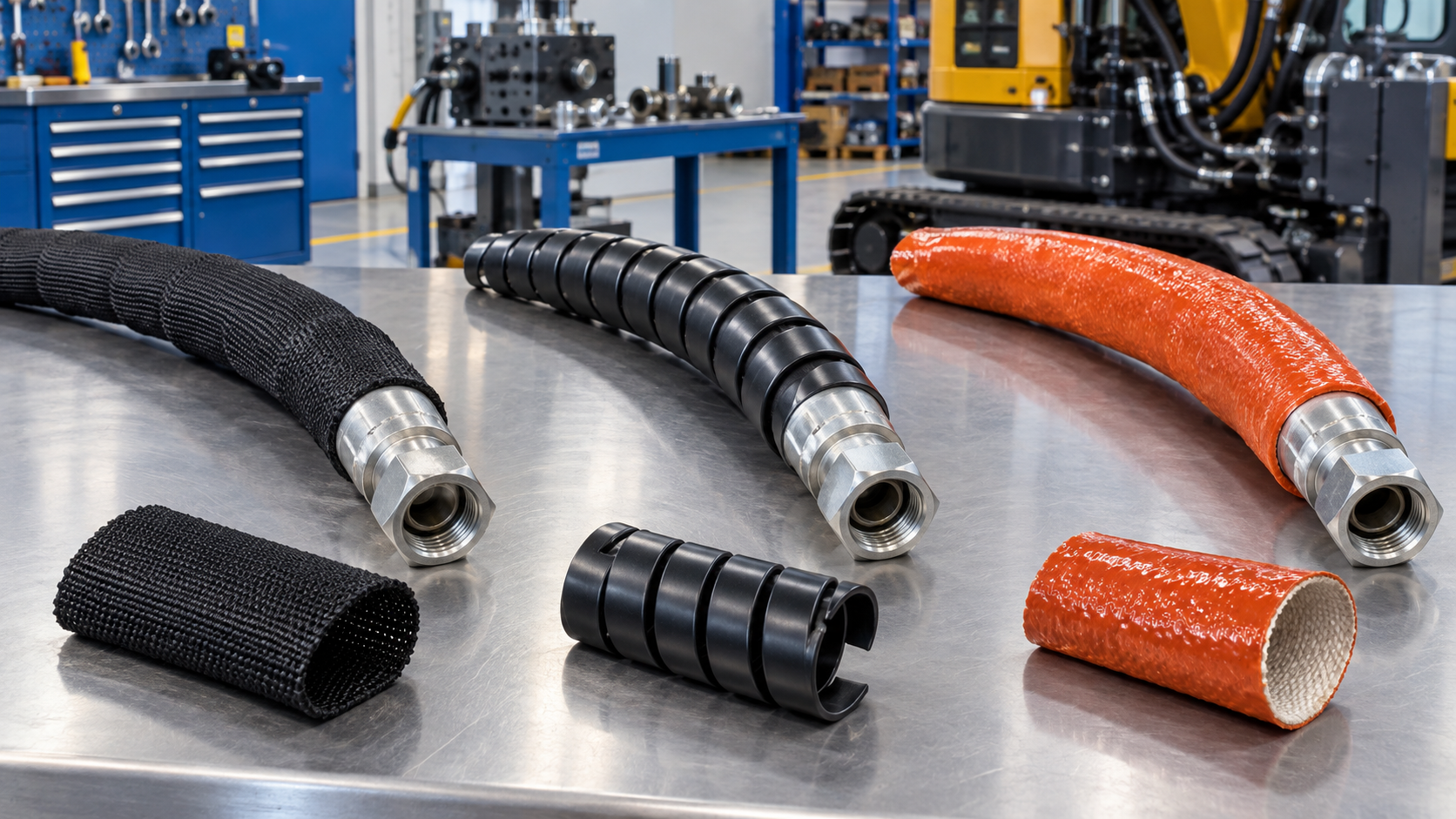
A hydraulic hose can meet every pressure, size, and reinforcement requirement and still fail in weeks if the inner tube material is incompatible with the hydraulic fluid running through it. Incompatibility causes the inner tube to swell, harden, crack, or delaminate — each failure mode releasing contamination into the system and ultimately degrading pump valves, cylinders, and seals. This guide covers the five most important inner tube materials, what they are and are not compatible with, and how to verify compatibility before an assembly goes into service.
Key Takeaways
- NBR (nitrile rubber) is the correct default for mineral oil-based hydraulic fluids — it handles petroleum-based fluids, air, and most standard hydraulic oils reliably at a low cost.
- EPDM (ethylene propylene diene monomer) is required for water-based fluids, glycol solutions, and phosphate ester fluids — it is incompatible with mineral oils and will swell rapidly if used with them.
- PTFE (polytetrafluoroethylene) is the universal compatibility solution for aggressive chemicals and extremely high temperatures — it is compatible with virtually all hydraulic media but costs significantly more and requires careful handling.
Why Inner Tube Material Is the First Compatibility Variable
The Three-Layer Hose Structure and Where Compatibility Matters
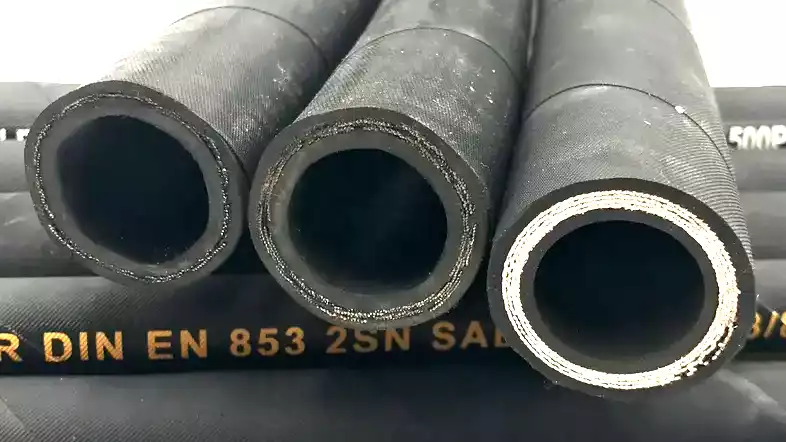
A hydraulic hose has three functional layers: an inner tube (the fluid-contact layer), a reinforcement layer (steel wire braid or spiral), and an outer cover. Fluid compatibility is primarily a property of the inner tube — the reinforcement and cover are not in sustained contact with the hydraulic fluid under normal operating conditions. However, when a failed or incompatible inner tube degrades, contamination can reach the reinforcement, accelerating corrosion and structural failure.
For this reason, every hose specification process should begin with the fluid type, not the pressure rating. Two hoses with identical SAE construction ratings and dash sizes — one with NBR inner tube, one with EPDM — will have completely opposite performance with mineral oil: the NBR tube will resist it; the EPDM tube will swell, soften, and shed particulate contamination into the system within hours. See Kingdaflex inner tube material specifications for Kingdaflex inner tube material specifications by hose series.
The Incompatibility Failure Mechanisms
Incompatible fluids attack elastomeric inner tubes through three mechanisms. Swelling occurs when the fluid is absorbed by the rubber, expanding the tube volume and reducing wall thickness — this weakens the tube’s ability to contain pressure and creates a flow restriction. Hardening (the opposite effect, seen with some non-polar solvents) makes the tube brittle and prone to cracking under flexing. Delamination occurs when chemical attack separates the inner tube from the reinforcement layer, allowing fluid to track between layers and eventually escape at fitting interfaces. According to a Fluid Power World technical analysis, inner tube material selection is the primary determinant of hose assembly service life in non-mineral oil applications.
The Five Primary Inner Tube Materials
NBR — The Mineral Oil Standard
Nitrile butadiene rubber (NBR) is the most widely used inner tube material in hydraulic hose manufacturing. Its non-polar molecular structure gives it excellent resistance to petroleum-based hydraulic fluids (ISO VG 32, 46, 68, mineral oil), engine oils, gear oils, and greases. NBR handles continuous service temperatures from -40°C to +100°C (-40°F to +212°F) and is compatible with air, nitrogen, and LP gas — making it the standard choice for the majority of mobile equipment and industrial hydraulic circuits.
NBR’s limitation is its incompatibility with polar media. It will degrade rapidly when exposed to water-glycol hydraulic fluids, phosphate esters, brake fluids (DOT 3/4 glycol base), and most ketone and ester solvents. For standard petroleum-based mineral oil circuits, however, NBR represents the optimal balance of performance and cost. All Kingdaflex SAE 100R1AT and R2AT hoses use oil-resistant NBR inner tubes conforming to SAE J517 tube compound specifications.
EPDM — Water-Based and Fire-Resistant Fluids
Ethylene propylene diene monomer (EPDM) rubber has the opposite polarity characteristic from NBR: it is highly resistant to polar media (water, steam, water-glycol solutions, glycol-based brake fluids, and phosphate ester hydraulic fluids such as Skydrol), but it swells severely in contact with mineral oils and petroleum-based fluids. The two materials must never be confused in service.
EPDM becomes the mandatory selection for fire-resistant hydraulic systems (mining regulations in many jurisdictions require fire-resistant hydraulic fluid — typically a water-glycol or HWCF type), for steel mill and die casting hydraulic circuits where hot metal contact risks demand fire-resistant media, and for mobile plant operating in environmentally sensitive areas where biodegradable polyglycol fluids are specified. Operating temperature range for EPDM is approximately -40°C to +120°C, with steam-service variants reaching +150°C in specialized construction.
PTFE — Chemical Universality at Premium Cost
Polytetrafluoroethylene (PTFE) inner tubes are compatible with virtually all hydraulic fluids, including aggressive chemicals that attack all rubber compounds — concentrated acids, aromatic solvents, chlorinated solvents, and high-temperature synthetic esters. PTFE’s temperature capability extends to +200°C (continuous) and its smooth bore reduces pressure drop and resists the accumulation of fluid residues that can initiate chemical attack in other materials.
The tradeoffs are cost, construction, and handling requirements. PTFE hose assemblies are significantly more expensive than rubber-based equivalents. They must be installed without twisting (PTFE does not recover from torsional deformation the way rubber does), and field assembly requires specialized tooling. For chemical process applications, semiconductor manufacturing, and food-grade circuits requiring full CIP (clean-in-place) compatibility, PTFE is the correct specification. For standard hydraulic service, the cost premium is not justified.
Neoprene (CR) — Weathering and Moderate Chemical Resistance
Chloroprene rubber (neoprene) provides moderate resistance to petroleum oils, improved ozone and UV resistance compared to NBR, and better flame resistance. It is most commonly specified for low-pressure return and suction lines in mobile equipment where cover durability and ozone resistance are important, rather than for high-pressure hydraulic service. Neoprene’s oil resistance is inferior to NBR, so it should not be specified for continuous contact with high-temperature mineral oils.
FKM (Viton) — High-Temperature Synthetic Fluids
Fluorocarbon rubber (FKM, commonly known by the trade designation Viton) provides excellent resistance to high-temperature mineral oils, phosphate esters, aromatic fuels, and silicone fluids. Its temperature ceiling of +200°C makes it viable for aerospace hydraulic systems and high-temperature industrial circuits where NBR would degrade. FKM is significantly more expensive than NBR and is primarily used in specialized applications where operating conditions exceed NBR’s envelope.
Fluid-to-Material Compatibility Reference
| Fluid Type | NBR | EPDM | PTFE | FKM |
|---|---|---|---|---|
| Mineral oil hydraulic fluid (ISO VG 32/46/68) | [OK] | [NO] | [OK] | [OK] |
| Water-glycol (HFC) fire-resistant fluid | [NO] | [OK] | [OK] | Limited |
| Phosphate ester (HFD-R) fluid | [NO] | [OK] | [OK] | [OK] |
| Biodegradable vegetable oil (HETG) | [OK] | [NO] | [OK] | [OK] |
| Synthetic ester (HEES) biodegradable fluid | Limited | [NO] | [OK] | [OK] |
| Compressed air / nitrogen | [OK] | [OK] | [OK] | [OK] |
Verifying Compatibility Before Installation
Use the Fluid Manufacturer’s Compatibility Data
Hydraulic fluid manufacturers publish compatibility data for hose and seal materials in their product technical data sheets. For example, biodegradable HEES synthetic ester fluids — increasingly used in construction equipment in Europe under environmental legislation — require explicit hose material verification because they attack NBR at elevated temperatures even though they have moderate compatibility at ambient. Always source the compatibility table from the fluid manufacturer’s published documentation, not from generic charts. Browse more technical articles on Kingdaflex’s technical resource section for application-specific fluid compatibility guidance.
Temperature Is the Compatibility Multiplier
All rubber materials tolerate a wider range of fluids at lower temperatures. As system operating temperature rises, chemical attack rates increase and swell rates accelerate. An NBR hose in contact with a synthetic ester-based fluid at 40°C may show acceptable short-term performance; at 80°C the same combination may cause visible inner tube swelling within days. For high-temperature circuits — particularly in steel mills, die casting, and hot-press hydraulic applications — use the maximum expected system temperature (not the target operating temperature) as the compatibility test condition. Fluid Power World’s analysis of hose assembly fluid compatibility confirms that temperature amplifies incompatibility effects by a factor of 2–4x between 40°C and 100°C operating conditions.
The Soak Test Protocol
When operating with an unfamiliar fluid or a fluid blend not covered in standard compatibility tables, a soak test provides direct validation. Immerse a short hose sample (cut to expose the inner tube) in the hydraulic fluid at operating temperature for 70 hours. Measure inner tube wall thickness and weight before and after. A weight gain of more than 5% or a hardness change of more than 10 Shore A points indicates marginal or unacceptable compatibility. This protocol is derived from ASTM D471, the standard test method for rubber property change in liquids.
Special Case: Biodegradable Fluids
HETG (Vegetable Oil) Fluids
Vegetable oil-based hydraulic fluids (rapeseed oil, soybean oil) are non-polar like mineral oils and generally compatible with NBR inner tubes. However, they oxidize more rapidly than mineral oils at elevated temperatures, forming acidic degradation products that can attack elastomers over time. Systems using HETG fluids should use hoses with enhanced oxidation-resistant NBR compounds and should adhere to shorter fluid change intervals than mineral oil systems. View Kingdaflex hydraulic hose series for biodegradable fluid service for hose series with enhanced compound options suited to biodegradable fluid service.
HEES (Synthetic Ester) Fluids
Synthetic ester-based biodegradable hydraulic fluids have higher polarity than mineral oils and present compatibility challenges for standard NBR. At temperatures above 70°C, standard NBR inner tubes may show unacceptable swell rates with HEES fluids. Some manufacturers offer “HEES-compatible NBR” compounds with modified acrylonitrile content — but the safest specification for HEES service above 70°C is FKM or PTFE inner tube construction.
Frequently Asked Questions
How do I know what inner tube material my existing hose uses?
Check the layline — the specification stripe printed along the hose body. It will include the SAE or DIN type designation (e.g., “SAE 100R2AT”) and may include a tube material code. If the layline is worn or absent, contact the hose manufacturer with the part number for the inner tube material specification. Do not assume NBR; verify before changing hydraulic fluid type in a system with existing hose assemblies.
Can I use the same hose for mineral oil and water-glycol fluid if I flush the system?
No. If the existing hose has an NBR inner tube, it must be replaced when converting a system from mineral oil to water-glycol or phosphate ester fluid. Flushing does not reverse the structural incompatibility. NBR in contact with water-glycol will swell regardless of prior fluid history. All hose assemblies, seals, and pump/valve seals must be specified for the new fluid type before conversion.
Is PTFE always the safe choice for any fluid?
For chemical compatibility, yes — PTFE is inert to virtually all hydraulic media. However, PTFE hose has specific installation requirements (no twist, specific minimum bend radius, specialized fittings) and is not a cost-effective substitute for rubber-based hose in standard hydraulic service. Use PTFE when operating with aggressive chemicals, high temperatures above NBR’s ceiling, or food/pharmaceutical-grade cleanliness requirements.
What happens if I use EPDM with mineral oil?
EPDM will swell rapidly and severely in contact with mineral oil. The inner tube can expand to the point of reducing the hose bore, fragmenting under pressure and releasing rubber particles into the system. This causes downstream contamination damage to pump pistons, valve spools, and cylinder seals — typically resulting in a system rebuild far more costly than the hose replacement that was avoided. EPDM and mineral oil is an incompatible combination with no acceptable workaround. For systems requiring both mineral oil service and fire-resistant fluid capability (dual-circuit configurations), separate hose assemblies with different inner tube specifications must be used on the respective circuits. Contact us for mixed-fluid system hose specifications for guidance on mixed-fluid system hose specifications.