When a hydraulic system starts running hot, the instinct is to look at the obvious suspects: a faulty heat exchanger, a worn pump, a blocked filter, or simply too little fluid in the reservoir. These are all legitimate causes. But there is one component that engineers and maintenance technicians consistently overlook — and it sits on the lowest-pressure, lowest-priority segment of the entire circuit.
An undersized, restricted, or degraded return hose creates back-pressure in the return line. That back-pressure converts directly into heat. And that heat accumulates in the hydraulic fluid, raises operating temperature across the entire system, degrades every seal and component downstream, and shortens equipment service life — all while looking completely innocent on the outside.
This article explains exactly how return line back-pressure generates heat, how to calculate whether your return hose is contributing to overheating, and what to do about it.
The Normal Temperature Range — and What Happens When You Exceed It
A properly designed hydraulic system maintains fluid temperature between 43°C and 60°C (110°F–140°F) during steady-state operation. Within this range, the fluid maintains its designed viscosity, lubricates pump and motor components correctly, and resists oxidation.
Once fluid temperature rises above 80°C (176°F), the consequences accelerate rapidly:
- Viscosity drops, reducing the oil film thickness that protects metal surfaces inside the pump, motor, and cylinder bores
- Seal compounds harden and crack — NBR seals are typically rated to 80–100°C; continuous operation above this range causes irreversible deterioration
- Oil oxidizes, forming varnish and sludge deposits that block orifices and stick valve spools
- System response slows as fluid compressibility increases at elevated temperatures
- Component wear rates increase across every moving part in the circuit
The critical point is that none of these failure modes require a dramatic spike to 150°C. A system running consistently at 75°C instead of 55°C is already operating in a range that cuts seal and fluid life by 50% or more. And that 20°C difference is entirely achievable from a single undersized return hose.
Where Does the Heat Actually Come From?
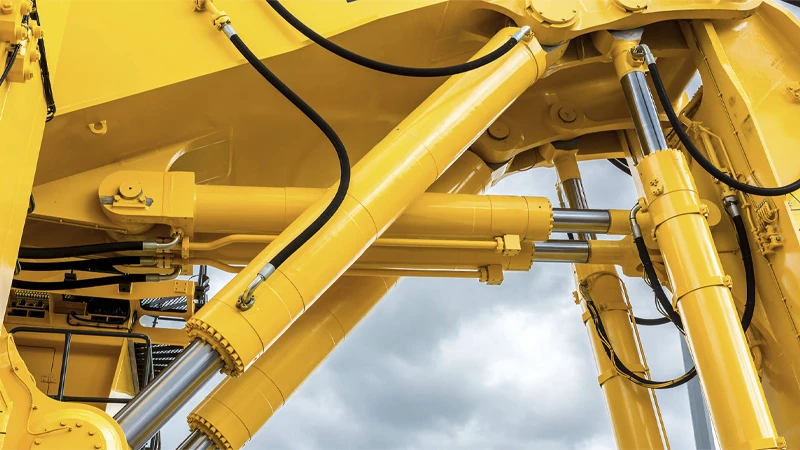
Hydraulic systems generate heat any time energy is converted without doing useful mechanical work. The fundamental rule is straightforward: where there is a pressure drop that does not move a load, the energy becomes heat.
In a return line, fluid flows from actuators back to the reservoir at low pressure — typically 2 to 15 bar under normal conditions. But if the return path is restricted by:
- An undersized hose bore
- A collapsed or kinked hose section
- A partially blocked return filter
- Excessive hose length with too many bends
- An undersized reservoir port or fitting
…then the fluid must overcome that resistance to reach the reservoir. The pressure required to push the fluid through the restriction does not contribute to any useful work. It is dissipated entirely as heat within the fluid.
This is not a small effect. A restriction that raises return line back-pressure by just 5 bar at a flow rate of 60 L/min generates approximately 5 kW of heat — continuously, every second the system is running. On a machine with a 10 kW heat exchanger, a single undersized return hose can account for half the exchanger’s entire capacity before the system has even begun its normal working cycle.
The Back-Pressure Heat Formula
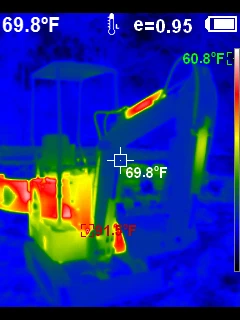
The relationship between pressure drop and heat generation in a hydraulic return line is direct and calculable. Engineers use the following formula to quantify return line heat load:
Heat Generated (kW) = Pressure Drop (bar) × Flow Rate (L/min) ÷ 600
Let’s put real numbers to this:
| Scenario | Return Pressure | Flow Rate | Heat Generated |
|---|---|---|---|
| Correctly sized return hose | 2 bar | 60 L/min | 0.2 kW |
| Slightly undersized bore | 8 bar | 60 L/min | 0.8 kW |
| Significantly undersized bore | 15 bar | 60 L/min | 1.5 kW |
| Blocked return filter + undersized hose | 25 bar | 60 L/min | 2.5 kW |
The difference between a correctly sized return hose and a significantly undersized one is 1.3 kW of continuous heat — the equivalent of a small electric heater running inside your hydraulic reservoir. Over an eight-hour shift, that is nearly 37,000 kJ of excess thermal energy the system must dissipate, on top of its normal heat load.
For large construction equipment or agricultural machinery running multiple hydraulic circuits simultaneously, the numbers scale accordingly. A 200 L/min return flow through an undersized hose at 15 bar back-pressure generates 5 kW of heat from the return line alone. This is why high-horsepower machines running at elevated temperatures so often “cure” their overheating problems simply by upsizing the return hose bore by one dash size.
How an Undersized Return Hose Creates Back-Pressure
Fluid mechanics in a hydraulic return line follows the Hagen-Poiseuille relationship: pressure drop through a hose is proportional to the fourth power of the bore diameter. This means that halving the hose bore increases pressure drop by a factor of 16 at the same flow rate.
In practical terms: the difference between a DN16 (5/8″) and a DN25 (1″) return hose at 60 L/min is not a small margin. The DN16 hose at that flow rate produces fluid velocity above 8 m/s — more than twice the recommended maximum of 4 m/s for return lines. The resulting turbulence and pressure drop can generate 8–12 bar of back-pressure where a correctly sized DN25 hose would produce less than 1 bar.
This is why return line sizing deserves the same engineering attention as pressure line sizing. The rule is simple: size the return hose bore to keep fluid velocity at or below 2–4 m/s at maximum flow rate. Use this formula:
Required bore area (cm²) = Flow rate (L/min) ÷ (600 × target velocity m/s)
For a 60 L/min maximum return flow targeting 3 m/s: 60 ÷ (600 × 3) = 0.033 cm² minimum bore area → approximately 20.5 mm minimum ID → select DN25 as the next standard size
If you are unsure of the maximum return flow rate, use the pump’s rated output as the baseline — in single-actuator circuits, the return flow closely matches pump output. In circuits with regenerative functions, load-lowering, or back-driven actuators, return flow can significantly exceed pump output. Always size for the worst-case scenario.
Five Signs Your Return Hose Is Causing Overheating
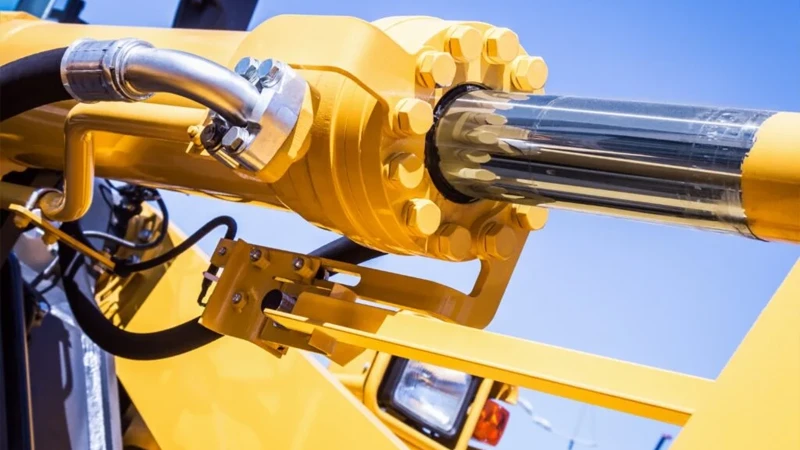
If your hydraulic system runs hot and you have already checked the obvious causes, inspect the return hose for these specific indicators:
1. The return hose is noticeably hot to touch near the reservoir port. A small temperature differential across the return circuit is normal. But a hose that is significantly hotter at the reservoir end than at the actuator end indicates that pressure drop — and therefore heat — is being generated within the hose itself.
2. The system runs hotter under high-flow conditions. Because return line pressure drop scales with the square of flow velocity, an undersized return hose causes disproportionately more heat at high flow rates. If your temperature gauge rises sharply when multiple actuators operate simultaneously, return line restriction is a strong candidate.
3. Actuator retraction is slower than extension. On a double-acting cylinder, restricted return flow creates back-pressure against the rod end, slowing retraction speed even when the pump is delivering full flow. This is often misdiagnosed as insufficient pump pressure.
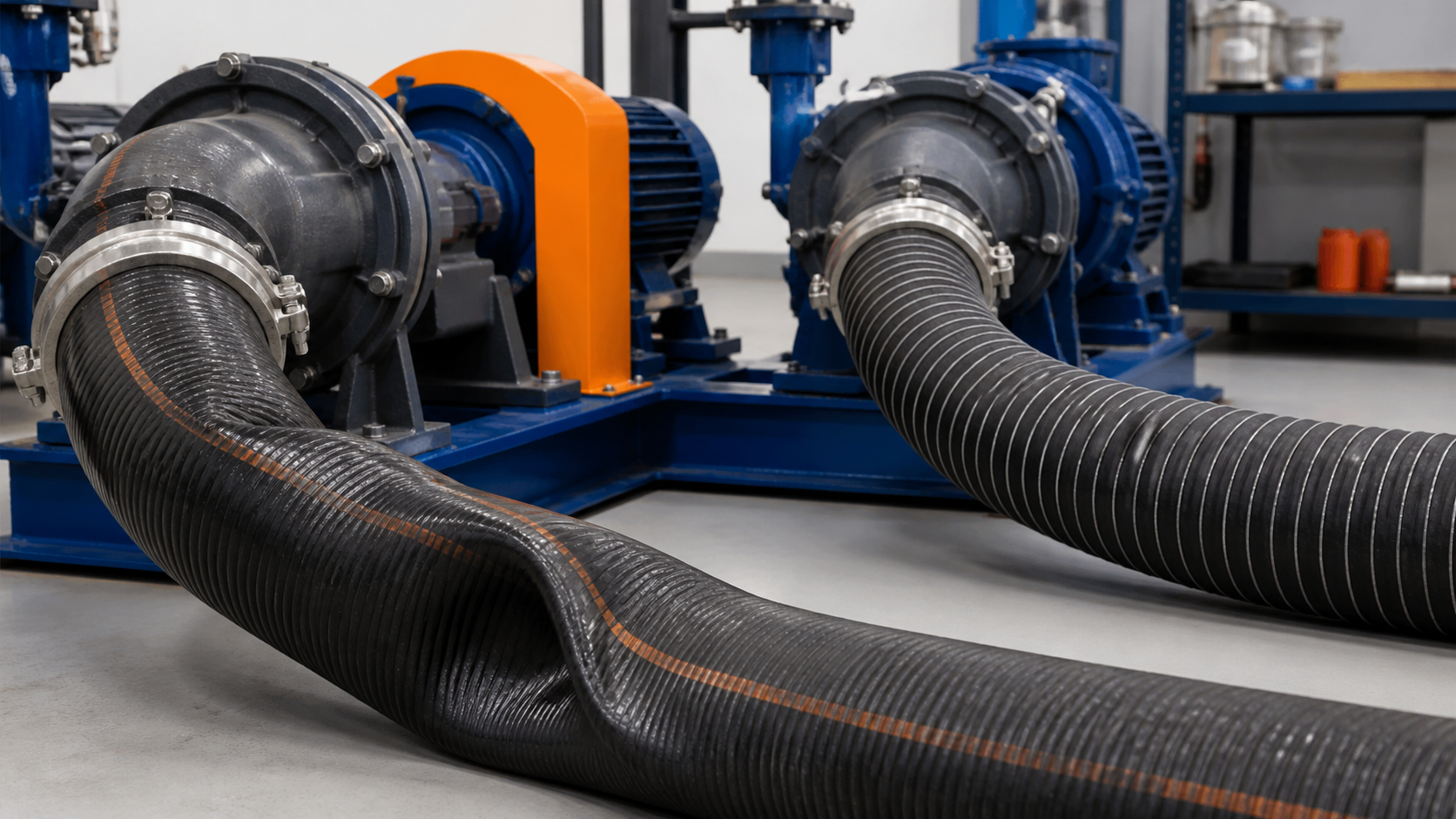
4. The return hose has visible deformation, kinks, or flattened sections. Even partial bore restriction from a kinked or collapsed section dramatically increases pressure drop. A hose that appears intact externally can have internal delamination that creates partial blockage invisible without cutting the hose open.
5. The return filter bypass indicator is triggered frequently. If return line restriction downstream of the filter causes back-pressure that equals the bypass valve cracking pressure, the filter bypass opens — sending unfiltered fluid directly to the reservoir and contaminating the entire system.
Return Hose Degradation Accelerates the Problem Over Time
A new, correctly sized return hose in a clean system may produce acceptable back-pressure at installation. But three factors cause that performance to degrade over the service life of the hose:
Inner tube swelling. Hydraulic fluid in contact with the hose inner tube causes gradual rubber swelling. Over years of service, an inner tube that has swollen by even 2–3 mm in a DN25 bore reduces effective flow area by 10–15%, with corresponding increases in pressure drop and heat generation.
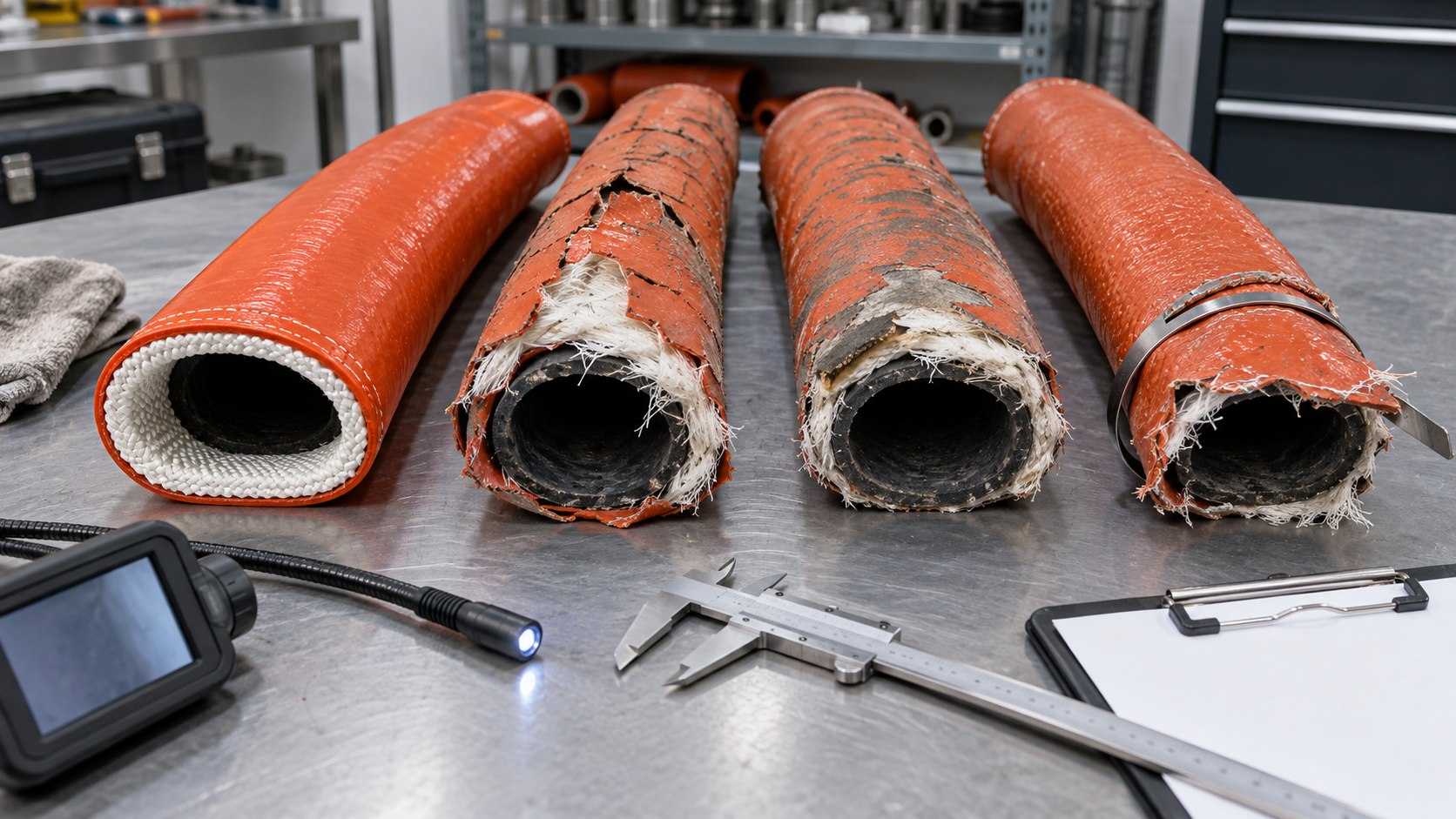
Inner tube delamination. Aged or incompatible inner tube compounds can delaminate from the reinforcement layers, creating internal flaps that partially obstruct flow. This failure mode is invisible from outside the hose and is often discovered only when the hose assembly is cut apart after a system overheating problem has been traced back to the return circuit.
Fitting corrosion and internal restriction. Corroded or incorrectly installed fittings at return hose ends can reduce the effective bore at the connection points, creating localized pressure drop that is disproportionate to the fitting’s small physical footprint in the circuit.
This is why proactive return hose replacement — not waiting for visible leaks or catastrophic failure — is the correct maintenance strategy. A hose that is still physically intact after five years of service may be contributing far more heat to the system than it did at installation.
What to Do: A Practical Return Hose Audit
Before replacing any other component in an overheating hydraulic system, conduct this return line audit:
Step 1 — Measure actual return line pressure.
Install a pressure gauge at the return port of the directional control valve, before the filter. Operate the system at maximum flow. Return line pressure should be below 5 bar in most mobile equipment applications. Readings above 10 bar indicate significant restriction in the return circuit.
Step 2 — Verify return hose bore size.
Cross-reference the installed hose bore against the maximum flow rate using the velocity formula above. If the bore produces fluid velocity above 4 m/s, upsize immediately.
Step 3 — Inspect the full return hose route.
Trace the hose from actuator to reservoir, looking for kinks, tight bends below the minimum bend radius, contact with sharp frame edges, and areas of localized heat or abrasion damage.
Step 4 — Check the return filter condition.
A blocked return filter can create as much back-pressure as an undersized hose. Replace the filter element and measure return pressure again to isolate whether the restriction is in the filter or the hose circuit.
Step 5 — Consider an upsized replacement.
If the system has been modified since original design — higher-capacity pump, additional actuator circuits, increased duty cycle — the original return hose specification may simply be inadequate for current operating conditions. Upsizing by one dash size typically reduces pressure drop by 50–70%.
Conclusion
Hydraulic system overheating is a thermal balance problem: heat generated must equal heat dissipated. Most engineers focus on increasing heat dissipation — larger coolers, bigger reservoirs — without systematically eliminating unnecessary heat sources first.
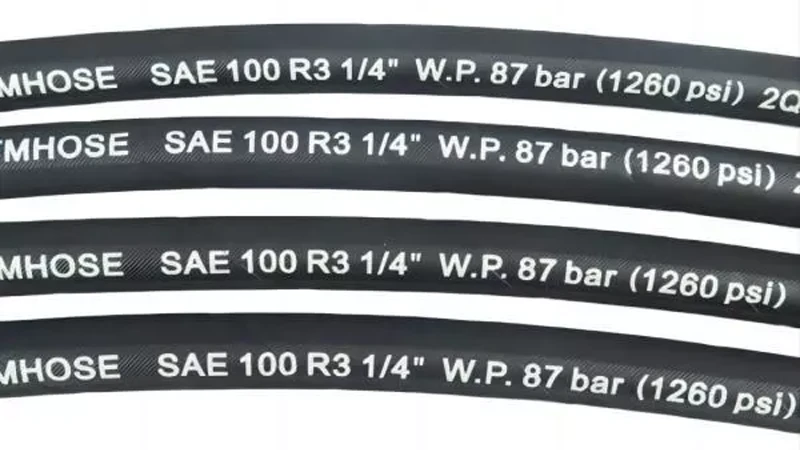
An undersized hydraulic return hose is one of the most cost-effective heat sources to eliminate. A correctly specified SAE 100R3 hose in the right bore costs a fraction of a new heat exchanger, installs in minutes, and can reduce continuous heat generation by several kilowatts — shifting the thermal balance back toward normal operating range without any other system changes.
Check the return line first. The answer is often simpler — and cheaper — than you think.