Excavators and skid steers are built to work in narrow, demanding spaces, but the same compact machine design that improves maneuverability often creates routing problems for hydraulic hoses. Around boom arms, loader arms, quick couplers, auxiliary circuits, and crowded engine compartments, there is often very little room for a hose to move freely. Add constant articulation, vibration, pressure spikes, dirt, and abrasion, and even a high-quality hose can fail early if it is not matched to the application correctly.
That is why the question is not simply, “What is the strongest hose?” In tight routing situations, the best hydraulic hose is usually the one that balances pressure capability, flexibility, minimum bend radius, hose diameter, and cover protection. A hose that is too stiff, too large, or poorly matched to fitting geometry may create installation stress from day one. Over time, that stress can turn into cover wear, kinking, leakage near the fitting, restricted flow, or repeated hose replacement in the same failure point.
For excavators and skid steers, the best choice is often a compact, flexible hydraulic hose designed for high performance in limited space. The exact answer, however, depends on where the hose is installed, how the machine moves, and how severe the hydraulic duty really is.
Why Tight Routing Is a Big Issue on Excavators and Skid Steers
Limited installation space
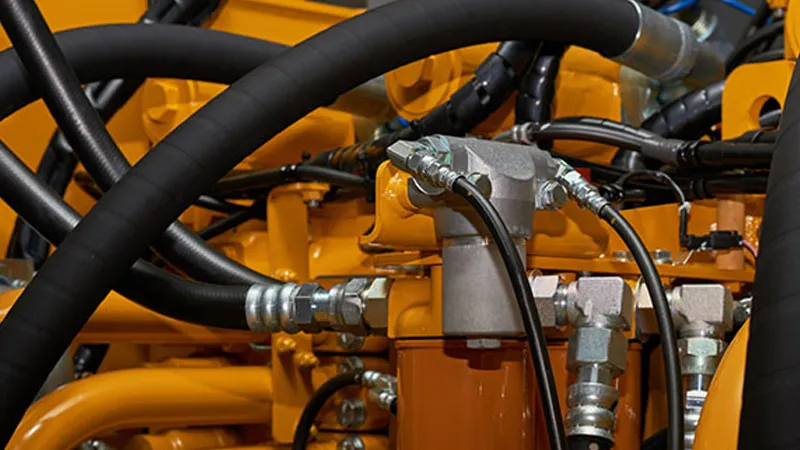
Unlike large stationary hydraulic systems, compact construction equipment has very little extra room for hose routing. Excavators must route hoses through booms, sticks, swing areas, and attachment interfaces. Skid steers must manage hydraulic lines through loader arms, compact frame sections, and auxiliary ports used for buckets, augers, grapples, trenchers, and breakers. In many cases, the hose must pass through areas where a large bend is simply not possible.
Constant motion and articulation
Tight routing becomes even more challenging because these hoses are rarely static. Every lifting motion, tilt movement, steering change, or attachment cycle places new stress on the hose assembly. A hose that looks acceptable when the machine is parked may become stretched, twisted, or over-bent during operation. Repeated flexing in a crowded zone is one of the main reasons hoses fail earlier than expected on mobile machinery.
Pressure is only one part of the answer
Many buyers focus first on working pressure, and that is important, but pressure rating alone does not guarantee long service life. A hose can be fully adequate on paper and still fail quickly if it is routed too tightly, clamped incorrectly, or forced to absorb machine movement beyond its design. In real excavator and skid steer service, bend radius, movement, and abrasion are just as important as PSI.
What Makes a Hydraulic Hose Good for Tight Routing?
Small outside diameter
A smaller outside diameter makes a real difference in compact machinery. It allows the hose to fit more easily through brackets, guards, and crowded hose bundles. It also reduces routing interference in areas where multiple hydraulic lines must move together. In many cases, a compact hose design makes installation cleaner and reduces the risk of rubbing against adjacent components.
Lower minimum bend radius
Minimum bend radius is one of the most important factors in tight routing. If a hose is forced into a bend tighter than its rated limit, the reinforcement structure and tube can experience continuous stress. That stress may not cause an immediate burst, but it often leads to shortened service life, internal damage, or reduced flow performance. In compact equipment, a hose with a lower minimum bend radius is often a better choice than a bulkier alternative with a higher pressure rating.
Better flexibility
Flexibility matters both during installation and during operation. A more flexible hose requires less force to bend into position, which means less tension at the fittings and less stress around clamps and articulation points. This is especially important on skid steers and compact excavators where hose routing paths are short, crowded, and constantly moving.
Strong impulse performance
Excavators and skid steers often experience frequent pressure fluctuations rather than perfectly stable hydraulic conditions. Attachment changes, directional valve action, shock loads, and repetitive cycles can create high impulse stress. A hose that handles real impulse conditions well will usually outperform a hose selected only for nominal working pressure.
Abrasion-resistant cover
In tight routing areas, cover protection is critical. Hose failure often starts from the outside. Repeated rubbing against metal edges, brackets, neighboring hoses, or machine frames can wear through the outer cover and expose the reinforcement. In these environments, an abrasion-resistant cover or additional protective sleeve can extend service life significantly.
Correct fitting compatibility
The hose itself is only part of the routing solution. Fitting angle, fitting length, and connection style often determine whether a hose assembly works smoothly or fails early. In compact routing zones, a well-chosen 45-degree or 90-degree fitting may reduce stress far more effectively than simply selecting a heavier hose.
Compact Braid Hose vs Spiral Hose: Which Is Better?
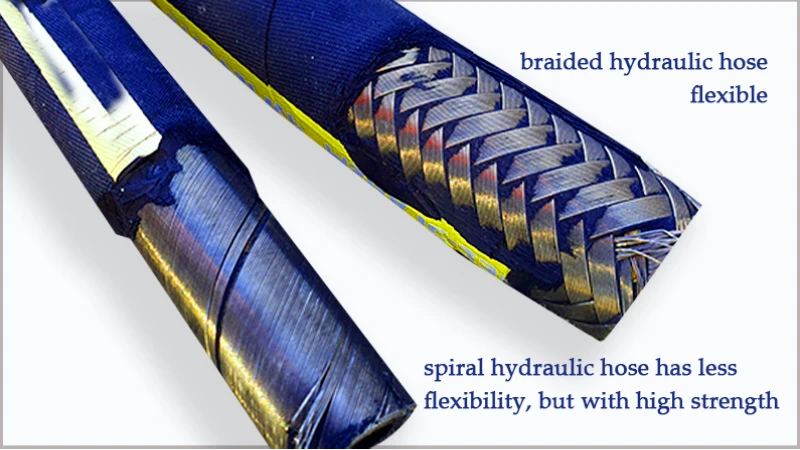
This is one of the most common questions in hydraulic hose selection. Many buyers assume spiral hose is automatically the best because it is associated with high pressure and heavy-duty service. In reality, that is only partly true.
Compact braid hose is often the better choice when space is limited. It typically offers better flexibility, easier installation, and a smaller bend profile. In many excavator and skid steer circuits, especially where hoses must route through tight areas or move frequently, a compact braid hose provides the best balance between pressure capability and routing performance.
Spiral hose still has an important role. It is often the right option for severe-duty main hydraulic circuits where extremely high pressure, demanding impulse performance, and longer service life under harsh operating conditions are required. On larger machines or in circuits where routing space is less restricted, spiral hose can be the best solution.
The key point is that spiral hose is not always better in cramped machine layouts. A hose that is technically stronger but too stiff for the routing path can create more problems than it solves. In many compact construction equipment applications, the best hose is the one that routes naturally, maintains the correct bend radius, and reduces continuous stress in service.
How to Choose the Best Hose for Different Lines on the Machine
Not every hydraulic line on an excavator or skid steer should be treated the same way. Main pressure lines usually require the highest confidence in pressure performance, impulse resistance, and reliability. If routing space is limited, a compact high-performance hose may still work, but the pressure demands of the circuit must be checked carefully.
Auxiliary attachment lines often place greater value on flexibility and routing ease. These lines serve tools such as breakers, grapples, augers, and trenchers, and they are frequently exposed to motion, vibration, and contact. In these areas, flexibility and abrasion resistance are often just as important as pressure class.
Pilot and control lines usually have different requirements. These may use smaller diameters and often benefit from lighter, more compact hose constructions that are easier to route cleanly through narrow spaces.
Articulating joint areas deserve special attention. Around booms, loader arms, couplers, and pivot sections, the hose assembly must allow controlled movement without twisting, stretching, or rubbing. In these locations, bend radius, clamp position, and protective sleeving should all be part of the selection process.
Common Mistakes When Selecting Hydraulic Hose for Tight Routing
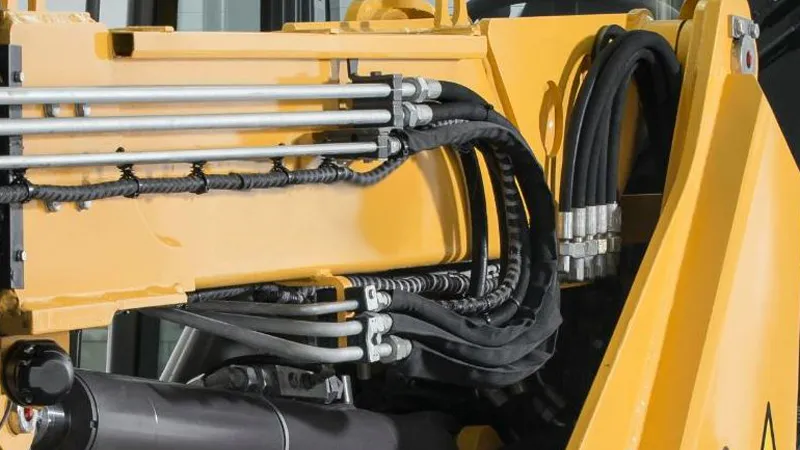
One common mistake is choosing hose by pressure only. This often leads buyers to select a stiff or oversized hose that looks safe on paper but performs poorly in the actual routing environment.
Another mistake is ignoring minimum bend radius. A hose forced into a bend tighter than its design limit will usually fail sooner, even if the pressure rating is correct.
Oversizing the hose is also a frequent issue. Some buyers think a larger hose provides extra safety, but in tight routing it may create installation stress, poor movement, and unnecessary bulk.
Fitting geometry is often overlooked as well. The wrong fitting angle can force the hose into a sharp bend directly behind the coupling, which is one of the most common failure zones.
Abrasion is another hidden problem. Even a correctly selected hose may fail if it rubs continuously against a clamp, bracket, or nearby line.
Finally, many people try to force a standard hose into a compact routing layout when a compact hose construction would be the better solution from the start.
Best Practices for Longer Hose Life in Compact Equipment
Good hose life begins with good routing clearance. Wherever possible, the hose should avoid constant contact with metal edges or neighboring hoses. High-wear zones should be protected with sleeves, guards, or abrasion wraps where movement cannot be eliminated.
Twist should also be avoided during installation. A twisted hose will not flex normally in service and often fails faster than a properly aligned assembly. Fittings should be selected as part of the routing plan, not as an afterthought. In many cases, the correct angled fitting reduces stress more effectively than changing the hose type alone.
Regular inspection matters too. On excavators and skid steers, the highest-motion areas should be checked first, especially around booms, couplers, loader arms, and pivot points. Early signs of wear in these areas usually appear before complete hose failure.
Conclusion
For excavators and skid steers, the best hydraulic hose for tight routing is usually a compact, flexible, abrasion-resistant hose with the correct working pressure and a bend radius suited to the installation space. In many crowded routing areas, compact braid hose is often the best overall choice because it is easier to route, easier to install, and better suited to repeated movement. For more severe-duty circuits, a spiral hose may still be necessary, but it should not be chosen automatically.
The right hose is not simply the strongest hose. It is the hose that matches the circuit, the machine movement, the fitting layout, and the available routing space. When those factors are considered together, hose life improves, downtime decreases, and the machine operates more reliably in the field.