Closed-loop power transmission systems represent the modern frontier of hydraulic technology, enabling unprecedented precision, efficiency, and control in industrial machinery. Unlike conventional open-loop hydraulic systems where fluid circulates from pump to actuator then returns to reservoir, closed-loop systems recirculate the same pressurized fluid repeatedly through sealed circuits. This fundamental architectural difference creates dramatically different performance characteristics and places unique demands on hydraulic hose selection and system design.
The hydraulic hoses in closed-loop systems operate under conditions fundamentally different from traditional applications. Fluid passes through multiple cycles per work cycle, accumulating contaminants and degradation at accelerated rates. Temperature control becomes more challenging as fluid recirculates without the heat dissipation opportunity of open-loop return flows. Pressure management and fluid compatibility become critical design parameters rather than secondary considerations. Understanding the specific demands closed-loop systems place on hydraulic hoses enables equipment designers to specify systems delivering the precision and efficiency these advanced applications demand.
Closed-Loop Architecture: Fundamentals and Advantages
Closed-loop hydraulic systems employ pressurized fluid recirculation where pump discharge flows directly to the load without intermediate reservoir circulation. When load demand decreases, high-pressure fluid recirculates back through proportional or directional control valves to the pump inlet at controlled pressure. This recirculation approach maintains system pressure within tight operating windows, enabling precise load control impossible in open-loop systems where pressure varies dramatically with load changes.
The efficiency advantage of closed-loop systems derives from reduced internal circulation losses. Open-loop systems pump fluid to full system pressure regardless of actual load requirement, with excess flow returning to reservoir through relief valves. This represents pure energy waste—the pump expends energy generating flow that immediately dissipates as heat. Closed-loop systems eliminate this waste by maintaining pump displacement proportional to load demand through variable-displacement pump controls.
Pressure ripple in closed-loop systems remains tightly controlled because fluid recirculates through proportional control valves rather than simple directional valves. This pressure stability enables highly responsive proportional actuator control, making closed-loop systems ideal for applications requiring rapid response and precise load management. A closed-loop system enabling load control within 2% of setpoint performs functions impossible for open-loop systems where load variations of 5-10% represent normal operating conditions.
Hydraulic Hose Requirements in Closed-Loop Systems
The recirculating nature of closed-loop systems creates unique hydraulic hose demands diverging significantly from traditional applications. Fluid passing through the same hoses repeatedly accumulates degradation products from each cycle. Standard mineral oil loses viscosity stability after dozens of recirculation cycles through high-temperature, high-shear conditions. This viscosity degradation directly impacts system performance—as fluid viscosity decreases, internal leakage increases, reducing system efficiency and load control precision.
Hose cleanliness requirements in closed-loop systems exceed those of open-loop systems by orders of magnitude. Particulate contamination that represents merely inconvenience in open-loop systems causes immediate malfunction in closed-loop systems where fluid contacts proportional valve spools repeatedly. A single particle obstructing a proportional valve spool can prevent the entire circuit from functioning. Closed-loop system filtration must maintain ISO 4406 cleanliness of 15/13/10 or better—far stricter than typical industrial hydraulic systems operating at 18/16/13 or worse.
Temperature management in closed-loop systems requires more sophisticated control than open-loop alternatives. Open-loop systems naturally cool recycled fluid as it exposes large surface area returning to an open reservoir. Closed-loop systems lack this natural cooling opportunity—recirculated fluid never exposes to atmosphere, making heat removal dependent entirely on active cooling systems. Proportional valve performance degrades rapidly if fluid temperature exceeds optimal ranges, directly degrading system responsiveness and load control precision.
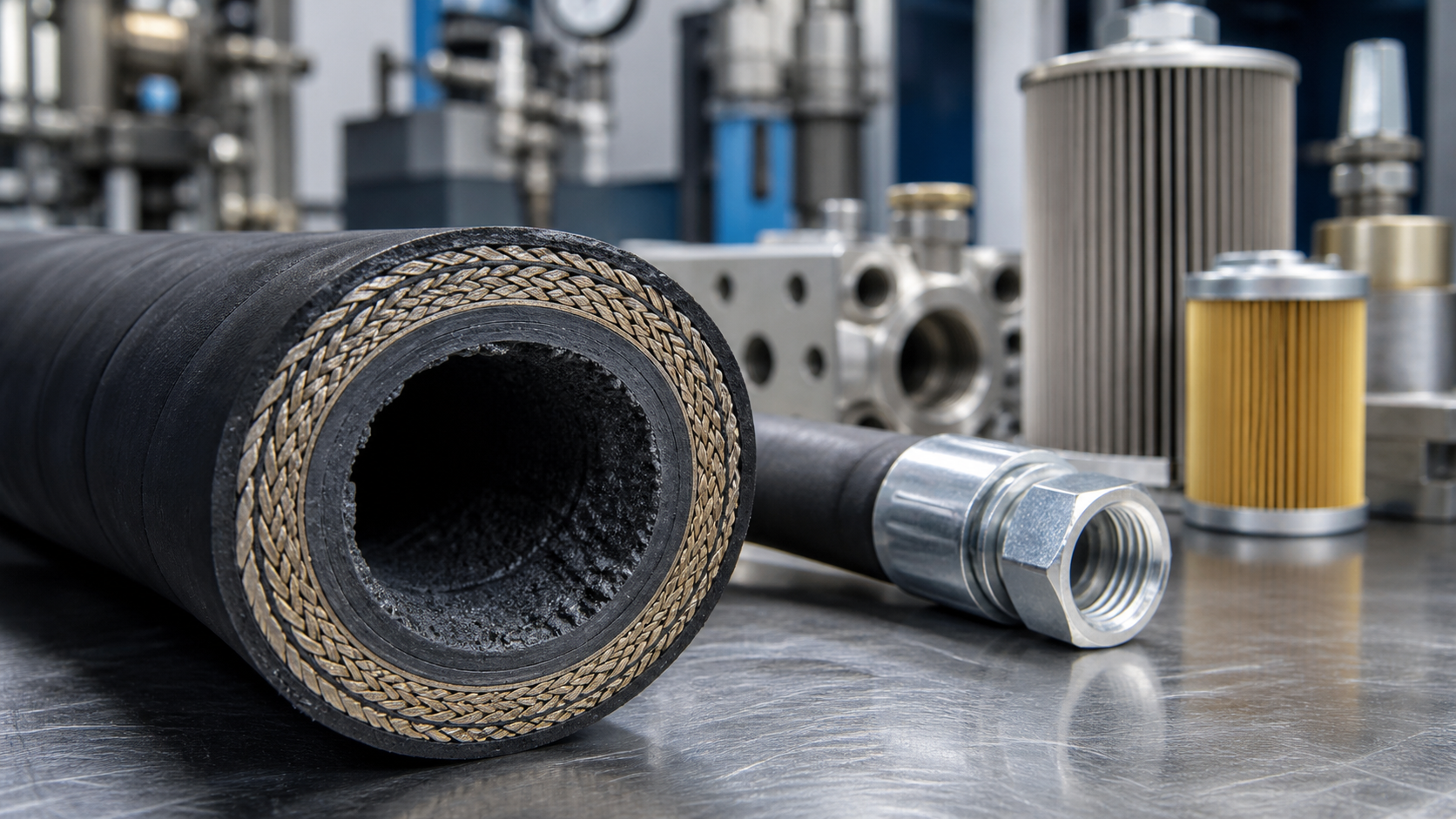
Hose material compatibility becomes critical in closed-loop systems where fluid remains in intimate contact with elastomers continuously. Open-loop systems periodically “refresh” fluid as new fluid enters from the pump and degraded fluid exits to reservoir. Closed-loop systems recirculate identical fluid indefinitely until scheduled fluid changes. Elastomers must tolerate extended exposure to oxidized fluid without degradation. We recommend high-pressure hydraulic hose engineered with premium elastomers demonstrating excellent compatibility with oxidized hydraulic fluids across extended operating temperatures.
Proportional and Directional Control in Closed-Loop Systems
Proportional valve technology enables the precise load control that distinguishes closed-loop systems from traditional alternatives. Rather than simple on-off directional control, proportional directional control valves enable stepless adjustment of pump displacement or main system pressure to match instantaneous load requirements. The proportional valve responds to electrical input signals from load sensors, continuously adjusting system pressure to maintain load setpoint.
This proportional control capability depends absolutely on pressure stability and responsiveness in hydraulic circuits. Any pressure ripple or oscillation in connecting hoses creates control instability where the proportional valve receives erratic feedback from load-sensing circuits. Hoses designed with optimized internal geometry and elastomer damping characteristics absorb pressure ripples, enabling stable closed-loop control. Standard industrial hoses lacking these damping properties transmit pressure oscillations unchanged, creating feedback instability that degrades control precision.
Load-sensing control in closed-loop systems automatically adjusts pump displacement maintaining constant pressure differential across proportional valves. This pressure-responsive control delivers dramatic energy savings compared to fixed pump displacement. Variable-displacement pumps coupled with sophisticated load-sensing logic enable systems maintaining efficiency across entire operating range—from no-load circulation to maximum load application.
Pilot-operated check valves in closed-loop systems prevent load drift when proportional valve centers. When the proportional valve reaches neutral position, pilot-operated check valves lock the actuator preventing uncontrolled load descent. These valves must respond instantly to pilot pressure signals without leakage. SAE 100R2AT hose engineered for rapid pressure response characteristics ensures instantaneous pilot valve response enabling stable load holding across extended dwell periods.
Application Domains: Where Closed-Loop Systems Excel
Offshore crane systems operate as textbook closed-loop applications where heave-compensated load control prevents suspended loads from swinging with wave motion. The closed-loop system continuously adjusts hydraulic pressure maintaining constant suspended load force despite vessel motion. This capability prevents dangerous load swing that would occur with fixed pressure systems. Closed-loop operation requires hydraulic hoses tolerating constant pressure cycling and maintaining strict cleanliness despite marine environments.
Industrial test systems and material testing equipment rely on closed-loop load control maintaining precise test loads throughout extended test cycles. Material properties testing requires load stability within 0.5% of setpoint across multi-hour test durations. Closed-loop systems enable this precision impossible with open-loop alternatives. Hydraulic hoses in test systems must maintain responsiveness throughout test cycles where load variations might occur hundreds of times per hour.
Precision manufacturing equipment including hydraulic presses often incorporates closed-loop systems enabling production within extremely tight tolerances. Stamping press systems maintaining constant pressure as material deforms throughout forming cycle produce more consistent parts than systems experiencing pressure variation. Closed-loop pressure control enables consistent dimensional accuracy across production runs.
Subsea equipment operating at extreme pressures relies on closed-loop systems for responsiveness and control reliability. The extreme hydrostatic pressures at depth combined with extreme cold temperatures create conditions where standard hydraulic systems perform poorly. Closed-loop systems maintaining precise pressure control enable sophisticated subsea tool operation impossible with simpler hydraulic architectures.
Fluid Degradation and Maintenance Strategy
Closed-loop systems recirculating identical fluid create accelerated fluid degradation compared to open-loop systems where fluid constantly refreshes. Oxidation products accumulate in recirculated fluid reaching problematic concentrations within shorter timeframes than open-loop systems. Fluid color darkens noticeably as oxidation products accumulate. Acid number increases indicating fluid chemical degradation.
Fluid sampling and analysis become critical maintenance practices in closed-loop systems. Regular fluid testing identifies oxidation progression and predicts required fluid change intervals. Ignoring fluid degradation in closed-loop systems creates catastrophic failures when oxidized fluid degrades proportional valve performance, suddenly triggering control system malfunction.
Filtration must accommodate frequent cycling of contaminated fluid through filter media. Closed-loop system filters experience higher particulate loading than open-loop alternatives because the same particles circulate repeatedly without removal opportunity. Bypass valves preventing filter blockage during cold startup must be carefully tuned to maintain cleanliness without creating pressure loss penalties.
Thermal management becomes complex in closed-loop systems operating across wide ambient temperature ranges. Cold startup requires careful heating before proportional valve engagement. Summer operation in hot climates requires proportional valve input signals accounting for fluid viscosity changes across temperature extremes. Advanced closed-loop systems incorporate fluid temperature monitoring enabling automatic control system compensation for temperature-induced viscosity changes.
Performance Metrics Defining Closed-Loop System Success
Responsiveness—the ability of proportional valves to achieve setpoint pressure rapidly—depends directly on hydraulic hose design. Hoses exhibiting excessive internal damping delay proportional valve response. Hoses transmitting full pressure ripple create overshoot and instability. Optimal hose design balances these requirements enabling rapid response without excessive ripple transmission or damping. We recommend hydraulic hose systems engineered specifically for proportional control applications where response time and pressure stability represent critical performance parameters.
Load holding precision—the ability to maintain constant load pressure despite minor disturbances—requires pilot-operated check valve leakage remaining below 0.1 cubic centimeters per minute. Hose internal degradation shedding particles contaminates pilot circuits, causing check valve stiction and degraded holding precision. This requirement places extreme emphasis on hose cleanliness throughout system life.
Energy efficiency in closed-loop systems approaches 94-96% with optimized design, dramatically exceeding the 85-90% efficiency typical of open-loop systems. This efficiency advantage justifies the additional cost and complexity of closed-loop architecture in applications operating continuously or with extended duty cycles. Over equipment operational lifetime, energy efficiency differences aggregate to substantial cost differences.
System stability—the ability to maintain proportional valve control without oscillation—depends on combined system compliance, fluid damping, and control valve tuning. Hydraulic hoses contribute significantly to system compliance through their elasticity. Hoses with optimized elasticity characteristics enable stable control across wider operating ranges than hoses with excessive compliance or insufficient damping properties.
Design Integration: System Optimization
Closed-loop system design requires integrated optimization across pump selection, proportional valve tuning, hose specification, and thermal management. Selecting undersized hoses reducing cost while increasing pressure drop creates control instability where load variations become unmanageable. Oversizing hoses reduces pressure responsiveness creating sluggish system response. Optimal hose sizing balances pressure drop, thermal response, and control responsiveness.
Variable-displacement pump selection enables dramatic efficiency improvements through pressure-responsive displacement adjustment. Coupling variable pumps with proportional control valves and load-sensing circuits creates systems maintaining efficiency across entire operating range. Hose selection supporting this pump technology must enable rapid pressure response as pump displacement changes occur.
Accumulator integration in closed-loop systems provides supplemental flow during rapid proportional valve transitions, smoothing pressure transients that would otherwise create instability. Accumulators precharge to optimal pressure levels coordinating with hose characteristics, proportional valve response, and load dynamics. This integrated design approach produces closed-loop systems achieving performance unattainable through component selection alone.
Pilot circuit design determines control responsiveness and stability. Pilot circuits operating at moderate pressure (500-1,000 PSI) must respond instantly to load sensor signals while maintaining absolute pressure stability. Hose sizing in pilot circuits receives insufficient design attention yet profoundly affects closed-loop system performance. Undersized pilot hoses delay proportional valve response degrading load control precision.
Conclusion: Hydraulic Hoses as Critical Performance Enablers
Closed-loop power transmission systems represent the apex of hydraulic system sophistication, delivering performance impossible with conventional architectures. Hydraulic hoses in these advanced systems are not commoditized components but precision-engineered elements where design parameters directly determine whether systems achieve intended performance or fall short of design objectives.
Equipment manufacturers designing closed-loop systems achieve competitive advantage through superior responsiveness, efficiency, and load control precision. These performance benefits directly translate to customer benefits—higher productivity, lower operating costs, and improved equipment reliability. Hydraulic hose selection critically determines whether closed-loop system design achieves these performance objectives.
Kingdaflex supplies closed-loop hydraulic systems to equipment manufacturers worldwide, combining engineering expertise with component innovation. Our understanding of proportional valve control, load-sensing optimization, and thermal management enables specification of hose systems delivering the performance precision that closed-loop applications demand.