Hydraulic energy losses often receive minimal attention in equipment operating cost analysis, yet they represent one of the largest controllable cost factors in industrial machinery operation. A hydraulic system operating at 85% efficiency—barely adequate by modern standards—wastes 15% of all input energy as heat and pressure losses. For a large mining truck consuming 300 kilowatts of hydraulic power during active operation, 85% efficiency means 45 kilowatts of wasted energy every hour. Over a mine’s operational lifetime spanning decades with hundreds of equipment units, these efficiency losses aggregate to millions of dollars in excess fuel consumption.
Hydraulic hose selection and system design directly determine whether systems achieve exceptional efficiency approaching 92-95% or operate at mediocre efficiency squandering energy and generating excessive heat. The relationship between hose selection, pressure losses, thermal management, and operational efficiency is not intuitive to equipment operators unfamiliar with hydraulic system fundamentals. Understanding how hydraulic hose design impacts energy efficiency enables equipment manufacturers, facility managers, and procurement teams to make informed decisions that simultaneously improve equipment reliability while reducing operating costs—a rare combination where both goals align perfectly.
Pressure Losses Through Hydraulic Hoses: The Primary Efficiency Drain
Pressure loss through hydraulic hoses represents the single largest efficiency loss in most hydraulic systems. As hydraulic fluid flows through a hose, internal friction between the fluid and hose walls creates resistance. This resistance converts hydraulic pressure into wasted heat. The magnitude of pressure loss depends on four factors: fluid viscosity, flow velocity, hose internal diameter, and hose length.
Higher flow velocities through smaller-diameter hoses create exponentially larger pressure losses. A hose sized for 8 feet-per-second flow velocity might generate 100 PSI pressure loss. The same flow through a hose sized for 12 feet-per-second flow velocity generates 225 PSI pressure loss—not linearly increased, but exponentially larger. For a hydraulic system maintaining 3,500 PSI pressure, a 225 PSI loss represents 6.4% of total system pressure wasted in pressure drop.
This pressure loss doesn’t simply reduce flow—it forces the pump to increase pressure output compensating for the loss. A pump maintaining 3,500 PSI at the actuator while losing 225 PSI in hose pressure drop must actually generate 3,725 PSI. This 225 PSI over-pressure multiplied across all system flows equals thousands of watts of wasted power generating excess heat that cooling systems must remove.
Optimizing hose diameter during equipment design phases dramatically improves system efficiency at minimal cost. Increasing hose internal diameter by just one size (for example, 0.5 inches to 0.75 inches) can reduce pressure losses by 40-60% depending on flow rates. This hose upgrade costs only marginally more than undersized alternatives yet delivers efficiency improvements directly reducing operating costs throughout the equipment’s life.
Temperature Management: The Efficiency Multiplier
Excessive system temperature amplifies efficiency losses across multiple mechanisms. Hydraulic fluid viscosity decreases with temperature. At 40°C, fluid viscosity might be 46 centistokes. At 70°C, the same fluid drops to 8 centistokes. Lower viscosity dramatically increases internal leakage across piston seals and valve spools. Leakage that would be negligible at optimal temperature becomes substantial at elevated temperatures, reducing system efficiency 2-5 percentage points.
Elevated temperatures accelerate fluid oxidation chemically degrading the hydraulic fluid. Oxidized fluid develops increased viscosity variations, sludge formation, and varnish buildup on component surfaces. These fluid degradation products increase internal friction and further reduce efficiency. Additionally, oxidized fluid loses performance in critical applications like rapid-cycling injection molding machines where fresh fluid maintains tighter viscosity tolerances essential for precision control.
Thermal runaway—a condition where system heat generation exceeds cooling capacity, causing further temperature increases—represents an efficiency death spiral. As temperature rises, efficiency decreases, generating more heat, raising temperature further. Uncontrolled thermal runaway can disable equipment suddenly despite the system appearing to operate normally minutes earlier.
Preventing thermal runaway requires multiple integrated strategies: properly sized heat exchangers matched to actual system heat load, high-efficiency hoses minimizing pressure-drop heat generation, clean hydraulic fluid maintaining optimal viscosity properties, and proportional pump controls reducing idle losses. These design elements work synergistically—eliminating any one element degrades the entire thermal management strategy.
Hose Construction’s Impact on Efficiency
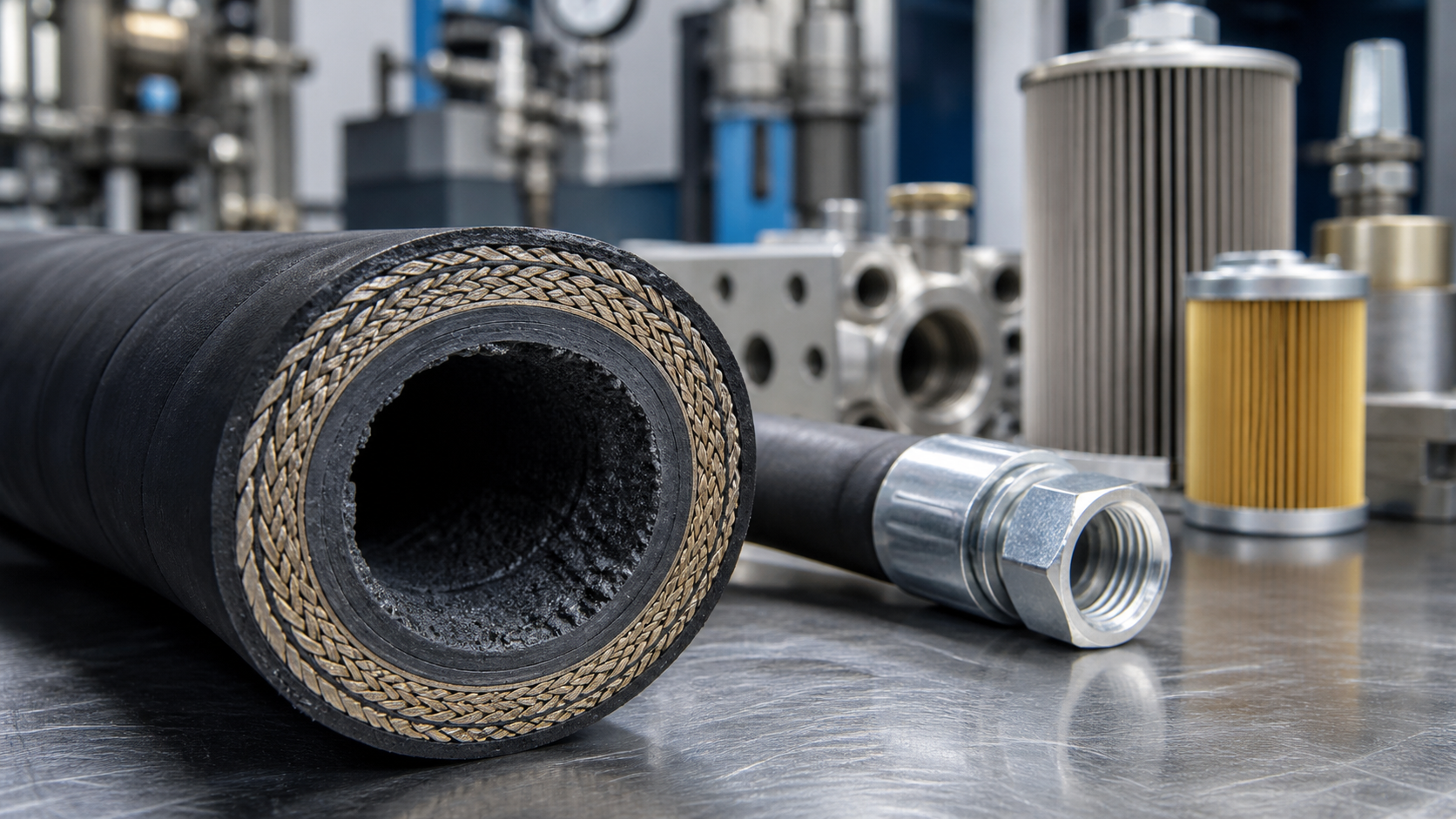
Different hose constructions exhibit different internal flow characteristics affecting pressure losses and efficiency. Hoses with smoother internal surfaces reduce flow turbulence, lowering pressure losses compared to rough-surface constructions. SAE 100R2AT hose with spiral reinforcement demonstrates superior flow efficiency compared to straight-braid constructions operating at equivalent pressures and flow rates.
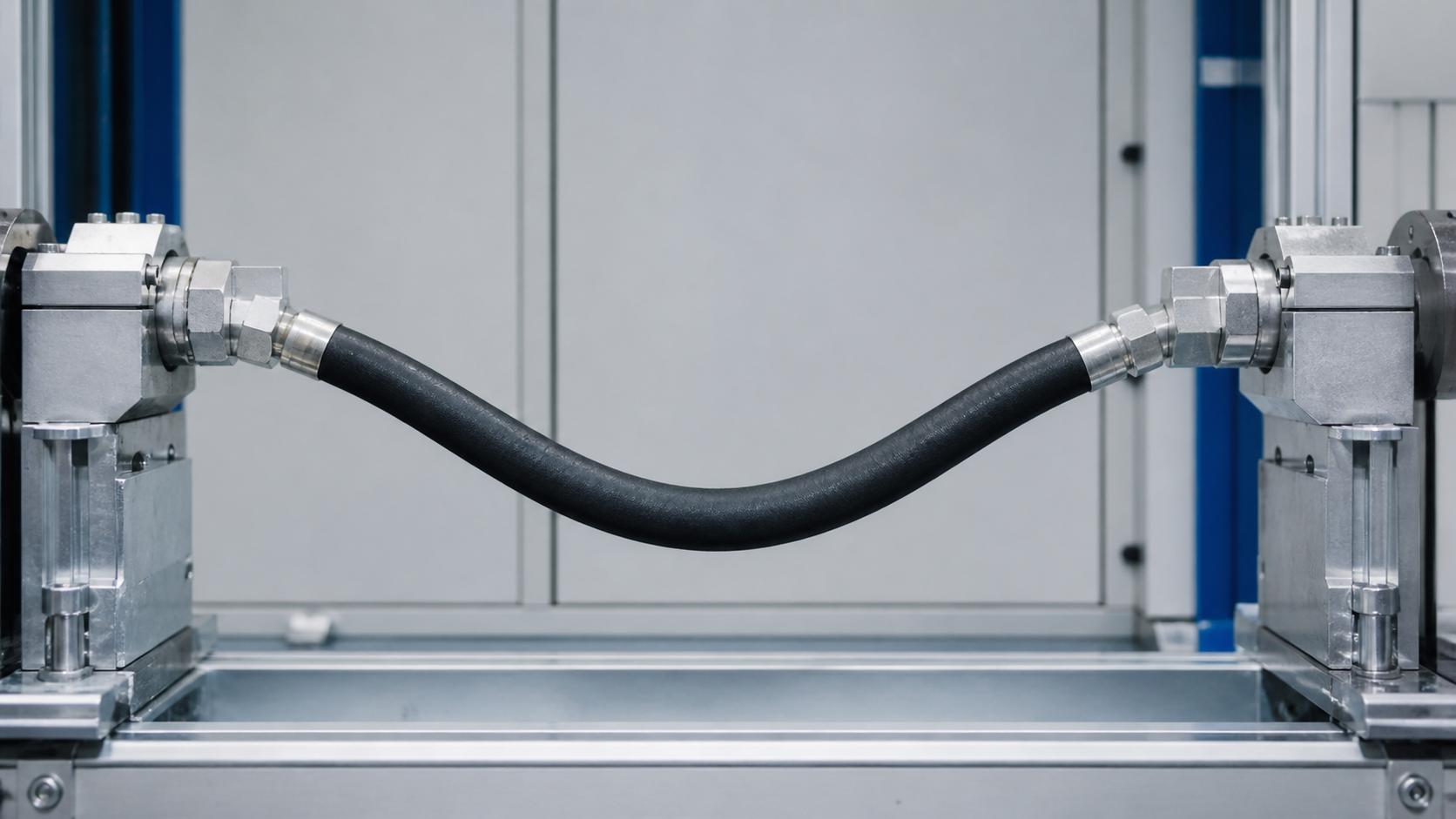
Hose flexibility affects system efficiency through pressure ripple behavior. Hoses with optimal elasticity absorb pump pressure ripples, smoothing pressure oscillations that would otherwise propagate through the system. These absorbed ripples would otherwise trigger relief valve chatter wasting energy in valve cycling. Hoses with insufficient elasticity transmit ripples unchanged through the system, increasing energy losses.
Internal hose cleanliness directly impacts efficiency through viscosity stability. Contaminated hydraulic fluid with suspended particles develops higher viscosity than clean fluid. Higher viscosity increases pressure losses throughout the system. Additionally, particle contamination in hoses causes internal erosion that roughens originally smooth internal surfaces, permanently increasing pressure drop even after the fluid is cleaned and refreshed.
High-pressure hydraulic hoses engineered for multiple reinforcement layers and optimized internal geometries deliver superior efficiency compared to minimum-specification designs. The engineering investment in premium hose construction pays dividends through reduced operational energy consumption that compounds over years of equipment operation.
Real-World Efficiency Gains: Quantifying the Value
Consider a practical example: a modern wheel loader operating in an aggressive loading cycle consuming 200 kilowatts of hydraulic power during a full-duty work shift. If the equipment operates at 85% efficiency (industry average for many systems), the machine wastes 30 kilowatts—equivalent to running a space heater continuously while performing productive work.
Optimizing the hydraulic system through proper hose design and sizing, improved pressure management, and enhanced cooling strategy improves efficiency from 85% to 92%. This 7-percentage-point improvement eliminates 14 kilowatts of wasted power. For equipment operating 200 hours annually consuming $150 per megawatt-hour fuel costs, this efficiency improvement saves $420 annually per unit.
For a mining operation running 200 equipment units through this optimization, annual savings reach $84,000. Over equipment life spanning 10 years, cumulative savings total $840,000 plus additional benefits from reduced component wear caused by lower operating temperatures and reduced thermal stress. This economic return on the optimization investment typically yields payback within 6-12 months through fuel savings alone.
System Design Integration for Maximum Efficiency
Advanced hydraulic systems incorporate load-sensing pump technology automatically adjusting pump displacement to match actual load requirements. Rather than maintaining constant maximum pressure regardless of load, load-sensing pumps reduce displacement during low-demand phases. This efficiency improvement can improve overall system efficiency 3-5 percentage points compared to fixed-displacement pump systems.
Proportional valve implementation enables smooth pressure ramps and precise flow control. Compared to simple on-off valves creating abrupt pressure changes and associated shock losses, proportional valves reduce transient energy losses. The improved control also enables operators to match pump output precisely to actual load requirements, further reducing wasted energy.
System pressure optimization during design phase establishes minimum working pressures achieving required performance. Equipment designed with unnecessarily high pressure margins wastes energy maintaining pressure higher than functionally necessary. Modern design uses pressure analysis identifying minimum required pressure for each circuit, then selects pumps and hoses accordingly.
Circuit segmentation enables different functions to operate at optimal pressures rather than forcing all functions into a single unified high-pressure circuit. A boom lifting circuit might operate at 3,500 PSI while a circulation cooling circuit operates at 300 PSI. This pressure differentiation enables smaller, lower-power pumps for low-pressure functions, directly improving overall system efficiency.
Material Science and Energy Efficiency
Elastomer compound selection affects hose performance under thermal stress. Premium synthetic elastomers maintain consistent viscosity properties across wider temperature ranges compared to standard elastomers. This property consistency preserves system efficiency across seasonal temperature variations. Equipment in tropical climates or arctic regions benefits significantly from temperature-stable elastomer selection.
Internal hose surface treatments can reduce flow friction and pressure losses. Some specialty hoses incorporate surface coatings or internal geometry optimization reducing turbulent flow patterns. These advanced constructions cost more than standard alternatives but deliver efficiency improvements justifying the investment in systems operating continuously or with high-intensity duty cycles.
Fluid compatibility with hose materials affects efficiency through viscosity stability. Hoses optimized for standard mineral oil might exhibit different pressure-drop characteristics with synthetic fluid, fire-resistant fluid, or biodegradable fluid. Equipment transitioning to specialty fluids for environmental or safety requirements must re-evaluate hose selection to maintain efficiency with the new fluid type.
Maintenance Impact on Efficiency: Preventing Efficiency Degradation
System cleanliness directly determines whether designed efficiency levels persist throughout equipment life or degrade progressively. Contaminated hydraulic fluid increases pressure losses, reduces pump efficiency, and accelerates component wear. Regular fluid sampling and filter maintenance preserves system efficiency throughout the equipment’s operational life.
Hose condition monitoring prevents efficiency degradation from failing hoses. A hose developing internal cracks and internal elastomer shedding creates turbulent flow patterns increasing pressure losses. Early detection through visual inspection and fluid analysis prevents progressive efficiency loss.
Pump maintenance preserves pump efficiency which degrades with wear. A pump delivering 95% efficiency when new gradually declines to 85-90% efficiency after thousands of hours of operation as internal clearances increase and seal wear permits internal leakage. Preventive pump maintenance extending service intervals preserves efficiency longer than simple run-to-failure approaches.
Comparative Analysis: Efficiency Outcomes by System Design Approach
| Design Factor | Basic System | Contemporary | Advanced Optimization |
|---|---|---|---|
| Hose Sizing | Undersized (8-10 FPS) | Optimized (6-8 FPS) | Fully optimized (5-7 FPS) |
| Pressure Management | Single high pressure | Multi-tier pressure | Load-sensing adaptive |
| Thermal Control | Passive cooling | Thermostat fan control | Active proportional |
| Pump Technology | Fixed displacement | Variable displacement | Load-sensing variable |
| System Efficiency | 80–85% | 88–92% | 92–96% |
| Energy Cost/Year | $50,000 | $37,500 | $30,000 |
| Payback Period | N/A | 18 months | 12 months |
Conclusion: Energy Efficiency as Competitive Advantage
Equipment manufacturers and facility operators pursuing energy efficiency as a core design and operational principle achieve dual benefits: reduced operating costs and enhanced equipment reliability. These goals reinforce each other—the thermal management, pressure optimization, and component selection strategies improving efficiency simultaneously improve component longevity and reduce failure rates.
The hydraulic hose selection decision represents a critical node in this efficiency optimization strategy. Hose sizing, construction quality, material selection, and system integration directly determine whether systems operate at maximum efficiency or waste substantial energy as heat and pressure losses. Partnering with hydraulic suppliers who understand efficiency as a core design objective ensures equipment specifications incorporate efficiency from initial design through field operation.
Kingdaflex works with equipment manufacturers worldwide to optimize hydraulic systems balancing performance, reliability, and energy efficiency. Our complete range of hose solutions includes efficiency-optimized designs for rapid-cycling applications, high-flow systems, and extreme-temperature conditions. We combine engineering expertise with field-proven performance, enabling manufacturers to create equipment delivering superior efficiency throughout operational life.
The equipment achieving 92-95% efficiency doesn’t represent theoretical maximum—it represents engineering excellence translating into tangible operating cost reductions. Equipment specifications and maintenance practices that prioritize efficiency deliver measurable savings in fuel consumption, reduced equipment wear, and extended component life. In competitive markets where equipment operating costs directly determine customer purchasing decisions, energy efficiency has become a critical competitive differentiator.