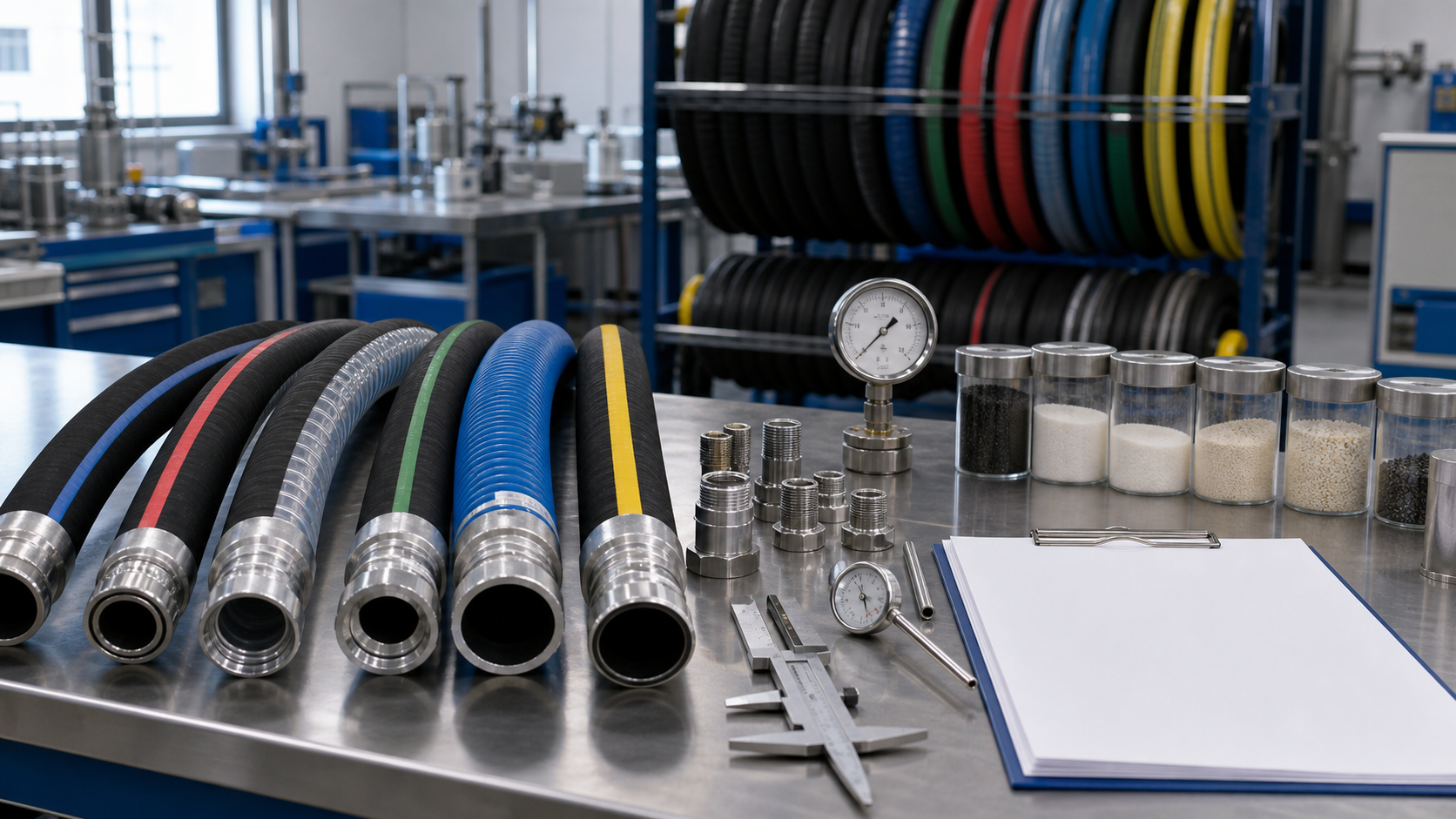
A hydraulic hose is flexible, but it is not dimensionally fixed. When pressure rises, the interaction between the inner tube, reinforcement, and cover can cause the assembly to shorten or lengthen slightly. The amount and direction depend on hose construction and manufacturer specifications.
If a designer ignores hydraulic hose length change under pressure, the assembly may pull on fittings, rub against structures, leave a guide, or form excess slack. Correct routing must accommodate pressure-related movement along with machine articulation, vibration, temperature, and installation tolerances.
Why Hose Length Can Change
Internal pressure produces force in multiple directions. Reinforcement restrains radial expansion and carries axial loads. As braid or spiral geometry responds, the hose can change in diameter and length.
Different constructions behave differently. A textile-braided hose, wire-braided hose, spiral hose, and thermoplastic hose should not be assumed to have the same response. The manufacturer may state an allowable percentage of length change for a standard or product family.
Treat that value as a design input. Do not apply a generic percentage when product-specific data is available.
Why Small Percentages Matter
Even a modest percentage becomes meaningful on a long assembly. Length change can:
- Pull directly on a coupling or adapter
- Reduce the straight section near a fitting
- Tighten a bend below its minimum radius
- Move the hose into contact with a structure
- Create slack that rubs, loops, or snags
- Shift a hose inside a clamp or carrier
- Alter the position of protective sleeves
The effect is especially important on long boom routes, vertical runs, hose reels, articulated arms, and assemblies connected to delicate valves or tubing.
Design Conditions to Combine
| Source of movement | Design question |
|---|---|
| Pressure-related length change | How much can this exact hose grow or contract? |
| Machine articulation | What are the maximum extension and rotation positions? |
| Temperature | Does the hose become stiff or expand differently? |
| Installation tolerance | How much variation exists in assembly and mounting points? |
| Vibration | Can the hose isolate relative motion without whipping? |
| Service access | Can fittings be installed without twisting the hose? |
Design allowance must address the combined worst credible condition rather than each item separately.
Use Product-Specific Data
A sound hydraulic hose design begins with the selected product, size, pressure, fluid, temperature, and route. Ask the supplier for applicable standards, dimensional tolerances, and length-change data.
Do not infer behavior from appearance. Two hoses with the same bore and outside diameter may use different reinforcement angles and compounds. A replacement from another family may fit when depressurized but move differently during operation.
If the application is highly sensitive, validate the proposed assembly under controlled pressure and temperature while measuring its movement.
Allow Slack Without Creating Loops
Slack is necessary for movement, but excessive slack creates its own hazards. A loose loop can rub against a frame, catch on an attachment, strike nearby components, or bend unpredictably when pressure changes.
The ideal route provides controlled length in the plane of movement. Use broad bends rather than sharp S-shapes. Position clamps and guides so pressure response occurs in an intended flexible section rather than at a fitting.
Avoid using hose length as a substitute for proper joint geometry. A continuously rotating connection may require a rotary union; adding a longer hose does not allow unlimited torsion.
Protect the Minimum Bend Radius
Pressure-related shortening can tighten an existing bend. Lengthening can push a hose into a smaller space and create a new bend. Both cases can violate the minimum bend radius.
The first bend should begin beyond the supplier’s recommended straight section at the fitting. A bend concentrated at the ferrule increases stress and can damage reinforcement or the tube.
Check bend radius at minimum and maximum pressure and throughout machine motion. The unpressurized installation view is only one condition.
Routing Fixed-to-Moving Connections
When a hose connects a stationary valve to a moving cylinder, boom, motor, or attachment, route it so motion creates a smooth bend in one plane. Avoid compound bends and twist.
Use the layline to verify installation. If the layline spirals along an assembly that should bend in one plane, the hose may have been twisted during connection. Pressure cycling then adds stress to already distorted reinforcement.
Follow hose routing best practices by observing every operating position. Consider stowed, transport, service, and emergency positions as well as the normal cycle.
Clamps, Guides, and Supports
Clamps control weight and movement, but their placement changes how the hose responds to pressure. A clamp too close to a fitting can concentrate axial movement at the coupling. A clamp at the wrong point can force a bend into a short section.
Use supports with suitable liners and diameters. They should not crush the cover or cut into it as the hose moves. Guides and rollers must match the hose outside diameter and minimum bend radius.
Long vertical hoses need weight support so the fitting does not carry the entire hanging load. The support system must still accommodate axial response and thermal movement.
Assembly Length and Tolerance
The specified assembly length should follow the supplier’s measurement convention, typically between defined fitting reference points. Angled ends also require rotational orientation.
A complete hydraulic hose assembly drawing should include:
- Hose product and size
- Cut or overall length and tolerance
- End fittings and connection standards
- Angular orientation of bent fittings
- Sleeve or guard positions
- Cleaning, capping, and marking requirements
- Test and inspection requirements
Copying a used hose can be misleading because it may have changed dimension, been routed incorrectly, or been made as an emergency replacement.
Common Design Mistakes
Common problems include installing a hose taut at zero pressure, clamping both ends of the flexible section rigidly, placing the first bend at the ferrule, using excess length to absorb twist, and substituting a stiffer construction without route review.
Another mistake is checking movement only by hand with the system off. Pressure, fluid temperature, vibration, and full mechanical load can change the hose position. Validation should reproduce representative operating conditions safely.
Prototype and Validation Testing
For OEM equipment, test the route through full motion while monitoring safe pressurization. Measure clearance, bend radius, movement at fittings, clamp behavior, and contact points.
Use cameras or markers where direct observation is unsafe. Do not stand near a pressurized hose or reach into moving machinery. If a route changes unpredictably, stop and revise supports or length before production release.
Document the approved product because changing hose construction may change movement even when pressure and dimensions appear equivalent.
Inspection After Installation
Look for a hose becoming taut under pressure, fittings receiving side load, clamps shifting, new rubbing marks, flattened bends, twisted laylines, or guards moving out of position. Check for leakage and cover damage after the initial service period.
Record recurring issues by machine position. A repeated failure near the fitting often indicates a route, length, support, or motion problem rather than insufficient burst pressure.
Final Design Principles
Hydraulic hoses should be designed as moving pressure components, not flexible pipes of fixed length. Pressure response must be combined with machine travel, temperature, tolerances, vibration, and service access.
Using product-specific data, maintaining bend radius, controlling slack, and validating the full operating envelope produces assemblies that protect fittings, avoid abrasion, and deliver more predictable service life.