Choosing the right fitting for a hydraulic hose assembly is not a small decision. The fitting is the connection point where failures most often occur, and picking the wrong type can mean leaks, downtime, or even safety incidents on a job site. Two of the most common options on the market today are one-piece fittings and crimped fittings (also called two-piece or skive fittings). Both can produce a reliable, high-pressure seal, but they differ in design, installation method, cost structure, and ideal use cases.
In this guide, we break down how one-piece and crimped hydraulic hose fittings work, compare their strengths and weaknesses, and help you decide which is the better fit for your application — whether you’re an OEM, a hose assembly shop, or a distributor sourcing fittings in bulk.

What Are One-Piece Hydraulic Hose Fittings?
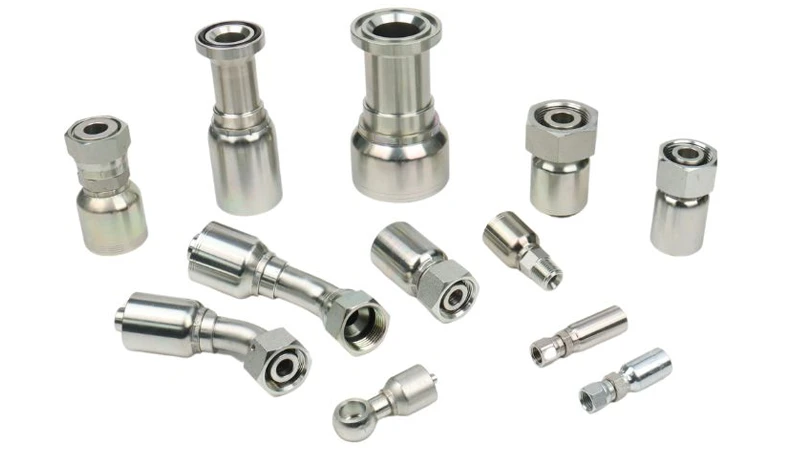
A one-piece fitting, as the name suggests, is manufactured as a single solid component. There is no separate ferrule or socket that needs to be assembled around the hose — the fitting itself is crimped directly onto the hose in one operation. This design eliminates the socket-and-nipple assembly step required by traditional two-piece systems.
One-piece fittings became popular because they simplify inventory management and speed up assembly. A hose shop only needs to stock one part number per size and hose type, rather than managing separate ferrules and nipples, or dealing with skiving (the process of removing the outer rubber cover before crimping).
Key characteristics:
- Single-component design, no skiving required in most cases
- Faster assembly time
- Fewer SKUs to manage in inventory
- Often more cost-effective for high-volume, standardized production
- Widely compatible with SAE 100R and EN 857 hose standards
What Are Crimped (Two-Piece) Hydraulic Hose Fittings?
Crimped, or two-piece, fittings consist of two separate components: a ferrule (the outer sleeve) and a nipple (the inner stem that fits inside the hose). During assembly, the hose is often skived to remove the outer cover, the nipple is inserted, and the ferrule is then crimped over the hose and nipple to create the seal.
This two-piece approach has been the industry standard for decades and remains dominant in heavy-duty, high-pressure, and custom hydraulic applications, particularly in industries like construction equipment, agriculture, and mining.
Key characteristics:
- Modular design — ferrule and nipple can be mixed and matched for different hose types
- Proven reliability across decades of industrial use
- Often preferred for high-pressure or large-bore hose assemblies
- Greater flexibility for custom or low-volume configurations
- Requires more inventory (separate ferrules and nipples)
One-Piece vs. Crimped Fittings: Side-by-Side Comparison
| Factor | One-Piece Fittings | Crimped (Two-Piece) Fittings |
|---|---|---|
| Assembly speed | Faster, fewer steps | Slower, requires skiving and stem insertion |
| Inventory complexity | Lower — single SKU per size | Higher — separate ferrules and nipples |
| Flexibility for custom hose types | Limited | High — mix-and-match components |
| Cost per unit | Generally lower at scale | Can be higher due to component count |
| Pressure rating range | Good for standard to mid-high pressure | Excellent, including very high-pressure applications |
| Industry standard status | Growing adoption | Long-established, widely trusted |
| Best suited for | Mass production, standardized hose assembly lines | Heavy machinery, custom builds, high-pressure systems |
Advantages and Disadvantages
One-Piece Fittings: Pros and Cons
Pros:
- Reduces labor time on the assembly line, which lowers per-unit production cost
- Simplifies procurement and warehouse management
- Consistent crimp quality since there’s no separate nipple to align
- Ideal for manufacturers running high-volume, repeatable hose assembly programs
Cons:
- Less flexibility if a customer needs a nonstandard hose-to-fitting combination
- Not always available in every size or pressure class
- If the fitting fails, the entire unit must be replaced (no swapping individual components)
Crimped Fittings: Pros and Cons
Pros:
- Decades of field-proven performance across nearly every hydraulic application
- Broad compatibility — ferrules and nipples can be paired to match specific hose constructions
- Typically rated for the highest pressure classes, including four-spiral and six-spiral wire hoses
- Easier to source replacement components individually in some markets
Cons:
- Requires skilled labor and proper skiving equipment
- More SKUs to manage across ferrule and nipple combinations
- Slightly longer assembly time per unit
Which Fitting Type Should You Choose?
The right choice really depends on your application, production volume, and pressure requirements.
Choose one-piece fittings if:
- You run a high-volume hose assembly operation and want to reduce labor costs
- You work with standard SAE or EN hose sizes that don’t require custom configurations
- You want simplified inventory and faster turnaround for customers
Choose crimped fittings if:
- Your application involves very high pressure, large-bore hoses, or spiral-wire reinforcement
- You need flexibility to mix different ferrules and nipples for custom builds
- You’re serving industries like construction, mining, or agriculture where component-level serviceability matters
In many hose assembly shops, both fitting types coexist on the same production floor, selected on a job-by-job basis depending on the hose type, pressure rating, and customer specification.
Quality Considerations Beyond Fitting Type
Regardless of which fitting style you choose, a reliable hydraulic hose assembly depends on more than the fitting design alone. A few factors matter just as much:
- Correct crimp diameter — Using the manufacturer’s crimp specification chart for each hose-fitting combination prevents over- or under-crimping, both of which can cause leaks or blowouts.
- Material and plating quality — Fittings should use certified carbon steel or stainless steel with proper zinc or zinc-nickel plating for corrosion resistance.
- Hose and fitting compatibility — Mismatched hose and fitting standards (for example, mixing SAE and DIN specifications) is one of the most common causes of premature failure.
- Testing and traceability — Reputable manufacturers pressure-test finished assemblies and can provide batch traceability for quality assurance.
Sourcing Reliable Fittings from a Trusted Manufacturer
Whether your operation relies on one-piece fittings for speed and efficiency, or crimped fittings for high-pressure versatility, the quality of the fitting itself is what ultimately determines the reliability of the finished hose assembly. Working with a manufacturer that produces both fitting types — and can advise on the right choice for your specific hose and application — helps avoid compatibility issues and reduces the risk of field failures.
At Kingdaflex, we manufacture a full range of one-piece and crimped hydraulic hose fittings compatible with SAE, EN, and DIN standards, alongside our hydraulic hose product lines. Our team can help you match the right fitting to your hose type, pressure requirements, and production volume, whether you’re placing a one-time order or setting up a long-term supply partnership.
FAQs
Are one-piece fittings as strong as crimped fittings?
For most standard and mid-pressure applications, one-piece fittings offer comparable strength and reliability. For very high-pressure or large-bore spiral hoses, crimped (two-piece) fittings are often still the preferred choice.
Can one-piece and crimped fittings be used on the same hose?
It depends on the hose construction and the fitting manufacturer’s specifications. Always check compatibility charts before mixing fitting types on a given hose.
Do one-piece fittings require skiving?
Most one-piece fittings are designed to be crimped without skiving, which is one of their main time-saving advantages over traditional two-piece systems.
Which fitting type is more cost-effective?
One-piece fittings often reduce overall assembly cost at scale due to lower labor and inventory requirements, though the per-piece fitting cost can vary by supplier and hose size.