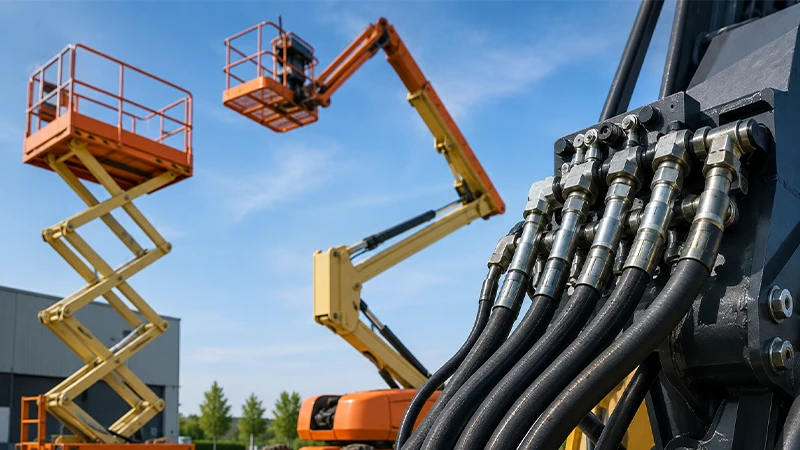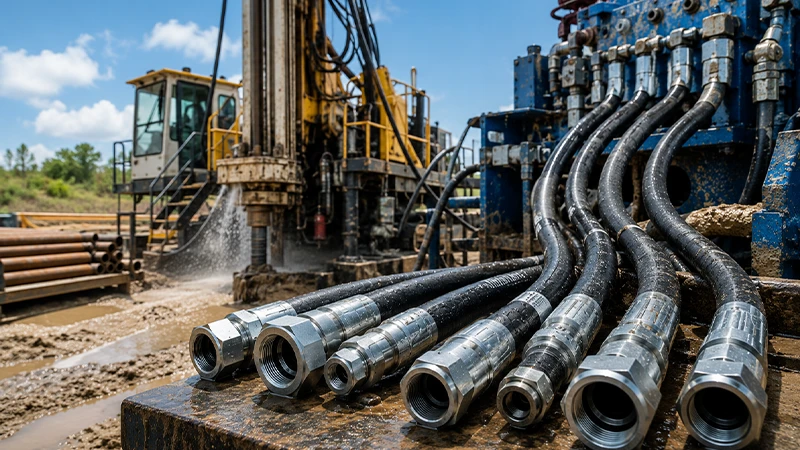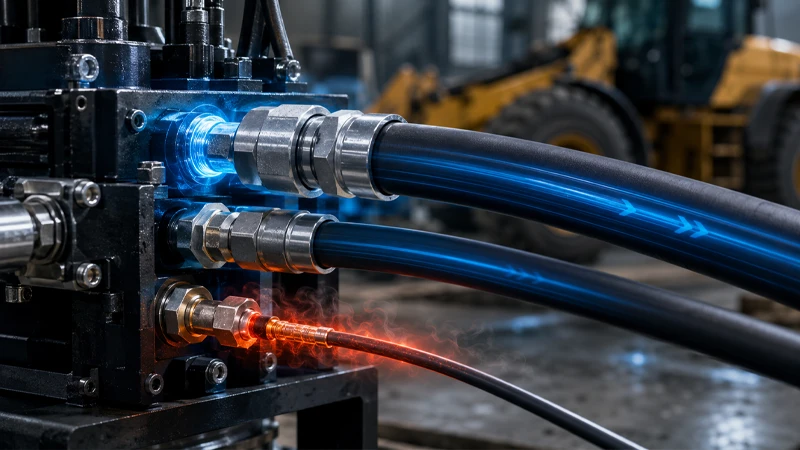
In mining and construction, hydraulic hoses rarely fail in clean, controlled conditions. They fail in dust, mud, vibration, impact zones, and high-temperature areas where hoses are constantly moving against steel structures, other hoses, and abrasive debris.
That is why hydraulic hose protection should not be treated as a small accessory choice. In many machines, it is part of the reliability strategy, the maintenance strategy, and the safety strategy at the same time.
Gates notes that the hose cover protects the tube and reinforcement from external factors such as abrasion and heat, while Parker describes hose guards and sleeves as products designed to reduce damage from abrasion and extreme heat and to help extend hose life.
For buyers in mining and construction, the real question is not whether a hose can survive its rated pressure on paper. The real question is whether the hose assembly can survive the actual work environment. A hose mounted near a boom pivot, routed across a sharp bracket, or exposed to hot engine components may wear out long before its theoretical service life.
On mobile equipment, repeated articulation and vibration only accelerate the problem. That is why hose protection decisions should be based on failure mode, machine layout, and duty cycle rather than on price alone.
Why hydraulic hoses fail faster in harsh field equipment
The first and most common problem is abrasion. In the field, hoses often rub against machine frames, clamps, guards, metal edges, and neighboring hoses. Over time, the outer cover wears down. Once the cover is damaged, the hose becomes more vulnerable to environmental attack and mechanical stress. Gates’ safety guidance specifically advises routing hose to avoid rubbing and abrasion, and notes that clamps, guides, and protective sleeves can help prevent unnecessary assembly failures.
The second major issue is heat. Construction and mining machines frequently route hoses through engine compartments, around hydraulic power units, or close to exhaust-related hot zones. Even when the hose itself is correctly selected, nearby radiant heat, hot splash, or repeated exposure to elevated temperature can shorten hose life and harden or degrade the outer cover. Parker’s product literature presents firesleeve and related hose protection solutions specifically for high-temperature conditions, while Gates also positions protective materials for exposure to heat and hot components.
The third issue is safety during failure. A leaking or ruptured hose is not only a maintenance event. In a high-pressure hydraulic system, a hose failure can spray fluid, contaminate components, stop equipment operation, and create danger around the machine. Gates states that hose routing must not create an injury hazard or damage the hose, which is an important reminder that protection and routing are inseparable.
What hydraulic hose protection is really meant to do
Many buyers think of hose protection as something added only after problems appear. In practice, good protection is preventive. It helps preserve the outer cover, reduce localized wear, support safer routing, and in many cases lower the frequency of emergency hose replacement. Parker’s hose protection shields are described as extending hose life by protecting against abrasion when hoses rub against other hoses, metal, or concrete. That language matches what maintenance teams see in the field every day.
Just as important, not every risk needs the same solution. A hose that suffers light rubbing in a bundle does not need the same protection as a hose located beside an exhaust path or near an operator area in a high-pressure circuit. Abrasion sleeves, spiral wrap, fire sleeves, and burst-protection solutions all solve different problems. Choosing the wrong one can leave the actual failure point unprotected, even though the assembly appears “covered.”
Abrasion protection: where most service-life gains begin
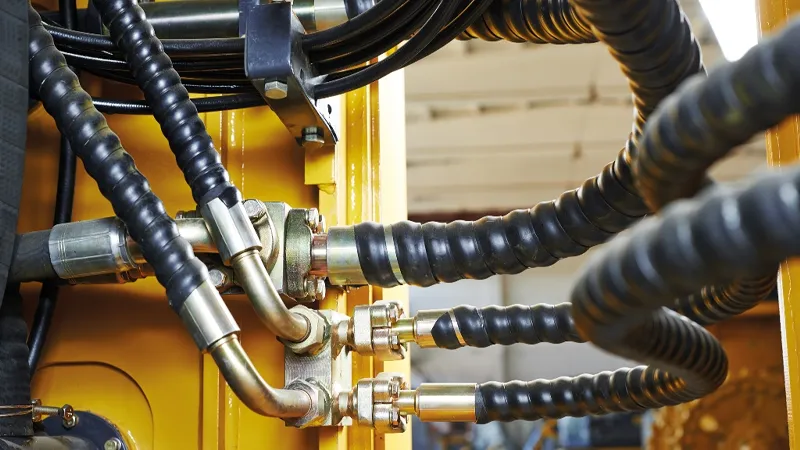
For many mining and construction applications, abrasion protection is the first upgrade that delivers visible results. Nylon sleeves and textile sleeves are often a good solution where hoses rub against each other or against machine structure in moderate-duty areas. They are especially useful in bundled hose runs and in applications where flexibility still matters.
Spiral wrap is often more practical in articulated zones or on mobile equipment with repeated hose movement. It can protect several lines together, gives flexible coverage, and works well when the risk is distributed along part of the hose run rather than at one single point. Parker’s Partek Wrap is specifically presented as a lightweight, flexible nylon solution for added abrasion resistance or bundling of multiple hoses or cables, which fits many mobile-equipment layouts.
For severe mining environments, buyers may need heavier-duty protection. Parker also markets Partek Sleeve as a nylon hose sleeve for abrasion resistance and offers protection shields for hose contact with hose, metal, and concrete. That matters in mines and quarries, where hoses may face rock contact, dragging, repeated impact, or severe contamination. The best choice depends on whether the wear is localized, continuous, or caused by machine articulation.
A common mistake is to choose protection based only on catalog appearance. The better method is to inspect where the hose actually moves, where it touches other surfaces, and whether the wear happens at the midpoint, near a clamp, or close to the fitting. Protection works best when it is placed where contact truly occurs.
Heat and flame protection: essential in selected machine zones
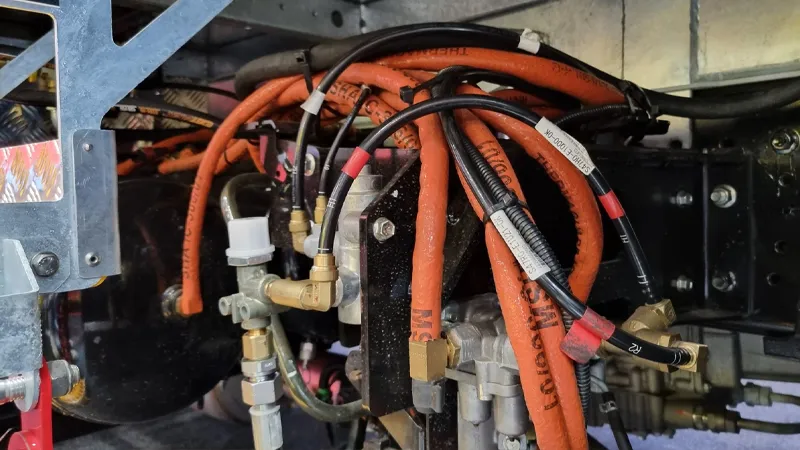
Heat protection becomes critical when hoses pass close to hot engines, turbo areas, exhaust lines, steel processing equipment, or other sources of radiant heat and hot splash. In those locations, a standard outer cover may not be enough to provide durable protection over time. Parker describes firesleeve as a flame-resistant braided fiberglass sleeve with a silicone outer layer intended to help protect users and hydraulic hoses in harsh heat conditions. Gates likewise recommends sleeves made from temperature-resistant material when hoses are near hot components.
The practical value of a fire sleeve is not that it replaces correct hose selection. It is that it adds a protective barrier where real thermal exposure exists. In road construction, for example, paving environments and engine compartments can expose hoses to more heat than general industrial service. In mining, heat may combine with dust and vibration, making protection even more important.
However, buyers should remember that protecting only the hose body is sometimes not enough. Ends, fittings, nearby clamps, and exposed transition points may remain vulnerable. The whole route should be evaluated, not only the middle section of the hose.
Burst containment and operator safety
In high-pressure systems, protection is also a safety issue. MSHA guidance for mines states that safety chains or suitable locking devices are required at certain high-pressure hose connections where a failure would create a hazard, including specific thresholds for hose inside diameter and pressure. That reinforces an important point: connection failure and hose failure are treated as real safety risks in mining operations, not merely as maintenance inconveniences.
Burst-protection sleeves can help reduce the consequences of certain failures by helping manage fluid spray and adding a level of protection in sensitive zones. They are especially relevant where high-pressure lines are routed near operators, walkways, service points, or critical components. But no sleeve should be viewed as a substitute for correct assembly design. Safe routing, proper restraint, suitable clamps, and hose-fittings compatibility remain fundamental. Gates’ routing guidance makes that clear: assemblies should not be installed in ways that create injury hazards or expose the hose to unnecessary damage.
The installation mistakes that erase the value of protection
Even a good sleeve can fail to deliver results when the assembly is poorly installed. One frequent problem is protecting the wrong section. If the actual wear point is at the bend radius near the fitting or at a clamp entry point, covering only the center of the hose does little. Another issue is twist. A protected hose that is twisted, over-bent, or stretched during machine movement can still fail early. Gates’ maintenance and safety guidance repeatedly emphasizes routing, support, and clamp use because these are often the real root causes behind premature failure.
Another mistake is using one protection product for every application. Mining shovels, compact excavators, loaders, drilling rigs, and crushers do not all expose hoses to the same hazards. Some machine zones demand abrasion resistance. Others need thermal shielding. Others require stronger attention to spray control and operator safety. Matching the protection type to the actual hazard is what creates value.
Conclusion
For mining and construction equipment, hydraulic hose protection should be treated as part of machine design and maintenance planning, not as an afterthought added after repeated failures. The right protection choice can reduce cover wear, help manage heat exposure, improve safety around high-pressure lines, and lower unplanned downtime. The most effective approach is simple: identify the real hazard first, then match the hose protection solution to that hazard. That is how buyers move from reactive hose replacement to longer service life and more reliable machine performance.