Hydraulic hoses are not just flexible tubes that transport fluid under pressure. In industrial environments, they are engineered components that must comply with specific international standards to ensure safety, durability, and compatibility. For B2B buyers such as equipment manufacturers, private-label brands, and industrial distributors, understanding hydraulic hose standards is critical to making correct sourcing decisions.
Among the most referenced standards globally are SAE, EN, and ISO. While these standards may appear similar at first glance, they differ in testing requirements, pressure ratings, dimensional tolerances, and regional application preferences. Misunderstanding these differences can lead to compliance issues, equipment failures, or rejected shipments.
In this guide, we break down SAE vs EN vs ISO hydraulic hose standards in practical terms, helping you understand what matters most when selecting a manufacturing partner.
What Are Hydraulic Hose Standards?
Hydraulic hose standards define the minimum technical requirements for hose construction, performance, and testing. These standards specify factors such as working pressure, burst pressure, bend radius, temperature resistance, reinforcement structure, and dimensional tolerances.
For manufacturers, standards provide a technical framework to ensure product consistency. For OEM buyers and distributors, they offer a reliable reference for quality comparison and regulatory compliance.
Standards typically include:
- Reinforcement type (braided or spiral wire)
- Pressure classification
- Impulse cycle requirements
- Oil and temperature compatibility
- Testing procedures
Importantly, standards do not represent a single global system. Instead, they are developed by different organizations and adopted across various regions. The three most influential systems in hydraulic hose manufacturing are SAE (primarily North America), EN (Europe), and ISO (international harmonization).
Understanding how these systems align—or differ—directly impacts product specification and sourcing decisions.
Overview of SAE Hydraulic Hose Standards
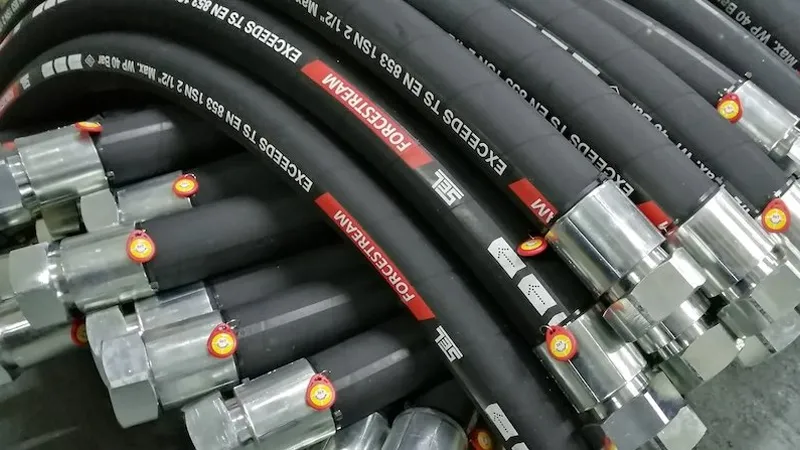
SAE standards are issued by the Society of Automotive Engineers (SAE International) and are widely used in North America and many global export markets. The most referenced document for hydraulic hoses is SAE J517, which covers common series such as 100R1, 100R2, 100R9, 100R12, and 100R13.
SAE standards categorize hoses mainly by reinforcement type and pressure capability. For example:
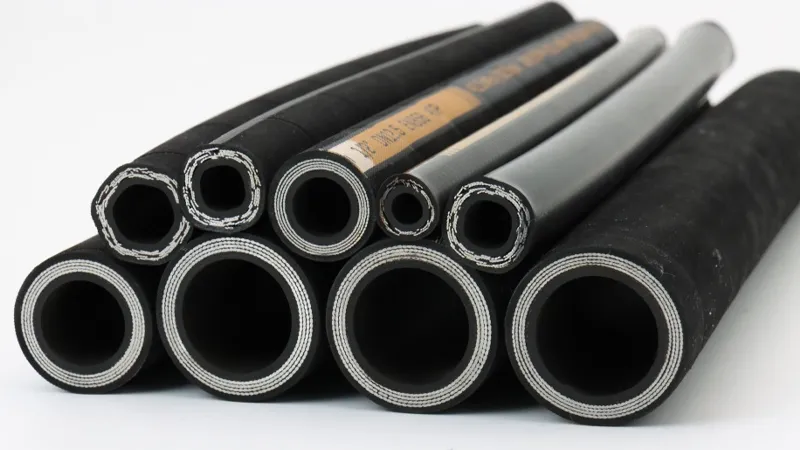
- SAE 100R1: Single wire braid
- SAE 100R2: Double wire braid
- SAE 100R9 / R12: Spiral wire reinforcement
One of the key features of SAE standards is the clearly defined relationship between working pressure and burst pressure (typically a 4:1 safety factor). SAE also specifies impulse testing cycles, which simulate real-world pressure fluctuations.
SAE hoses are widely used in construction machinery, agricultural equipment, mining machinery, and industrial hydraulic systems across the United States and Canada.
For B2B buyers targeting the North American market, compliance with SAE standards is often a baseline requirement. Many OEM technical drawings explicitly reference SAE part numbers, making it critical for manufacturers to produce hoses that strictly meet dimensional and pressure tolerances.
Overview of EN Hydraulic Hose Standards
EN standards are developed under the European Committee for Standardization and are commonly referenced throughout the European Union and surrounding regions. Typical hydraulic hose standards fall under EN 853, EN 854, EN 856, and EN 857.
Unlike SAE, EN standards often classify hoses by structural design and performance testing methods with slightly different dimensional tolerances. For example:
- EN 853 1SN / 2SN: Comparable to SAE 100R1 / 100R2
- EN 856 4SP / 4SH: High-pressure spiral hoses
While many EN and SAE hoses appear interchangeable, differences may exist in outer diameter tolerances, impulse test cycles, and cover thickness requirements.
In European markets, CE compliance and alignment with EN standards are frequently mandatory for machinery manufacturers. Therefore, distributors and OEMs supplying into Europe must ensure that their hydraulic hose supplier can certify products according to relevant EN specifications.
For manufacturers exporting globally, producing hoses that simultaneously meet both SAE and EN parameters can provide a significant competitive advantage.
Overview of ISO Hydraulic Hose Standards
ISO standards are developed by the International Organization for Standardization and aim to harmonize technical specifications across different countries. In hydraulic hose manufacturing, ISO 1436 and ISO 3862 are among the most referenced standards.
ISO standards often mirror technical aspects of both SAE and EN systems but focus more on unified testing methodologies and global consistency. For multinational OEMs operating across multiple regions, ISO standards simplify cross-border procurement.
For example:
- ISO 1436 Type 1SN corresponds closely to EN 853 1SN
- ISO 3862 Type R12 aligns with high-pressure spiral hose classifications
ISO standards are particularly relevant in international tenders, large-scale infrastructure projects, and multinational supply contracts.
While ISO is considered globally recognized, many markets still prioritize SAE or EN depending on regulatory tradition. Therefore, manufacturers serving global B2B clients often produce hoses tested under multiple standards to ensure maximum compatibility.
Key Differences: SAE vs EN vs ISO
Although these standards overlap significantly, several technical differences should be considered:
- Dimensional Tolerances
EN standards may specify slightly different outer diameter tolerances compared to SAE. - Impulse Testing Requirements
Impulse cycle counts and test conditions can vary, affecting long-term fatigue performance. - Marking and Identification
SAE and EN may require different labeling formats on the hose cover. - Regional Acceptance
SAE is dominant in North America, EN in Europe, and ISO is internationally recognized but not always legally mandatory. - Application Preference
Some OEM technical drawings specify only one system, meaning substitution may not be acceptable without engineering approval.
For B2B buyers, the most important factor is not which standard is “better,” but which standard aligns with the end-use market and equipment requirements.
How B2B Buyers Should Choose the Right Standard
When sourcing hydraulic hoses as a brand owner, distributor, or equipment manufacturer, standard selection should be guided by three factors:
- Target Market
If your primary market is the U.S. or Canada, SAE compliance is typically expected. For the EU, EN standards are essential. - OEM Technical Drawings
Always follow the hose specification referenced in the machinery design documentation. - Regulatory Requirements
Some government tenders and infrastructure projects explicitly require ISO-certified products.
From a manufacturing standpoint, partnering with a supplier capable of testing hoses according to multiple standards reduces risk. It also allows you to consolidate sourcing under one supplier while serving multiple geographic markets.
Why Manufacturing Capability Matters More Than Labels
Standards define minimum requirements—but consistent performance depends on manufacturing control.
Key production factors include:
- Rubber compound formulation
- Wire reinforcement quality
- Braiding or spiral precision
- Vulcanization temperature control
- Impulse testing validation
Two hoses labeled under the same standard may perform differently if manufacturing quality varies.
For B2B buyers, evaluating a hydraulic hose supplier should include reviewing in-house testing equipment, quality control procedures, and batch traceability systems—not just checking standard markings printed on the hose cover.
Conclusion
Understanding the differences between SAE, EN, and ISO hydraulic hose standards helps B2B buyers reduce risk, ensure compliance, and improve product reliability.
SAE dominates North America. EN governs much of Europe. ISO supports global harmonization. While technical overlap exists, small differences in tolerance and testing can significantly impact equipment compatibility.
For distributors, OEMs, and private-label brands, the safest strategy is to work with a manufacturer capable of producing and testing hoses according to multiple international standards.
Clear communication of end-use requirements, operating pressure, and regional regulations will ensure that the selected hydraulic hose not only meets the standard—but performs reliably in real-world conditions.