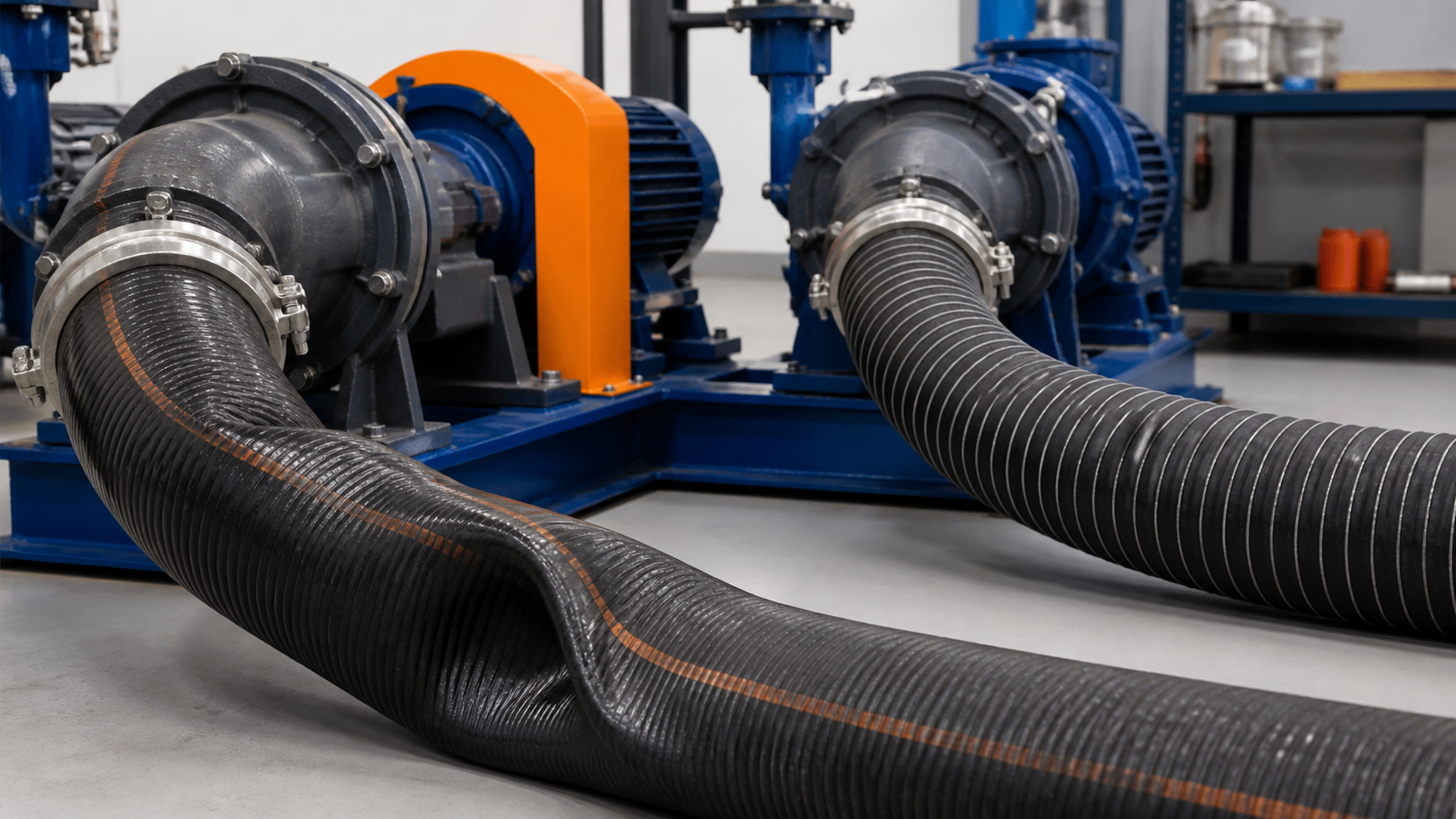
A suction hose does not need to leak to stop a transfer system. Under vacuum, atmospheric pressure pushes inward. If the tube, reinforcement, and helix cannot resist—or heat, bending, blockage, or damage weakens them—the hose can flatten, kink, or delaminate.
Understanding why suction hoses collapse under vacuum helps operators distinguish a hose-selection problem from a system problem. The correct solution may involve a stronger hose, but it may also require a larger bore, shorter route, cleaner strainer, lower temperature, or better pump inlet design.
Pressure Hose vs Suction Hose
Positive-pressure hose is designed mainly to contain force pushing outward. Suction service applies force inward because pressure inside the hose is below surrounding atmospheric pressure. Reinforcement that handles discharge pressure does not automatically prevent vacuum collapse.
A purpose-designed suction hose normally uses a helix, suitable reinforcement, and a wall designed to retain shape. Confirm its vacuum capability for the actual size, temperature, and bend condition.
Common Collapse Mechanisms
| Cause | What happens | Typical sign |
|---|---|---|
| Wrong hose construction | Wall lacks vacuum support | Uniform flattening |
| Excessive vacuum | Pump pulls beyond hose rating | Collapse near pump or restriction |
| Tight bend | Cross-section becomes oval | Local kink at bend |
| High temperature | Materials soften | Collapse after warming |
| Blocked inlet/strainer | Vacuum rises sharply | Intermittent collapse and low flow |
| Undersized hose | High loss at required flow | Noise, cavitation, poor output |
| Liner delamination | Tube separates and obstructs bore | External hose may look normal |
| Damaged helix | Local support is lost | Repeated flat spot |
Several causes often act together. A marginal hose may work when straight and cool but collapse after being bent tightly beside a hot pump.
1. The Hose Is Not Rated for Vacuum
The most direct cause is using a discharge-only or general-purpose hose on the suction side. Working-pressure markings describe internal pressure capability; they do not prove full-vacuum performance.
Check the manufacturer’s vacuum rating for the exact series and size. Ratings may use full vacuum, percentage vacuum, absolute pressure, or a gauge value, so confirm units and reference conditions.
For equipment that needs both loading and unloading through one line, select a suction and discharge hose designed for both directions of pressure. Confirm coupling retention in both modes.
2. The Pump Creates More Vacuum Than Expected
A pump does not pull a fixed vacuum under all conditions. Inlet pressure changes with flow, fluid viscosity, hose length, elevation, fittings, strainers, valves, tank venting, and blockage.
As resistance increases, pressure at the pump inlet falls. The hose may collapse before the pump’s nominal limit is reached. Transient vacuum can be especially severe when a valve opens rapidly, a tank empties, product thickens, or a suction nozzle becomes blocked.
Measure pressure near the pump inlet during actual operation, including startup and worst-case flow. A gauge located elsewhere may not reveal the lowest local pressure.
3. The Hose Bore Is Too Small
An undersized hose creates higher velocity and friction loss. The pump must operate at a lower inlet pressure to maintain flow, increasing collapse and cavitation risk.
Sizing should consider fluid viscosity, density, temperature, required flow, total length, elevation, and every fitting or valve. Long routes and multiple elbows can make a nominally adequate bore perform poorly.
Increasing diameter may reduce pressure loss substantially. Use a process calculation rather than simply matching the pump port.
4. Bend Radius Is Too Tight
Bending makes a circular hose cross-section oval. As the bend tightens, the inner wall compresses and the outer wall stretches. Under vacuum, the already distorted section becomes the easiest place to collapse.
Maintain at least the specified minimum bend radius and allow extra margin for hot, dynamic, or high-vacuum service. Start bends away from the coupling, because bending directly behind the ferrule adds concentrated stress.
Use elbows or routing changes when space forces a sharp turn. Never clamp the hose into a smaller envelope.
5. Temperature Softens the Hose
Tube, cover, and reinforcement materials can lose stiffness as temperature rises. A hose that resists vacuum with cold water may collapse when transferring hot oil or cleaning solution.
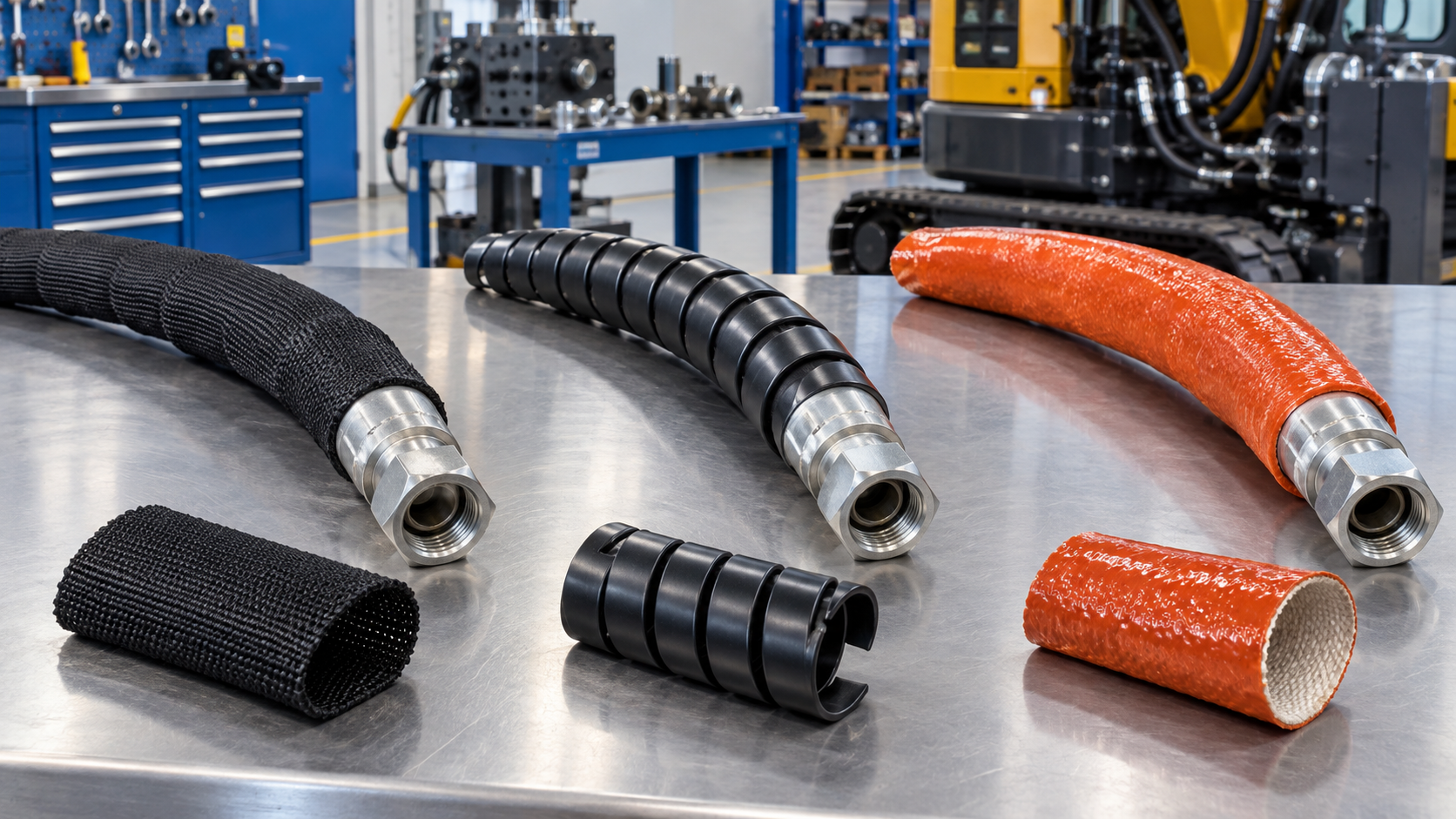
Confirm whether the published vacuum rating applies across the required temperature range. Include ambient heat, radiant sources, recirculation, and cleaning cycles. Insulation may protect from external heat but can also trap heat generated by the fluid.
A rubber suction hose should be selected by compound and construction, not by material family alone. Formulations vary in heat resistance, stiffness, flexibility, and chemical compatibility.
6. The Fluid Is Too Viscous or Too Cold
Viscous fluid creates greater inlet loss. Many oils, syrups, slurries, and waste products thicken as temperature falls. A system commissioned in summer may struggle in winter even though the hardware has not changed.
Check viscosity at minimum startup temperature, not only at normal operating temperature. Options may include a larger or shorter suction hose, lower startup flow, controlled preheating, fewer restrictions, or a pump designed for the fluid.
Never heat a product or hose without reviewing chemical, fire, pressure, and material limits.
7. A Strainer, Valve, or Tank Vent Is Restricted
A clogged suction strainer or partially closed valve increases vacuum downstream. A blocked tank vent can also create vacuum in the source vessel as liquid leaves.
Inspect strainers, valves, quick couplings, and screens for sediment, frozen material, or foreign objects. Confirm that valves are fully open and correctly sized.
If the hose collapses progressively during unloading, examine tank venting and falling liquid level. If it collapses suddenly, investigate intermittent blockage or rapid valve action.
8. The Inner Liner Has Delaminated
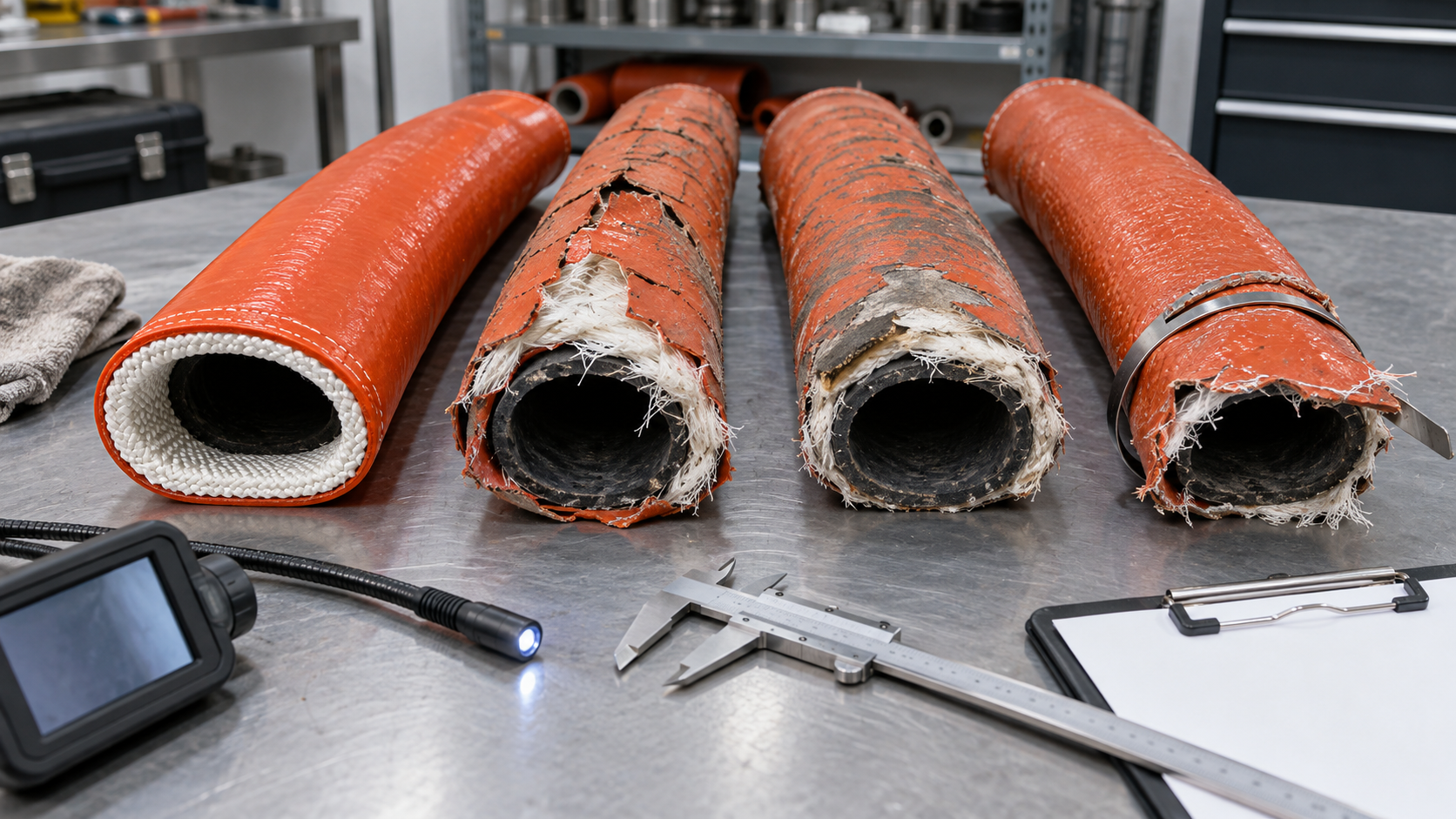
Chemical attack, excessive heat, vacuum, poor assembly, or aging can cause the liner to separate from reinforcement. Vacuum may pull the loose liner inward and block flow while the outer cover remains round.
Warning signs include reduced flow without an obvious external kink, soft spots, blistering, unusual noise, debris in the transferred product, or a hose that recovers after the pump stops.
Remove the hose, make it safe, and inspect the bore with suitable lighting or a borescope. A delaminated hose should be quarantined; external reinforcement does not restore the internal flow path.
9. The Helix Is Damaged
Crushing, vehicle traffic, tight storage, severe bending, dragging, or incorrect coupling installation can deform or break the helix. The affected section loses radial support and becomes a repeat collapse point.
Inspect for flat areas, uneven pitch, protrusions, local softness, rust staining, and permanent kinks. Do not attempt to reshape a severely damaged hose and return it to critical service. Internal damage may remain even when the hose looks round again.
10. The Hose Is Too Long or Poorly Supported
Every extra meter adds friction loss, and unsupported weight can pull the hose into a tighter bend. Loops may trap product, while hanging sections load the couplings.
Use the shortest practical route with smooth changes. Support the natural curve without crushing the cover, and avoid excess length that creates low points or abrasion.
Understand the functional suction vs discharge hose differences when planning the route. The suction side is especially sensitive to restrictions and deformation.
Diagnose the System Before Replacing the Hose
When collapse occurs, record:
- fluid and actual temperature;
- flow rate and pump speed;
- inlet pressure or vacuum over time;
- tank level and vent status;
- hose part number, size, length, age, and rating;
- bend locations and support points;
- valve and strainer condition;
- collapse location and whether it recovers;
- recent changes in fluid, equipment, or cleaning.
Stop the pump before approaching a severely collapsed assembly. Isolate and depressurize the system according to site procedure. Do not place hands near a hose that may suddenly recover or release trapped product.
Prevention Checklist
- Select a hose with an explicit vacuum rating for the application.
- Verify rating at the required temperature and bend radius.
- Size the bore using real flow, viscosity, length, and fittings.
- Keep suction routes short and smooth.
- Maintain minimum bend radius near couplings and clamps.
- Inspect and clean strainers, valves, and tank vents.
- Protect the hose from crushing, abrasion, and heat.
- Verify chemical compatibility of the tube and cleaning media.
- Monitor pump inlet pressure under worst-case operation.
- Replace hose showing delamination, helix damage, or permanent deformation.
Final Troubleshooting Principle
Suction hose collapse is a pressure-balance and structural-support problem. The visible flat spot may be the weakest point, but the root cause can be excessive system restriction, poor sizing, heat, viscosity, tight routing, damage, or unsuitable construction.
Diagnose the entire inlet system, then select and install a hose for the measured worst case. That approach restores flow and prevents the replacement hose from failing in exactly the same way.