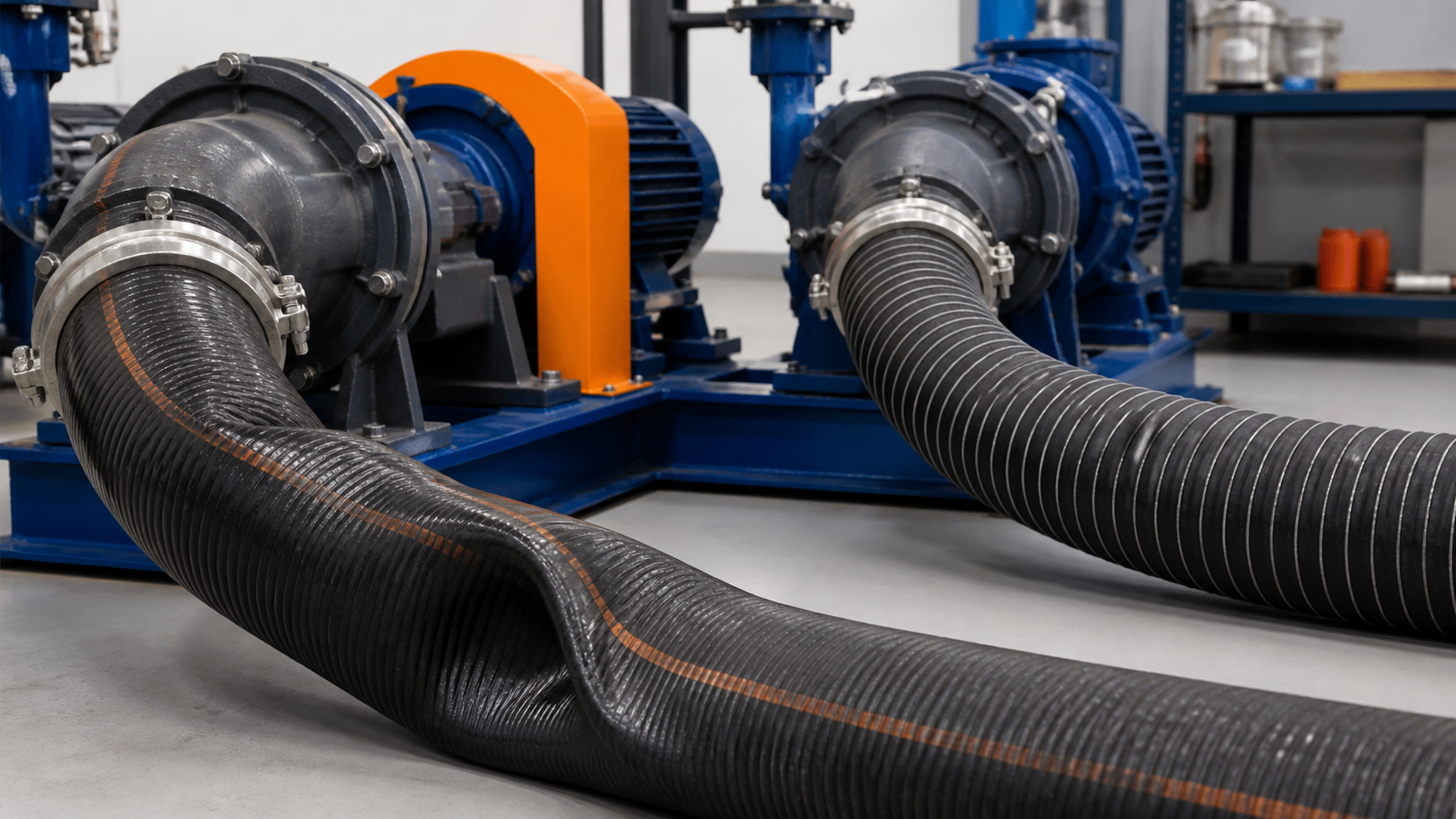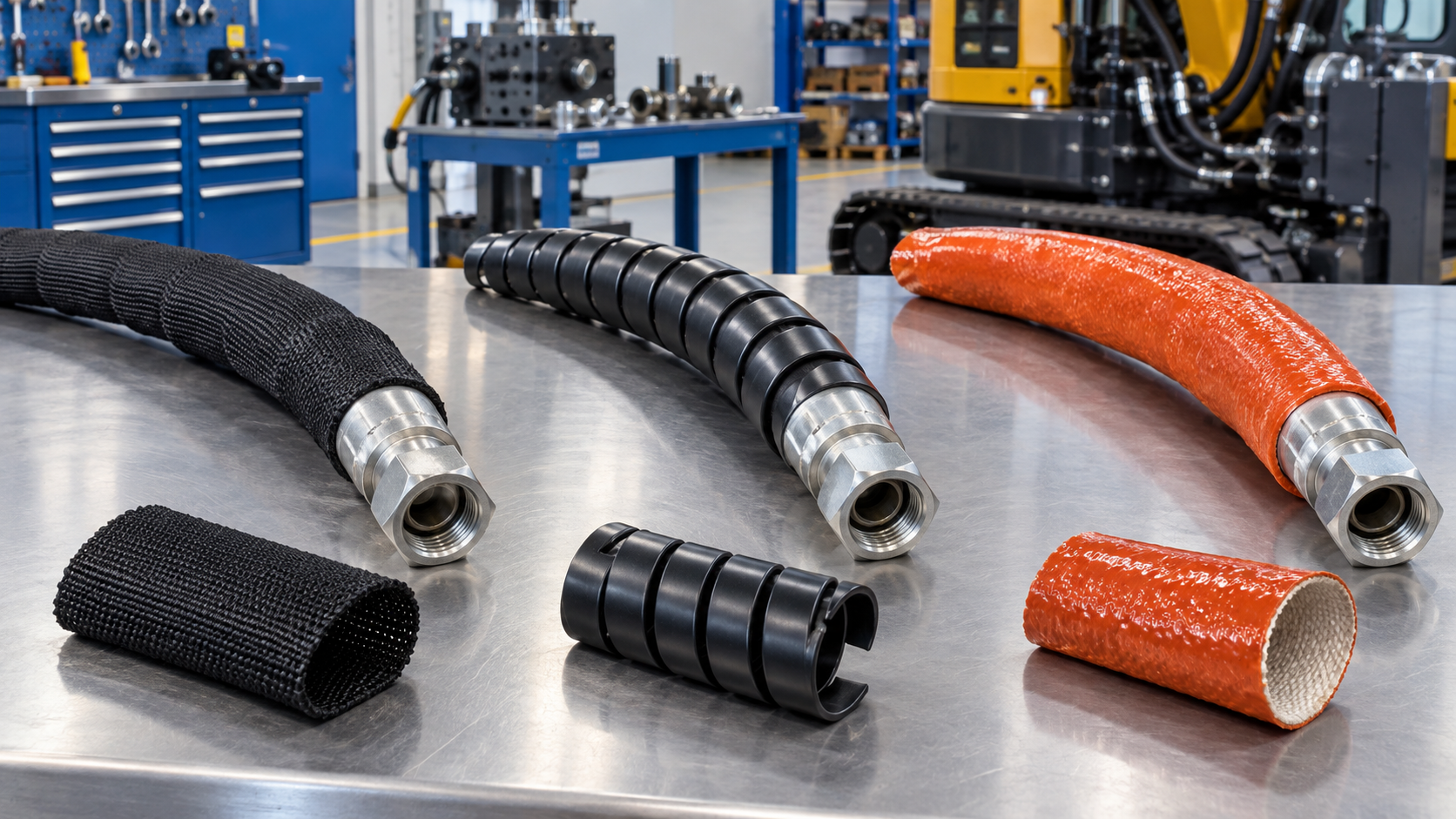
Hydraulic hoses fail for different reasons, so one protective product cannot solve every problem. Nylon sleeve helps manage abrasion and may contain spray after some failures. Spiral guard resists direct rubbing, impact, and crushing at contact points. Fire sleeve protects against heat, flame, and hot splash.
Choosing among nylon sleeve vs spiral guard vs fire sleeve starts with the dominant hazard. Adding the wrong guard can increase bulk, trap heat, restrict movement, or hide damage without addressing the real failure mode.
Quick Selection Matrix
| Hazard or requirement | Nylon sleeve | Spiral guard | Fire sleeve |
|---|---|---|---|
| Hose-to-hose abrasion | Strong choice | Strong choice | Limited unless rated |
| External rubbing on edges | Moderate | Strong | Limited |
| Impact/crushing | Limited | Moderate to strong | Limited |
| Heat and radiant exposure | Limited | Material dependent | Strong choice |
| Flame/molten splash | Not primary purpose | Not primary purpose | Strong choice |
| Bundle organization | Strong | Good | Possible with sizing review |
| Easy spot inspection | Depends on weave | Good between coils | Limited without opening |
| Added flexibility | High | Moderate | Moderate |
| Burst spray management | Product dependent | Low | Not primary purpose |
Ratings vary by product. Confirm test data rather than relying on the category name.
Start with the Failure Mechanism
Inspect failed hoses and record where and how damage begins. Common mechanisms include:
- cover wear from rubbing;
- reinforcement damage at a sharp edge;
- crushing or impact;
- excessive heat or flame;
- hose-to-hose chafing in bundles;
- external chemicals or molten splash;
- bending below minimum radius;
- twisting and poor routing;
- pressure spikes or incompatible fluid.
No sleeve can correct undersizing, twist, chemical incompatibility, excessive pressure, or a route below minimum bend radius. Use hose protection solutions after the root cause is understood.
Nylon Hose Sleeve
A woven nylon hose sleeve is flexible and lightweight. It is commonly used around individual hoses or bundles to reduce hose-to-hose abrasion and protect covers from moderate external wear.
Strengths
- flexible through moving routes;
- suitable for bundling multiple hoses;
- lightweight and relatively compact;
- can reduce chafing between adjacent lines;
- may help diffuse or contain some spray when specifically designed and tested;
- available in tubular or wraparound forms.
Limitations
Nylon is not a substitute for high-temperature fire protection. Its temperature, flame, UV, oil, and chemical performance depend on the exact product. Woven sleeve may snag on sharp edges or trap abrasive particles.
Some constructions are primarily abrasion sleeves; others have defined burst-containment performance. Do not assume all black woven sleeves provide the same safety function.
Best applications
- mobile hydraulic hose bundles;
- articulated equipment;
- hose-to-hose rubbing;
- moderate abrasion where flexibility is important;
- routes requiring compact protection.
Spiral Hose Guard
A spiral hose guard is a helical strip wrapped around a hose or bundle. It forms a sacrificial barrier against external contact.
Strengths
- strong protection at direct rubbing points;
- useful against impact, dragging, and local crushing;
- open spiral allows some visual inspection and drainage;
- can be installed on existing assemblies by wrapping;
- multiple hoses can be grouped while retaining movement.
Limitations
Spiral guard increases outside diameter and can make bundles stiffer. Incorrect pitch or tight installation may restrict flexing. Gaps between coils can expose the hose to small sharp objects, while dirt can collect beneath the guard.
Thermoplastic spiral is not intended for severe flame or molten splash unless specifically rated. It may soften near hot components.
Best applications
- hoses rubbing against structures;
- mining, construction, forestry, and mobile machinery;
- external impact or dragging;
- routes where visible hose gaps aid inspection;
- grouped lines needing a rugged sacrificial guard.
Fire Sleeve
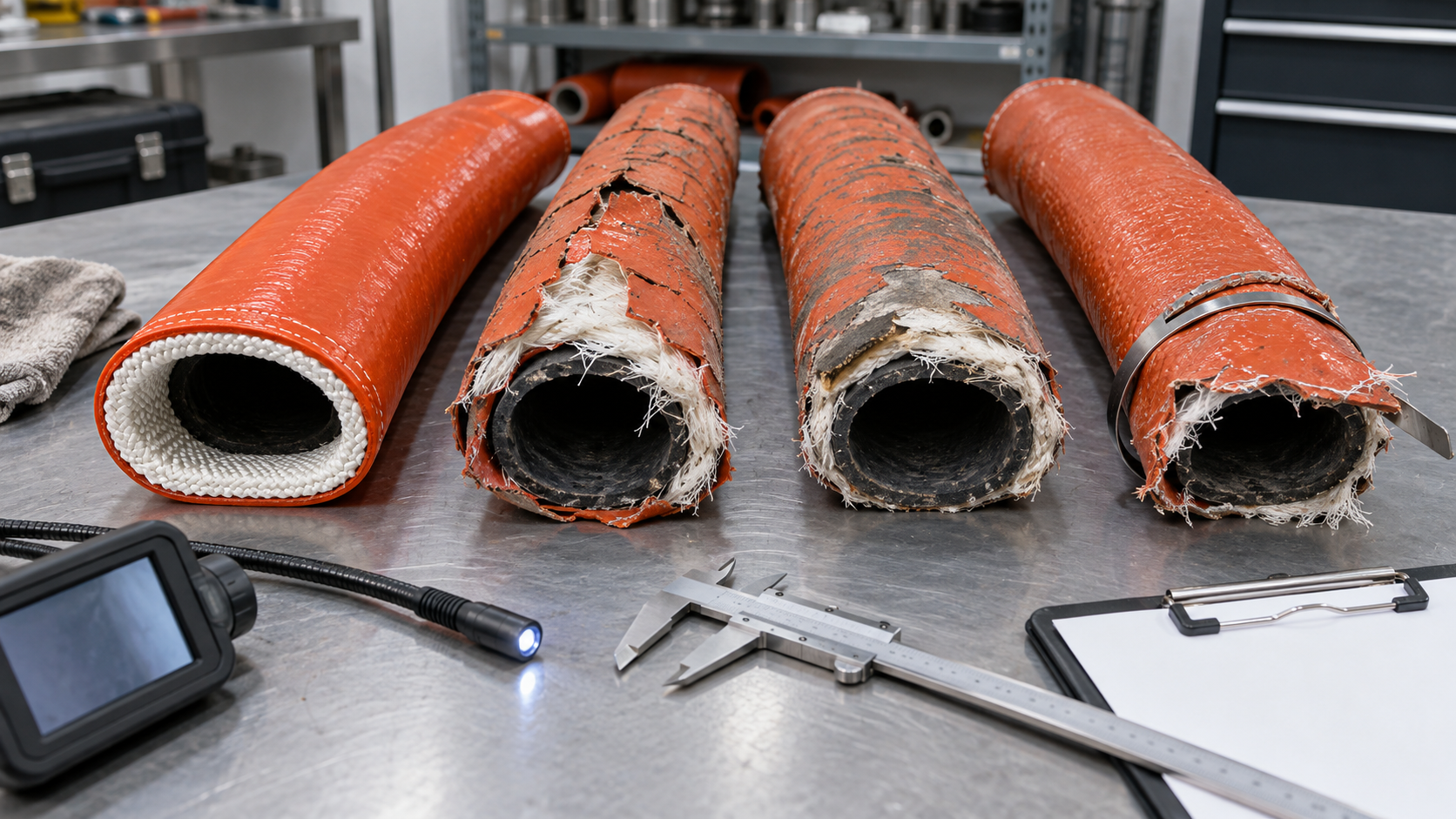
A silicone-coated fiberglass fire sleeve is designed primarily for thermal protection. It helps shield hose from radiant heat, flame exposure, and hot or molten splash, depending on its tested performance.
Strengths
- high-temperature protection;
- resistance to radiant heat and short thermal peaks;
- smooth silicone surface can shed some hot splash;
- helps protect hose cover near furnaces, exhausts, and engines;
- available in tubular and retrofit closure styles.
Limitations
Fire sleeve is bulkier than some abrasion guards and hides the hose cover. It needs correct sizing and end sealing. Severe rubbing can wear through silicone and expose fiberglass. It can also trap heat if placed over a hose already carrying hot fluid.
Best applications
- foundries and steel plants;
- furnace and casting equipment;
- engine compartments and exhaust-adjacent routing;
- welding or hot-process areas;
- hydraulic lines exposed to flame or molten splash.
Compare Abrasion Modes
Hose-to-hose rubbing favors a flexible sleeve that moves with the bundle. Direct rubbing against a bracket may favor thick spiral guard. Heat plus light abrasion may justify fire sleeve with improved routing or an additional compatible outer shield.
Do not layer products automatically. Multiple guards add weight, diameter, stiffness, and heat retention. Confirm that the combined system allows movement and inspection.
Temperature and Environment
List continuous and peak ambient temperature, hose fluid temperature, flame possibility, splash direction, UV, ozone, oil, chemicals, saltwater, and washdown.
Nylon and thermoplastic spiral guard have temperature limits that may be well below those of fire sleeve. Fire sleeve closures, tapes, snaps, and end treatments may have limits below the sleeve body.
Use measured temperatures when possible. Distance from a heat source and airflow can change conditions significantly.
Hose Movement and Bend Radius
Protection must not force the hose below its minimum bend radius or transfer movement into the fitting. Test the route through every machine position.
Nylon sleeve usually follows complex motion easily. Spiral guard adds bending resistance, especially when tightly wrapped or used on bundles. Fire sleeve needs clearance to avoid binding and bunching at bends.
Check for snag points, telescoping, migration, and clamp movement. The guard should not become the mechanism that damages the hose.
Inspection Access
Protective products hide different amounts of cover. Spiral guard leaves gaps but can conceal wear directly beneath its coils. Nylon weave may allow limited visibility. Fire sleeve generally requires opening or moving for detailed inspection.
Define how inspectors will examine critical areas and how often guards must be removed. Do not clamp protection permanently over a known wear point without a monitoring plan.
Installation Considerations
Nylon sleeve
Size by hose or bundle OD and movement. Secure ends without cutting the weave or crushing the hose. Control fraying at cut ends.
Spiral guard
Select internal diameter and pitch for the hose or bundle. Wrap evenly and secure according to instructions. Avoid sharp cut ends.
Fire sleeve
Measure actual hose OD and fitting clearance. Follow the approved installation and end-sealing procedure. Orient split closures away from the most severe exposure where permitted.
When a Combination Makes Sense
Some routes face both heat and abrasion. A carefully engineered combination may be appropriate, such as fire sleeve for thermal protection plus a localized external wear shield at a bracket.
Review temperature, trapped heat, compatibility, bend stiffness, overall diameter, and inspection access. A route change or bracket modification may be better than multiple protective layers.
Procurement Checklist
Provide the supplier with:
- hose sizes, bundle arrangement, and fitting dimensions;
- dominant failure mechanism;
- continuous and peak temperature;
- flame or molten-splash exposure;
- abrasion, impact, and crushing conditions;
- route, bend radius, and movement;
- oil, chemical, UV, and weather exposure;
- inspection and replacement method;
- required test evidence;
- cut lengths, quantity, and end treatments.
Final Selection Principle
Choose nylon sleeve for flexible abrasion protection and bundling, spiral guard for robust contact and impact protection, and fire sleeve for heat, flame, and hot splash. If hazards overlap, prioritize the highest-consequence failure and engineer the combination carefully.
The best protection is not the thickest or most expensive guard. It is the product that addresses the real damage mechanism without creating a new routing, heat, or inspection problem.