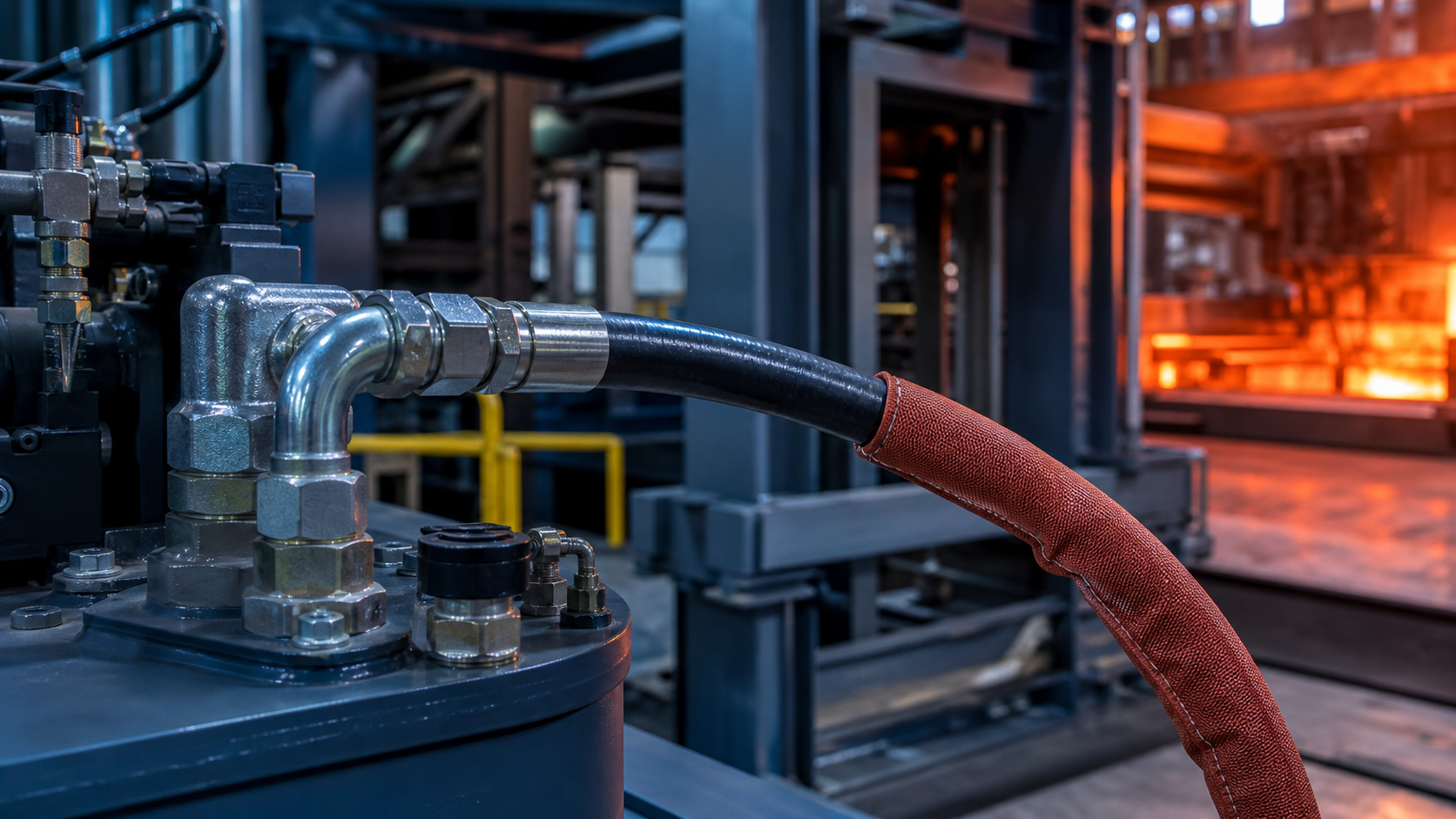
Water-glycol hydraulic fluids are used where mineral oil could create an unacceptable fire risk, including steel mills, foundries, die-casting operations, and furnaces. Their fire-resistant behavior also changes the requirements placed on hoses, seals, and other wetted components.
A hose that performs reliably with petroleum-based hydraulic oil is not automatically suitable for water-glycol service. The fluid contains a significant water phase, glycol, corrosion inhibitors, and other additives. These ingredients can affect the inner tube, reinforcement, fittings, and assembly life in ways that differ from ordinary oil.
Selecting the correct water glycol hydraulic hose compatibility requires more than checking pressure. Buyers and engineers should evaluate the complete fluid formulation, temperature range, hose compound, reinforcement, external environment, and maintenance program.
What Is a Water-Glycol Hydraulic Fluid?
Water-glycol fluids are commonly classified as HFC fire-resistant hydraulic fluids. They are solutions containing water and glycol together with additives for lubrication, corrosion protection, stability, and other performance requirements. The water content helps absorb heat and makes the fluid more difficult to ignite than mineral oil.
The exact formulation varies by supplier and application. Two fluids described as water glycol may contain different additive packages or proportions. Compatibility should therefore be checked against the named fluid and its current technical data, not assumed from the general HFC category alone.
Why Hose Compatibility Is Different from Mineral-Oil Service
The inner tube is continuously exposed to the hydraulic fluid. If the compound is unsuitable, it may swell, soften, shrink, harden, crack, or lose adhesion to the reinforcement. Some changes appear quickly, while others develop over months of temperature cycling and pressure impulses.
Water can also reach exposed reinforcement through a damaged cover or poorly protected hose end. Once moisture contacts steel wire, corrosion can weaken the reinforcement and reduce assembly life. This makes cover condition, end sealing, and storage particularly important in wet or washdown environments.
The correct hydraulic hoses must therefore satisfy both chemical and mechanical requirements. A hose may be chemically compatible but too lightly reinforced for the circuit. It may also have adequate working pressure but use a tube compound that is not approved for the fluid.
Start with the Exact Fluid Information
Before asking a hose supplier for a recommendation, collect the following information:
- Fluid manufacturer and full product name
- Fluid classification, such as HFC
- Water and glycol content where available
- Additive or inhibitor information
- Normal and maximum fluid temperature
- System pressure and pressure spikes
- Duty cycle and impulse frequency
- Hose size and flow rate
- External heat, molten splash, and abrasion exposure
- Cleaning chemicals and washdown practices
The fluid supplier’s compatibility guidance should be reviewed together with the hose manufacturer’s data. If the application is critical or the formulation is unusual, laboratory immersion testing or a controlled field trial may be appropriate.
Inner Tube Material Is the First Decision
Hydraulic hose tubes are manufactured from different elastomers and thermoplastic materials. Their behavior depends on the fluid chemistry, temperature, concentration, and duration of exposure.
General-purpose nitrile-based tubes are widely used with petroleum hydraulic oils, but compatibility with a particular water-glycol fluid should be confirmed rather than assumed. Special elastomer compounds may be formulated for fire-resistant fluids. Thermoplastic or fluoropolymer tubes can provide different chemical and temperature characteristics, but they also have distinct flexibility, permeation, and fitting requirements.
A broad hydraulic hose media compatibility guide is useful for initial screening. It should not replace approval for the specific fluid, concentration, and operating temperature.
Pressure Rating Still Matters
Fire resistance does not reduce the mechanical demands of the circuit. The hose must remain suitable for maximum continuous pressure and transient peaks. Equipment in steel production and metal processing often operates under severe shock, vibration, heat, and repeated movement.
Choose the reinforcement according to pressure and impulse duty. Wire-braided hoses may serve many medium- and high-pressure circuits. Wire-spiral constructions are used where higher pressure, severe impulse loads, or heavy equipment duty requires them.
Use the working-pressure rating for the actual hose size. Do not use burst pressure as the design limit. Larger sizes within the same hose family may have lower working-pressure ratings, so the specification must be checked for the selected bore.
Control the Operating Temperature
Temperature affects both fluid stability and hose life. Excessive heat can accelerate chemical attack, hardening, swelling, and loss of tube-to-reinforcement adhesion. It may also change fluid viscosity and reduce lubrication performance.
The maximum temperature printed in a generic hose table may apply to a different fluid. A hose rated to a particular temperature with mineral oil may need a lower limit with water-glycol service. Confirm the allowed temperature for the combination of tube material and fluid.
External heat must be evaluated separately. A hose near a furnace, ladle, mold, or hot casting can be exposed to radiant heat far above the fluid temperature. Routing, guards, reflective barriers, or fire sleeves may be necessary even when the inner tube is compatible.
Consider PTFE for Demanding Chemical or Heat Conditions
In some systems, a PTFE hydraulic hose may be considered because PTFE offers broad chemical resistance and high-temperature capability. However, it is not a universal replacement for reinforced rubber hose.
PTFE hose has its own bend-radius, vibration, permeation, conductivity, and fitting requirements. The reinforcement and assembly construction must match the pressure and motion of the application. Repeated flexing near the fitting can shorten life if routing is poor.
The decision should be based on the complete duty. A properly compounded rubber hose may provide better flexibility for moving equipment, while PTFE may be appropriate where chemical resistance or temperature is the dominant requirement.
Fittings and Seals Must Be Compatible Too
The hose is only one part of the fluid path. Fitting materials, plating, O-rings, seals, valve components, and pump materials must all be suitable for water-glycol service.
An incompatible seal may soften or leak even when the hose tube remains stable. Corrosion inhibitors in the fluid help protect the system, but their effectiveness depends on fluid condition and concentration. Incorrect top-up practices can dilute the inhibitor package and change compatibility.
When ordering hose assemblies, specify the fluid so the supplier can check both the hose and fitting system. Avoid combining an approved hose with an unverified ferrule or insert.
Installation and Routing in High-Risk Areas
Water-glycol fluids are chosen because the surrounding environment may be hazardous. Hose routing should reduce the likelihood that a leak reaches hot surfaces or personnel.
Keep hoses away from sharp edges, moving machine parts, molten metal paths, and direct radiant heat where possible. Use clamps that support the assembly without crushing it. Allow motion without twisting the hose or bending it below the specified radius.
At articulation points, use abrasion protection and leave enough length for movement. Near high-temperature zones, a fire-resistant sleeve can provide an additional barrier, but it does not make an incorrectly specified hose safe.
Maintenance of Water-Glycol Hose Assemblies
Inspection intervals should reflect the severity of the application. A hose operating beside a furnace requires more frequent review than a protected hose in a stationary indoor power unit.
Check for:
- Cover cracking, blistering, softening, or discoloration
- Abrasion and exposed reinforcement
- Rust staining near fittings or damaged cover areas
- Leakage, wetness, or residue at connections
- Kinks, flattening, twisting, or tight bends
- Excessive heat exposure or damaged protective sleeves
- Changes in fluid concentration or contamination
Fluid maintenance affects hose life. Follow the fluid supplier’s procedures for concentration control, filtration, pH or reserve alkalinity checks where applicable, and additive maintenance. Adding plain water or mixing products without approval can change the chemistry of the system.
Questions to Ask a Hose Supplier
For a new project or replacement program, ask the supplier to confirm:
- Is the tube approved for the exact water-glycol fluid?
- What temperature limit applies in HFC service?
- What working pressure applies to the required hose size?
- Is the assembly suitable for the expected impulse duty?
- Are the fittings, plating, and seals compatible?
- Is a fire sleeve or abrasion guard recommended?
- What inspection and replacement guidance applies?
- Is additional compatibility testing needed for the application?
Document the answers in the hose specification so future replacement orders use the same approved construction.
Conclusion
Selecting a hydraulic hose for water-glycol fluid requires coordinated chemical and mechanical evaluation. Begin with the exact fluid formulation, then confirm the inner tube, operating temperature, working pressure, reinforcement, fitting system, and external protection.
Do not select by pressure rating alone or assume that a hose approved for mineral oil will provide the same life in HFC service. The best specification combines verified compatibility with correct pressure capacity, routing, corrosion protection, and disciplined inspection.