Biodegradable hydraulic fluids are increasingly specified for equipment operating near forests, farms, waterways, ports, and other sensitive areas. Compared with mineral oil, they are designed to reduce the environmental persistence of accidental releases.
Changing the fluid does not automatically make an existing hydraulic system compatible. Biodegradable formulations may interact differently with hose tubes, seals, coatings, adhesives, and metals. A hose that has delivered years of service with mineral oil may swell, soften, shrink, harden, or leak after conversion if its materials are not suitable.
Reliable biodegradable hydraulic fluid hose compatibility depends on the exact fluid chemistry, operating temperature, pressure, hose construction, and conversion procedure. Equipment manufacturers and fleet operators should treat the fluid change as an engineering project rather than a simple drain-and-fill service.
What Counts as a Biodegradable Hydraulic Fluid?
The term covers synthetic esters, vegetable-oil-based fluids, and other biodegradable formulations. Their properties differ.
Synthetic ester fluids may offer good temperature stability and long service life, while vegetable-based fluids can provide strong lubricity but may have different oxidation and low-temperature characteristics. Additive packages also vary. Two products within the same general category can produce different effects on elastomers.
This is why a generic statement such as “suitable for biodegradable oil” may be insufficient for a critical application. Approval should reference the named fluid or a defined fluid family, concentration, and temperature range.
Why Hose Materials Can React Differently
The inner tube is exposed to the fluid continuously. Its compound must resist chemical attack while maintaining strength, flexibility, dimensions, and adhesion to the reinforcement.
An incompatible tube may absorb fluid and swell. Swelling can reduce mechanical properties and alter how the hose grips the fitting insert. Other combinations may extract plasticizers, causing the tube to shrink or harden. Softening, surface tackiness, cracking, and blistering can also indicate compatibility problems.
The reaction may accelerate at higher temperature. A combination that appears acceptable during a short room-temperature exposure may perform poorly after months of hot, pressurized operation. Use a detailed hose and fluid compatibility review as an initial screen, followed by application-specific confirmation.
Identify the Exact Fluid Before Selecting a Hose
The hose supplier needs more than the word “biodegradable.” Provide:
- Fluid manufacturer and product name
- Fluid family and base chemistry
- Relevant environmental classification or project requirement
- Minimum, normal, and maximum operating temperature
- Maximum continuous pressure and transient peaks
- Hose size and flow rate
- Duty cycle and expected service hours
- Previous fluid used in the system
- Cleaning or flushing products used during conversion
- External environment, including water, UV, heat, and abrasion
The supplier can then compare the fluid with available tube compounds and confirm whether additional testing is required.
Rubber Hose Options
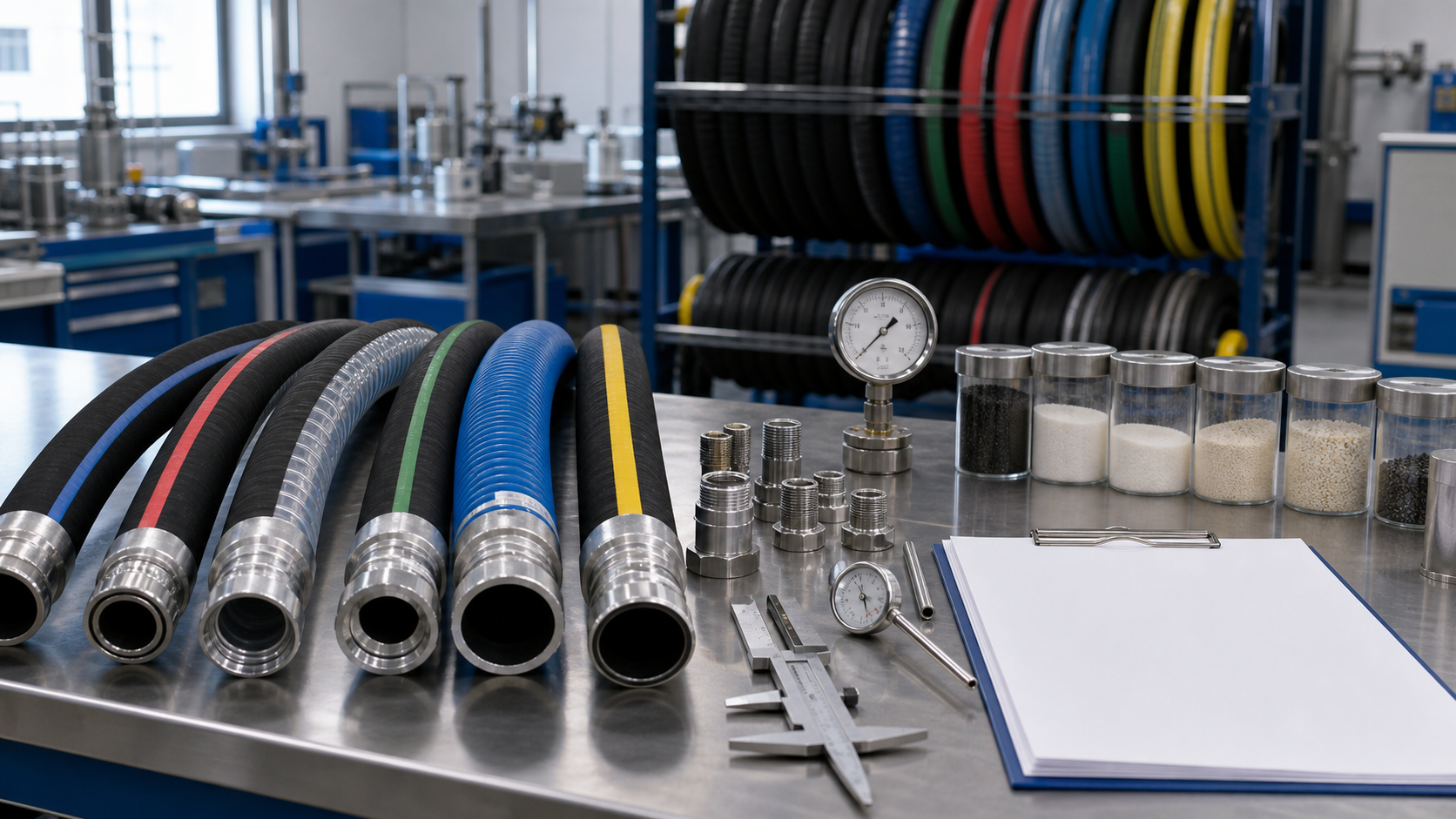
Hydraulic rubber hose is widely used because it combines pressure capability, flexibility, vibration resistance, and durability. However, rubber is a broad category rather than one material. Tube formulations are designed for particular fluids and temperature ranges.
Some nitrile-based compounds used with mineral hydraulic oil may work with selected biodegradable fluids, while others may experience excessive swelling or changes in hardness. Special compounds can be developed for ester-based fluids, but compatibility must still be documented.
For mobile equipment, rubber hose often provides practical flexibility around cylinders, booms, articulation points, and vibrating components. When an approved construction is available, it can be an effective choice. The key is verifying the compound rather than assuming that all black rubber hydraulic hoses behave the same way.
Thermoplastic Hose Options
Thermoplastic hydraulic hose may be considered for equipment that needs a compact outside diameter, low weight, long continuous lengths, or particular chemical characteristics. Its tube and cover materials differ from rubber hose, creating a separate compatibility profile.
Thermoplastic constructions are often used in agricultural machinery, material handling, lubrication systems, and compact equipment. They can also provide a clean outer surface and good resistance to certain environmental conditions.
As with rubber, the word thermoplastic does not guarantee compatibility. The specific polymer, reinforcement, cover, fitting system, temperature, and pressure class must match the biodegradable fluid and the application.
Temperature Is a Critical Variable
High temperature can accelerate both fluid degradation and material interaction. Biodegradable fluids have different oxidation and thermal limits, while hose compounds may have fluid-specific temperature restrictions.
Confirm the actual oil temperature at the hose, not only the reservoir reading. Pressure losses, throttling, proximity to engines, and continuous cycling can create local heat. External radiant heat should be evaluated separately from internal fluid temperature.
Cold performance also matters. Some biodegradable fluids become more viscous at low temperature, increasing suction loss, return backpressure, and start-up loads. A hose may become stiffer in the same conditions. Forestry, winter construction, and outdoor material-handling equipment should be evaluated at the coldest expected start-up temperature.
Pressure, Impulse, and Permeation
Chemical compatibility does not replace pressure qualification. The selected hose must have a working-pressure rating appropriate for its size and the system’s maximum pressure. Equipment with repeated cycling needs sufficient impulse performance.
Fluid permeation may also differ from mineral oil. Permeation is the gradual movement of fluid molecules through the tube and hose wall. Excessive permeation can contribute to odor, surface wetness, cover changes, or fluid loss. It may be influenced by fluid chemistry, temperature, wall thickness, and hose material.
Ask the hose supplier whether permeation data or field experience is available for the proposed combination, especially for enclosed machinery or applications with strict cleanliness expectations.
Fittings, Seals, and Other System Materials
A successful hose specification can still fail if other components are incompatible. Review O-rings, rod seals, pump seals, accumulator bladders, valve seals, reservoir coatings, filter adhesives, and fitting materials.
Ester-based fluids can interact with some elastomers differently than mineral oil. The fluid supplier should provide guidance for common seal materials. Hose fittings should use an approved insert and ferrule system, and the crimp specification should be validated for the chosen hose.
Do not reuse old hose assemblies automatically during a fluid conversion. Even if they show no visible damage, they may contain residual mineral oil and may not use a tube compound approved for the new fluid.
Converting an Existing System
Mixing biodegradable fluid with the previous oil can reduce environmental performance and alter viscosity, additives, or compatibility. A controlled conversion normally includes more than draining the reservoir.
Follow the fluid supplier’s conversion instructions. The correct process depends on the two fluids, equipment design, and required environmental classification. Avoid improvised solvent flushing because the cleaning agent itself may attack hoses and seals or remain trapped in the system.
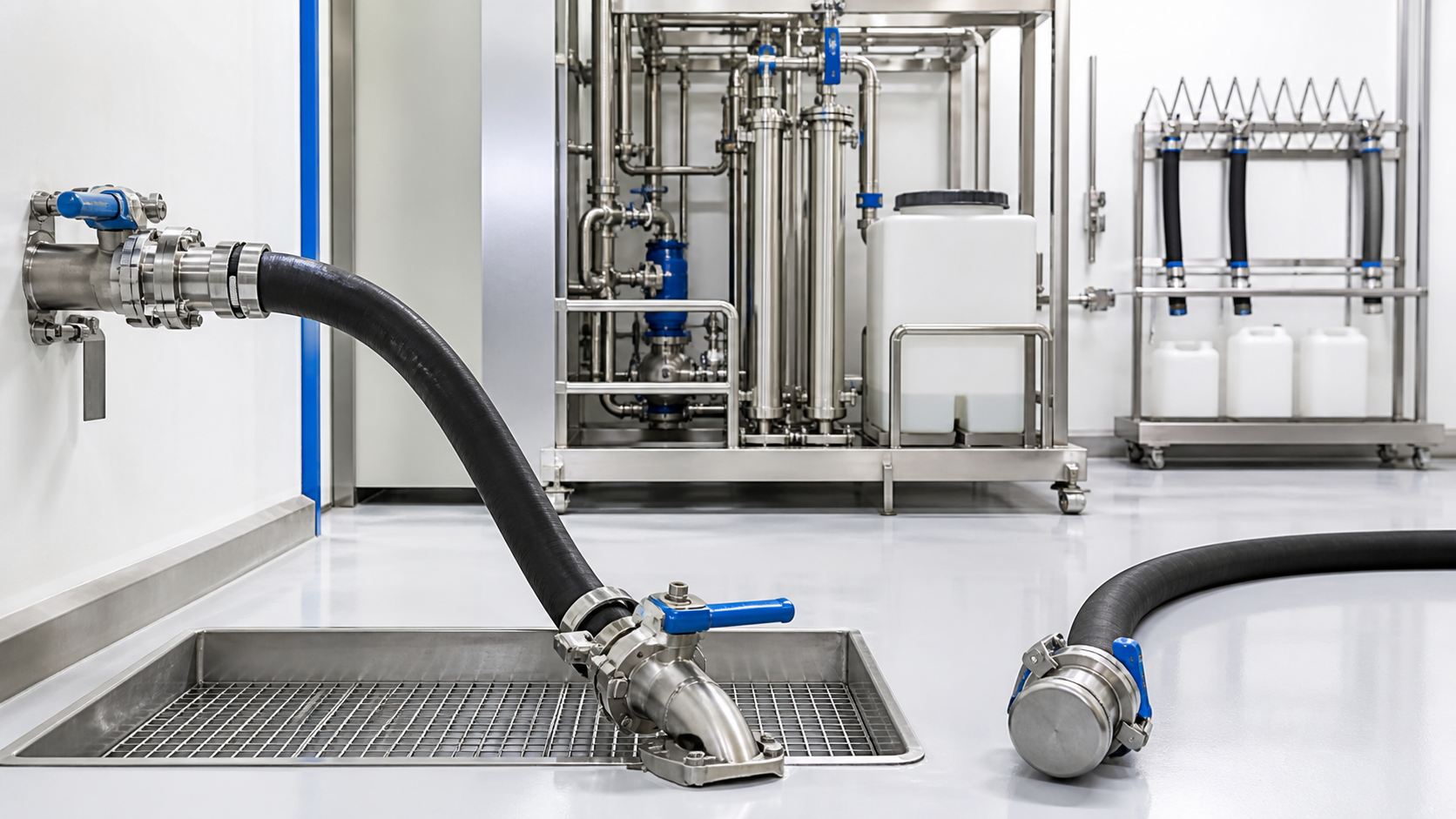
If hoses are replaced during conversion, cap them after cleaning and install them using contamination-control procedures. This is also an opportunity to correct damaged routing, undersized lines, or mismatched fittings.
Testing and Approval
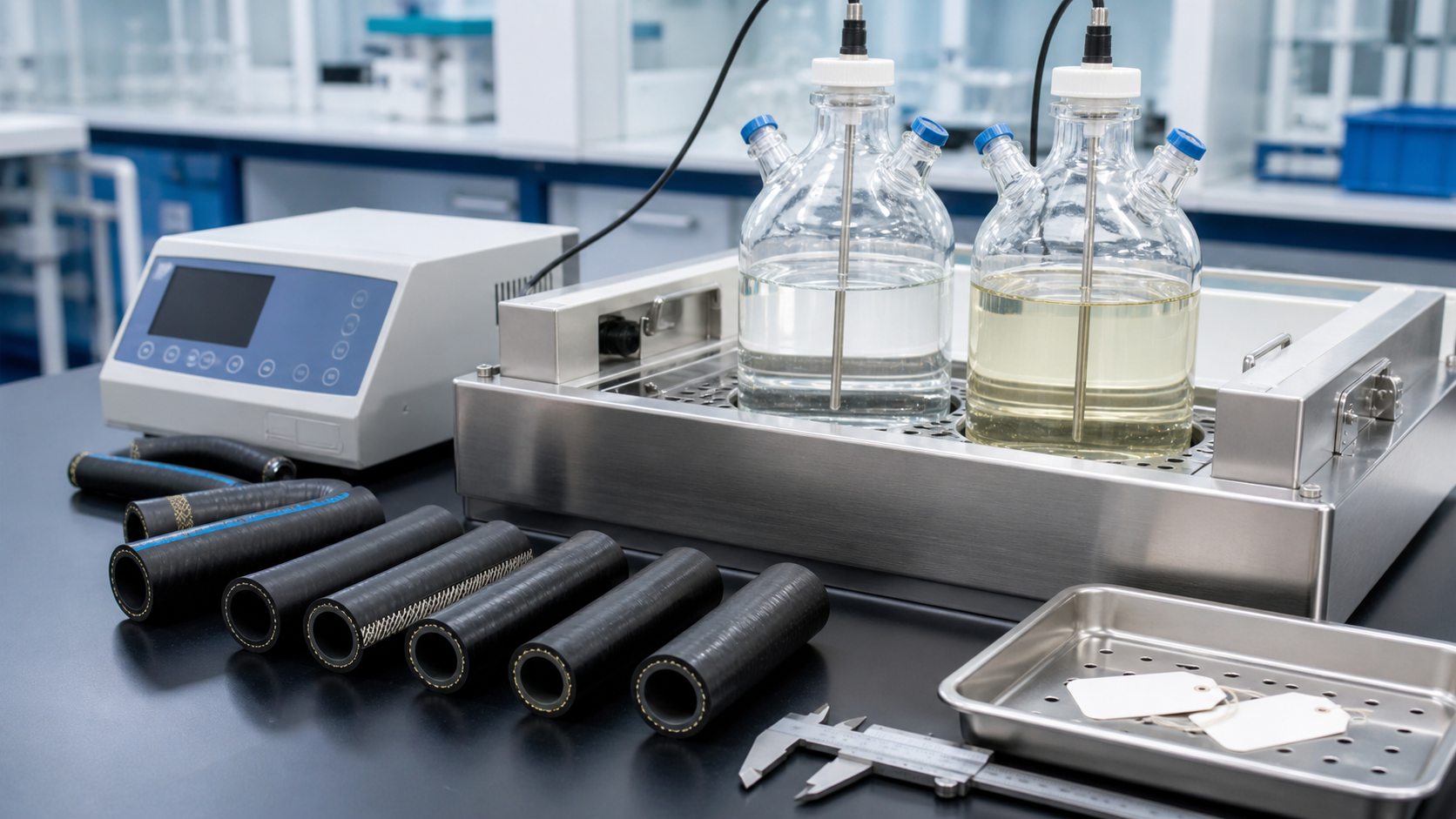
For a new fluid-hose combination, the approval process may include immersion testing, changes in volume and hardness, tensile-property evaluation, visual inspection, pressure testing, and controlled equipment trials. Test conditions should reflect the maximum expected temperature and a meaningful exposure period.
Field trials should be documented. Record the hose construction, batch, fluid, operating hours, temperature, pressure, and inspection findings. A successful trial on one machine is more useful when its duty can be compared with the broader fleet.
For OEM production, add the approved fluid and hose combination to drawings, bills of material, service manuals, and replacement specifications. This prevents a future maintenance team from installing a visually similar but unapproved hose.
Inspection After the Fluid Change
Increase inspection frequency during the early stage of a conversion. Look for:
- Tube or cover swelling
- Soft, sticky, brittle, or cracked surfaces
- Blistering or separation between layers
- Leakage or movement near the fitting
- Changes in hose diameter or flexibility
- Cover wetness that may indicate permeation
- Seal leaks elsewhere in the system
- Unexpected fluid discoloration or contamination
If unusual changes appear, stop and investigate the complete material combination. Replacing only the visibly damaged hose may not address the underlying compatibility problem.
Questions for the Hose and Fluid Suppliers
Before approving the specification, ask:
- Has the hose tube been tested with this exact fluid?
- What temperature limit applies to the combination?
- Are changes in volume, hardness, or strength documented?
- Is the fitting and crimp system approved?
- Are permeation or long-term field data available?
- What flushing procedure is recommended for conversion?
- Which seals and other materials require review?
- What inspection interval should be used after start-up?
Written answers create a useful technical record for procurement and maintenance.
Conclusion
Biodegradable fluids require a compatible system. The hose decision must begin with the exact chemistry and continue through tube material, temperature, pressure, impulse duty, permeation, fittings, seals, and conversion practices. Rubber and thermoplastic hoses can both work when the specific construction is approved. Coordination among the fluid supplier, hose manufacturer, OEM, and maintenance team should produce a documented specification used consistently in production and replacement service.