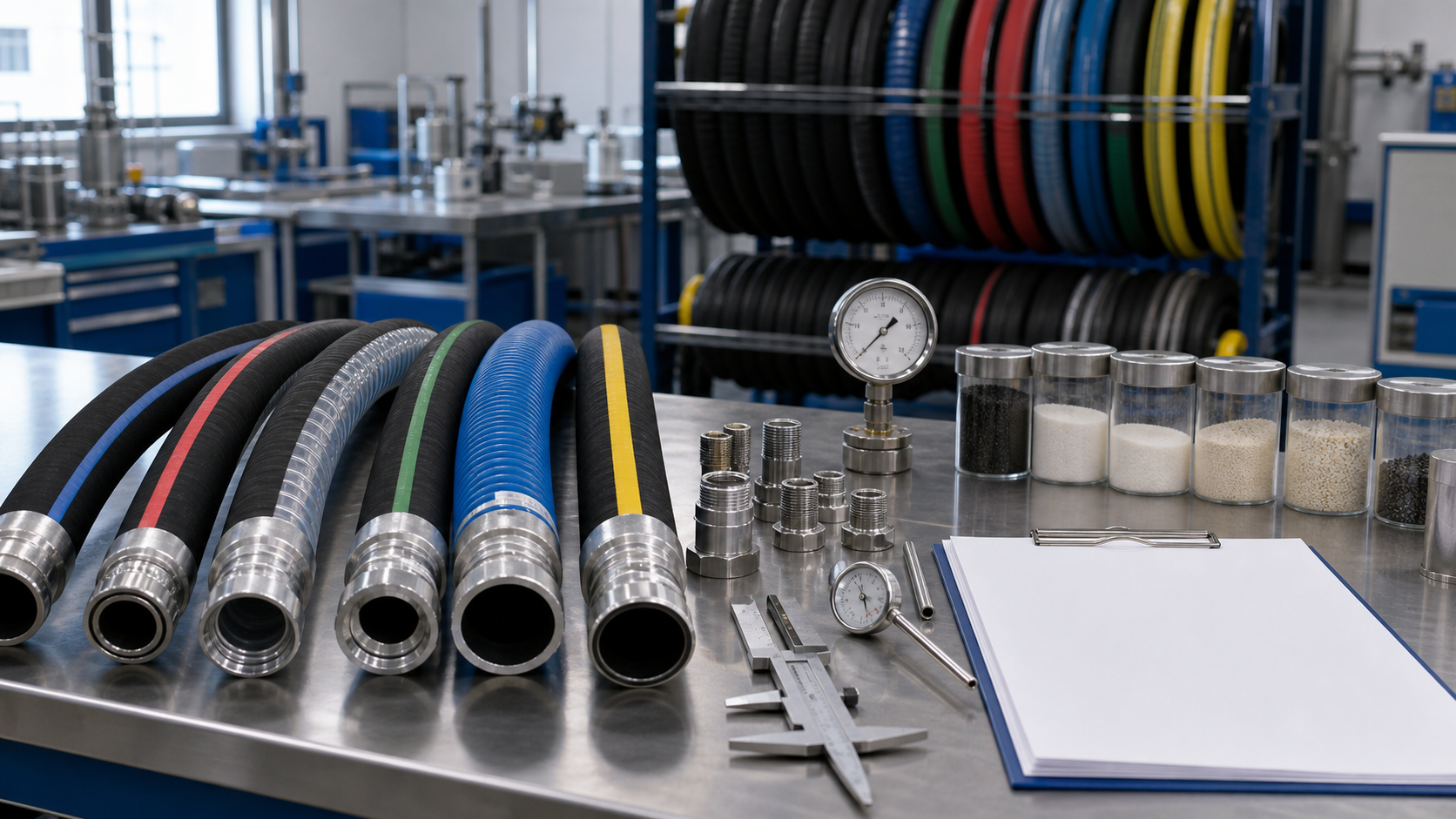
Receiving a shipment of hydraulic hose is not the end of the purchasing process. It is the point at which the buyer confirms that the material delivered is the material approved. If a dimensional, marking, construction, or packaging problem reaches the cutting and crimping area, the resulting assemblies may fail inspection, delay production, or create a field risk.
A practical hydraulic hose incoming inspection checklist should therefore verify identity, condition, traceability, dimensions, documentation, and—when required—performance. The inspection effort should match the order’s risk rather than treating every delivery exactly the same.
Quick Incoming Inspection Checklist
| Inspection area | What to verify | Typical evidence |
|---|---|---|
| Purchase order | Part number, standard, size, quantity | PO and packing list |
| Traceability | Manufacturer, batch, production date | Layline, tag, certificate |
| Visual condition | Cover, bore, ends, contamination | Visual inspection |
| Dimensions | ID, OD, length, coil format | Approved drawing and gauges |
| Marking | Required content and legibility | Layline specification |
| Packaging | Caps, wrap, pallet and coil protection | Packaging standard |
| Documentation | Certificates and test reports | Approved document list |
| Performance | Proof or laboratory checks when specified | Test record |
1. Prepare Before the Shipment Arrives
Incoming inspection works best when acceptance criteria are defined before the purchase order is released. The receiving team should have the approved specification, supplier part number, hose standard, size, pressure class, cover requirement, marking format, packaging instructions, and agreed sampling plan.
For a large bulk hydraulic hose order, identify which characteristics are critical. Incorrect bore, reinforcement, pressure rating, or tube compound can affect safety and function. A slightly different coil length or packaging format may be commercially important but less critical. This classification helps inspectors respond consistently.
Do not rely on a catalogue description alone. Keep a controlled reference sample, approved technical data sheet, or first-article record when practical. Record the revision used for inspection.
2. Check the Shipment Against the Purchase Order
Before opening every coil or pallet, compare the delivery note and packing list with the purchase order. Verify:
- buyer and supplier part numbers;
- hose standard and construction;
- nominal bore or dash size;
- ordered and delivered quantities;
- coil or reel length requirements;
- batch count and manufacturing dates;
- special marking, color, packaging, or certification requirements.
A mixed-size or mixed-batch shipment is not automatically unacceptable, but it must match the agreement. Segregate unidentified material until its status is confirmed. Never assign an identity based only on where a coil was placed on the pallet.
3. Verify Layline and Traceability
The layline is one of the fastest ways to confirm hose identity. Compare its manufacturer name or mark, product designation, standard, size, working pressure, date or batch code, and any approval markings with the order requirements.
Use the approved hydraulic hose layline format as the reference. Check legibility, repeat interval, color contrast, and durability. Look for inconsistent information between the hose, reel tag, packing list, and certificate.
Traceability should link the received material to a manufacturing lot. Record enough information to isolate affected stock if the supplier later reports a nonconformance. Photographs of the layline and pallet tags can strengthen the receiving record.
4. Inspect the Hose Cover
Examine accessible sections of each sampled coil under good lighting. The cover should be uniform and free from cuts, cracks, blisters, exposed reinforcement, deep abrasion, flattening, severe kinks, embedded foreign material, or obvious curing defects.
Minor surface impressions from handling may be harmless, while damage that reaches reinforcement is not. Define acceptable cosmetic variation so inspectors do not make subjective decisions. Pay special attention to the outer turns of coils, banding points, reel flanges, and areas contacting damaged pallets.
If the hose has a special color, abrasion-resistant cover, wrapped finish, or smooth finish, compare it with the approved sample. Unexpected odor, tackiness, blooming, or color variation may justify further review, especially when storage or transit conditions were severe.
5. Examine the Bore and Cut Ends
Inspect hose ends for ovality, crushing, contamination, moisture, corrosion debris, loose rubber, and damaged reinforcement. Caps should be present when specified. A clean-looking cover does not prove that the bore is clean.
Use adequate lighting or a borescope where contamination sensitivity is high. Check for mandrel lubricant, dust, rubber particles, metal fragments, insects, water, or packaging debris. If cleanliness has a measurable requirement, follow the agreed extraction and analysis procedure rather than judging by sight alone.
Do not cut production material merely to inspect the bore unless the sampling plan permits it. Identify and control any length removed for destructive inspection.
6. Confirm Key Dimensions
Measure the characteristics specified by the drawing or product standard. Common checks include inside diameter, outside diameter, cover thickness where relevant, coil length, and minimum acceptable coil diameter. Use calibrated equipment with a suitable method; compressing a rubber hose with a caliper can produce misleading results.
Inspect several points around and along the sample when ovality or dimensional variation matters. For bulk lengths, verify the supplier’s length-marking method and tolerance. If material is delivered on reels, confirm reel dimensions and winding direction when these affect the customer’s equipment.
Record actual measurements, not only “pass.” Numerical records reveal trends before they become rejection-level problems.
7. Review Packaging and Storage Condition
Packaging should prevent damage, contamination, moisture exposure, and excessive bending. Check that bands are not cutting into the cover, coil diameters respect storage limits, reel flanges are sound, and pallets are stable. Confirm end caps, protective wrapping, desiccants, labels, and individual bags where specified.
Look for evidence of heat, direct sunlight, standing water, chemicals, or rough handling during transit. Note container or truck damage before unloading when possible. Transfer accepted material promptly to a clean, dry storage area and preserve first-in, first-out or first-expiring, first-out controls.
8. Match Documents to the Physical Batch
Certificates are useful only when they clearly apply to the delivered material. Verify supplier name, product, size, standard, batch number, quantity, test date, acceptance criteria, results, and authorization. Confirm that document revisions and purchase-order references are correct.
If the order requires a declaration of conformity, material certificate, inspection report, proof-test record, or third-party certificate, do not close receiving until the complete package is available or a controlled concession is approved.
9. Decide Whether Performance Testing Is Required
Routine receiving inspection does not always require destructive testing. However, risk-based verification may include dimensional tests, adhesion checks, change-in-length measurements, proof pressure, burst, impulse, fluid compatibility, or laboratory identification.
The purchase specification should state frequency and responsibility. If hydraulic hose pressure testing is required, use the correct medium, pressure, hold time, safety enclosure, calibrated instruments, and acceptance criteria. Do not improvise a test based on the hose’s burst rating.
10. Use a Risk-Based Sampling Plan
Sampling should consider supplier history, product criticality, lot size, process changes, and prior failures. New suppliers, first shipments, special constructions, or lots following a corrective action may deserve tightened inspection. Proven standard products may qualify for reduced inspection after sustained performance.
A formal hydraulic hose inspection plan should define sample selection, acceptance numbers, measurement methods, and reaction rules. Samples must be spread across pallets, reels, and batch numbers—not taken only from the easiest package to reach.
Handling Nonconforming Material
Clearly label and physically segregate suspect hose. Record the defect, quantity inspected, quantity affected, batch, photographs, measurements, and purchase-order reference. Notify the supplier with objective evidence and request containment, root-cause analysis, replacement, rework, or credit as appropriate.
Do not return, scrap, cut, or use the material before disposition authority is clear. If a concession is considered, engineering and quality should assess functional and safety impact, not procurement alone.
Final Receiving Decision
A strong incoming inspection process answers four questions: Is this the correct hose? Is it undamaged and clean? Can every coil be traced? Is there objective evidence that requirements were met?
When those answers are documented, buyers can release material confidently and detect supplier or transport problems before value is added. The checklist also creates useful performance data for supplier reviews, sampling adjustments, and future sourcing decisions.