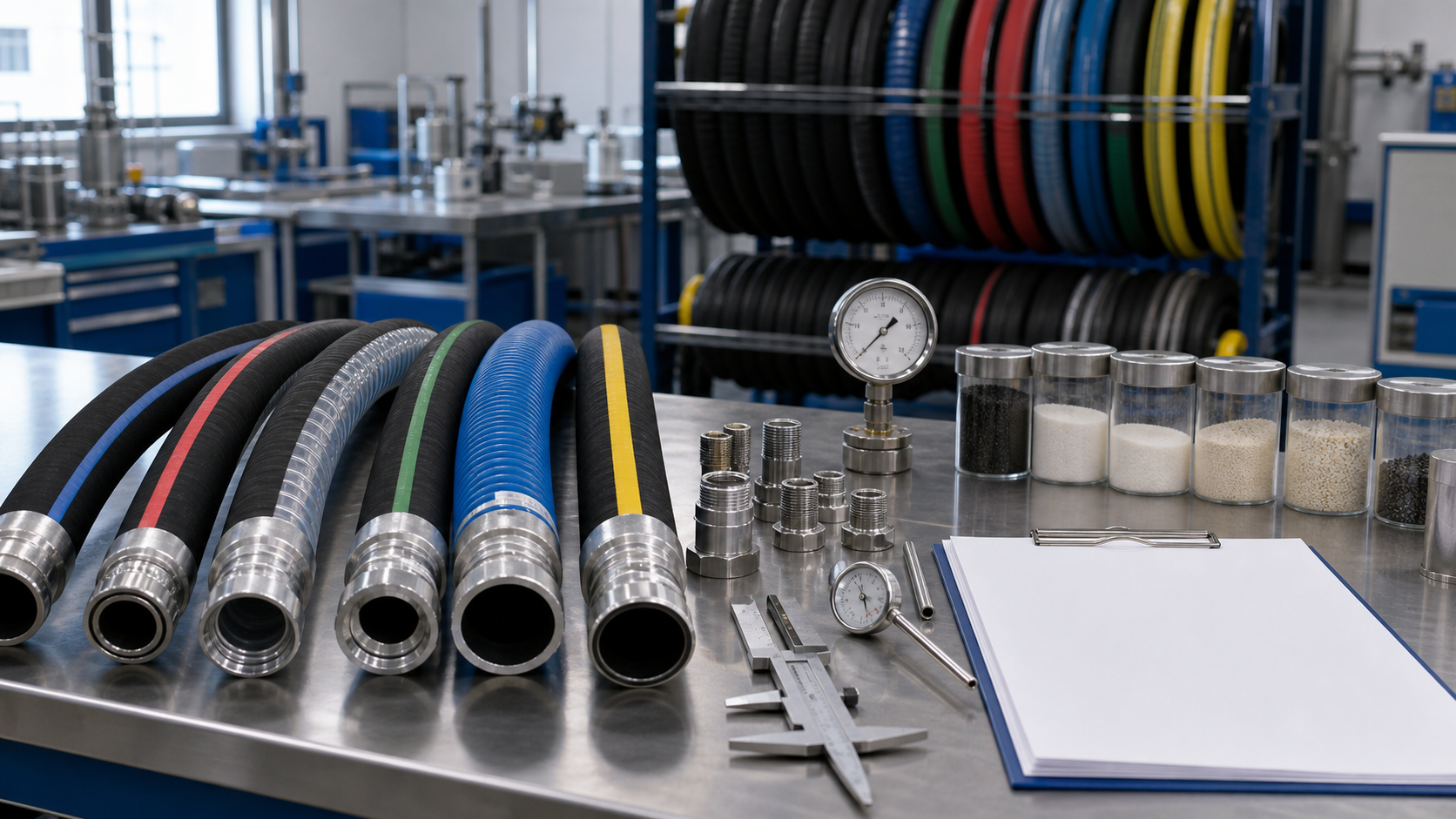
Selecting an industrial hose by inside diameter and working pressure alone is risky. A hose can fit the connection and still fail early because the conveyed material attacks the tube, the ambient temperature damages the cover, the assembly is too short for movement, or the end fittings are unsuitable for the process.
The STAMPED hose selection method gives engineers, maintenance teams, distributors, and buyers a repeatable way to collect application data before choosing a hose. STAMPED stands for Size, Temperature, Application, Material, Pressure, Ends, and Delivery. Used correctly, it reduces assumptions and makes supplier recommendations easier to compare.
STAMPED at a Glance
| Letter | Selection factor | Essential question |
|---|---|---|
| S | Size | What bore, length, and outside constraints are required? |
| T | Temperature | What are the media and ambient temperature limits? |
| A | Application | How and where will the hose operate? |
| M | Material | What product will flow through the hose? |
| P | Pressure | What are the working, surge, and vacuum conditions? |
| E | Ends | Which fittings, seals, and connection standards are required? |
| D | Delivery | What quantity, testing, documentation, and date are needed? |
This framework applies across an industrial hose range, including water, air, chemical, fuel, material-handling, steam, suction, and discharge applications. Each category still requires product-specific verification.
S — Size
Start with inside diameter because it controls flow velocity and pressure loss. A hose that is too small can restrict the process, generate heat, increase pump load, or cause excessive velocity. An oversized hose may be difficult to route, heavier than necessary, and more expensive.
Specify nominal bore using one consistent unit. Do not substitute outside diameter for inside diameter. Hose constructions with the same bore may have different wall thicknesses and outside dimensions.
Also document:
- required overall assembly length and tolerance;
- measurement points for fitted assemblies;
- available routing envelope;
- minimum bend radius;
- space for couplings, clamps, and guards;
- movement or length change during operation;
- coil or reel length for bulk hose.
When replacing an existing assembly, measure it in a relaxed condition and identify whether it has stretched, shrunk, or deformed in service. Copying a failed hose without reviewing the route can reproduce the original problem.
T — Temperature
Record both the conveyed material temperature and the external environment. These are separate exposures. A hot fluid may age the tube from within, while radiant heat, ovens, exhausts, sunlight, or winter weather affect the cover and reinforcement.
Define normal, minimum, and maximum temperatures. Include cleaning, steaming, sterilization, startup, shutdown, and upset conditions. Short peaks matter even when average operation is moderate.
Published temperature limits may depend on the fluid and duration. A hose rated for hot water may have a different limit for oil, chemicals, or saturated steam. High temperature can reduce pressure capability and accelerate permeation or aging; low temperature can reduce flexibility and increase cracking risk.
If insulation or a heat sleeve is planned, consider whether it traps heat instead of protecting the hose. Verify the complete assembly rather than relying on the tube material alone.
A — Application
Describe what the hose actually does. “Transfer hose” is not enough. State the equipment, industry, process step, installation, duty cycle, and failure consequence.
Useful application details include:
- suction, discharge, gravity feed, or pressurized transfer;
- fixed installation or repeated flexing;
- frequency and duration of use;
- indoor, outdoor, marine, underground, or washdown environment;
- abrasion, dragging, crushing, vibration, or vehicle traffic;
- exposure to ozone, UV, salt spray, chemicals, flame, or molten splash;
- operator handling and required flexibility;
- food, pharmaceutical, cleanliness, or regulatory needs.
Review the main types of industrial hoses only after the service conditions are clear. Product categories are useful starting points, but the final selection must match the specific duty.
For mobile equipment, document the full range of motion and possible twist. For suction service, include vacuum level, bend conditions, elevation, pump inlet arrangement, and potential blockage. For abrasive materials, specify particle type, size, concentration, velocity, and whether the flow is wet or dry.
M — Material
Identify every substance that will contact the hose. Use the full chemical or product name rather than a broad term such as “solvent,” “oil,” or “acid.” Include concentration, composition, additives, contaminants, suspended solids, and physical state.
Also list products used during flushing and cleaning. A tube that handles the process fluid may be damaged by a strong cleaning agent. In multi-product service, evaluate every material and the possibility of residues reacting during changeover.
Consult a hose chemical compatibility chart as a screening tool, not as the only approval. Compatibility can change with temperature, concentration, pressure, exposure duration, and compound formulation. If the chart is unclear, request written confirmation or testing from the hose manufacturer.
Consider permeation as well as visible attack. Some fluids can migrate through the tube, cause cover blistering, create odor, or build hazardous vapor concentrations. Cross-contamination may make an otherwise functional hose unacceptable for food, coating, or high-purity processes.
P — Pressure
Specify maximum continuous working pressure, surge or pulsation, test pressure, and any vacuum. Never select a hose using burst pressure as the normal operating rating.
Pressure data should include:
- pump discharge and relief settings;
- transient spikes caused by valves or rapid closure;
- frequency of pressure cycles;
- trapped pressure after shutdown;
- static head and elevation effects;
- full or partial vacuum on the suction side;
- temperature-related derating where applicable.
The lowest-rated component controls the assembly. Hose, couplings, clamps, gaskets, adapters, and equipment connections must all suit the service. Coupling retention can also be affected by tube hardness, cover thickness, temperature, and pressure cycling.
For suction hose, vacuum rating and resistance to collapse are critical. A pressure-rated discharge hose without structural support may flatten at the pump inlet.
E — Ends
Define both end connections completely. Include connection type, nominal size, thread or flange standard, pressure class, sealing method, material, plating, gasket or O-ring material, orientation, and any sanitary finish requirement.
Similar-looking threads may have different angles or sealing principles. Photographs can support identification, but dimensions and standards should control. Confirm whether the connection seals on a taper, flare, face, gasket, or O-ring.
Coupling selection must be compatible with the hose construction and attachment method. Crimped, swaged, clamped, reusable, cam-and-groove, flange, and sanitary connections have different limitations. Electrically continuous service may require a designed conductive path through hose and couplings.
Specify guards, handles, bend restrictors, strain relief, whip restraints, caps, plugs, or safety locks when required. Their position and materials should be included in the assembly drawing.
D — Delivery
Delivery covers more than the requested date. Provide quantity, annual forecast, order frequency, packaging, marking, testing, certification, destination, and acceptable shipment splits.
Clarify whether the requirement is for bulk hose, complete assemblies, samples, or replacement kits. State the required layline, part label, batch traceability, end protection, coil diameter, reel type, pallet limits, individual bags, and moisture protection.
If proof testing, cleanliness verification, material certificates, inspection reports, or third-party witness is required, define the frequency and acceptance criteria before quotation. These activities affect cost and lead time.
Turn STAMPED Data into a Supplier RFQ
Use one controlled form for every application. Attach drawings, route photographs, fluid data sheets, equipment specifications, and applicable standards. Separate confirmed facts from assumptions and unresolved questions.
A useful RFQ should ask the supplier to identify:
- proposed hose and coupling system;
- applicable standard and performance ratings;
- compatibility basis;
- deviations or operating limitations;
- test and inspection scope;
- marking and traceability;
- price, MOQ, and lead time;
- storage and service recommendations.
Compare responses against the same STAMPED fields. This prevents a lower quotation from appearing equivalent when it excludes testing, uses a different connection, or assumes a less demanding environment.
Common STAMPED Mistakes
The most common mistake is leaving a field blank and assuming the supplier will know. Others include giving only normal temperature, naming a chemical without concentration, reporting pump pressure but not surge, omitting vacuum, identifying fittings from a photo, and treating requested delivery as the only commercial requirement.
Do not let one department complete the form alone. Operations understands the process, engineering owns performance, maintenance knows handling and failure history, safety evaluates hazards, quality defines evidence, and procurement manages commercial terms.
Final Selection Principle
STAMPED does not automatically choose a hose. It ensures that the right questions are answered before selection and that the supplier has enough information to make a defensible recommendation.
When Size, Temperature, Application, Material, Pressure, Ends, and Delivery are documented together, buyers reduce premature failures, quotation gaps, and costly field changes. The method turns hose selection from a catalogue guess into a controlled engineering and purchasing decision.