A chemical compatibility chart is often read as a simple yes-or-no answer: compatible or not compatible. In real service, compatibility is conditional. A hose tube that performs well with a dilute chemical at room temperature may soften, swell, crack, permeate, or lose strength when concentration or temperature rises.
Understanding chemical hose compatibility at different temperatures and concentrations is essential when selecting a transfer assembly. The decision must consider the exact fluid, formulation, exposure, pressure, cleaning process, and complete hose construction—not only the generic polymer name.
Compatibility Is a Set of Conditions
Chemical resistance describes how a material behaves under defined exposure. It does not mean universal immunity. Four applications using the same named chemical can produce different results because the operating conditions differ.
| Variable | Why it matters |
|---|---|
| Concentration | Changes chemical activity and water content |
| Temperature | Accelerates diffusion and many degradation reactions |
| Exposure time | Distinguishes brief transfer from continuous contact |
| Pressure/vacuum | Can increase permeation or mechanical stress |
| Flow and velocity | Influence erosion, heat, and static generation |
| Mixture composition | Components may interact or vary by batch |
| Cleaning process | Exposes the tube to additional chemicals and heat |
A properly selected chemical transfer hose should be reviewed against the worst credible combination, not just normal average operation.
How Temperature Changes Chemical Resistance
Higher temperature generally increases molecular movement and diffusion. Fluids may penetrate an elastomer or plastic more quickly, while chemical reactions that cause oxidation, hydrolysis, chain scission, or crosslink changes can accelerate.
Possible symptoms include:
- swelling and dimensional growth;
- softening or loss of tensile strength;
- hardening and surface cracking;
- blistering between layers;
- increased permeation and odor;
- loss of adhesion between tube and reinforcement;
- reduced pressure capability;
- accelerated seal or gasket failure.
Temperature also changes the fluid itself. Viscosity falls as many liquids heat up, which can alter flow and permeation. Vapor pressure can rise, increasing vapor formation or pressure in blocked sections. A chemical may become more reactive, or dissolved ingredients may separate.
Low temperature creates different risks. A tube may become stiff and less resistant to flex cracking. Some liquids crystallize, thicken, or freeze, producing blockage and mechanical loads. An assembly acceptable while stationary may fail when bent immediately after a cold start.
Always distinguish fluid temperature from ambient temperature. A hose carrying warm chemical through a freezer or a cool liquid beside a furnace experiences both.
Why Concentration Matters
Chemical concentration can change compatibility in nonlinear ways. Dilution is not always safer, and a more concentrated solution is not always more aggressive to every material.
Water content can strongly influence behavior. A dry chemical may have limited interaction with a polymer, while an aqueous solution enables ion transport or hydrolysis. Conversely, water may reduce the solvent strength of some organic mixtures.
Concentration also affects pH, oxidation potential, conductivity, viscosity, and vapor pressure. Commercial chemicals may contain inhibitors, surfactants, colorants, impurities, or stabilizers that change their effect on the hose.
Specify concentration as a range and state whether it is by weight, volume, or another basis. Include variation caused by evaporation, dilution, process carryover, or cleaning. A tank filled at 20 percent concentration may become more concentrated during heated recirculation.
Temperature and Concentration Act Together
Compatibility decisions should not evaluate temperature and concentration independently. A chart rating for 10 percent solution at 20°C does not automatically apply to 30 percent at 60°C.
Consider a screening matrix:
| Operating case | Concentration | Fluid temperature | Exposure |
|---|---|---|---|
| Normal transfer | Normal range | Normal range | Intermittent |
| Startup/shutdown | Possible residue | Minimum/maximum | Short duration |
| Process upset | Maximum credible | Maximum credible | Defined emergency duration |
| Cleaning | Cleaning-agent strength | Cleaning temperature | Repeated cycles |
| Stagnant condition | Concentrated residue | Ambient or heated | Extended contact |
Each case may control a different failure mechanism. The cleaning cycle or stagnant weekend condition can be more severe than the transfer itself.
Read Compatibility Charts Carefully
A chemical compatibility chart is an effective first filter. Check its legend, material abbreviations, test basis, temperature assumptions, and notes. Ratings such as excellent, good, conditional, and not recommended are not standardized across every publisher.
Confirm that the chart refers to the actual tube compound or liner, not merely a broad material family. “EPDM,” “NBR,” or “UHMWPE” can describe materials with different formulations and performance.
A blank entry means data may be unavailable; it does not mean compatible. When the exact chemical, concentration, or temperature is missing, ask the manufacturer for a written review. Provide the safety data sheet and full product name, but remember that an SDS may not disclose every proprietary ingredient.
Evaluate the Complete Hose, Not Only the Tube
The tube has direct fluid contact, but the entire assembly can be exposed through permeation, spills, immersion, splash, vapor, or cleaning. Review:
- inner tube or liner;
- reinforcement textile or wire;
- cover compound;
- bonding layers and adhesives;
- coupling and ferrule materials;
- gaskets, O-rings, and seals;
- conductive components;
- external sleeves or guards.
A compatible liner does not compensate for a corroding fitting or an unsuitable seal. If the fluid permeates through the tube, it may attack reinforcement even without visible leakage.
For higher working pressure or demanding handling, a braided chemical hose may provide structural performance, but reinforcement selection does not remove the need to verify chemical and temperature limits.
Understand Common Material Behaviors
Rubber tubes can provide flexibility and good fatigue resistance, but their behavior depends heavily on compound formulation. Chemical exposure may cause volume change, extraction of plasticizers, hardening, softening, or loss of adhesion.
Fluoropolymer liners offer broad resistance to many fluids and high temperatures, but they can have limitations involving permeation, flex life, static control, cold flow, or specific chemicals. Thermoplastic liners may be lightweight and chemically resistant but require attention to temperature and bending.
UHMWPE chemical hose is widely considered for broad chemical transfer service. Even so, the exact product, temperature, concentration, and coupling system must be checked. No liner is universally suitable for every chemical and condition.
Account for Mixtures and Contamination
Do not assess a mixture by checking only its largest component. A small percentage of solvent, oxidizer, acid, or additive may control compatibility. Process fluids can also pick up metal fines, water, cleaning residue, or reaction products.
If composition changes by batch, define the allowable envelope. For waste transfer or recovered solvents, characterization may be uncertain; a hose should not be approved based on a generic waste name.
Sequential service introduces another risk. Residues from two individually compatible chemicals may react inside the hose. Use dedicated assemblies where cross-contamination or reaction is possible.
Include Pressure, Vacuum, and Movement
Chemical exposure can reduce mechanical properties over time. A tube that appears visually acceptable may provide less support to the reinforcement. Elevated temperature can also reduce rated working pressure.
Pressure cycling, vacuum, bending, and vibration add stresses that immersion coupons do not reproduce. For suction service, liner softening may contribute to collapse or delamination. For flexing service, chemical aging can accelerate cracks at bend points.
Ask whether the supplier’s compatibility recommendation applies to static immersion, intermittent transfer, or the intended dynamic assembly.
When Testing Is Appropriate
Testing is valuable when published data are absent, conditions are near product limits, the mixture is proprietary, failure consequence is high, or the application is continuous.
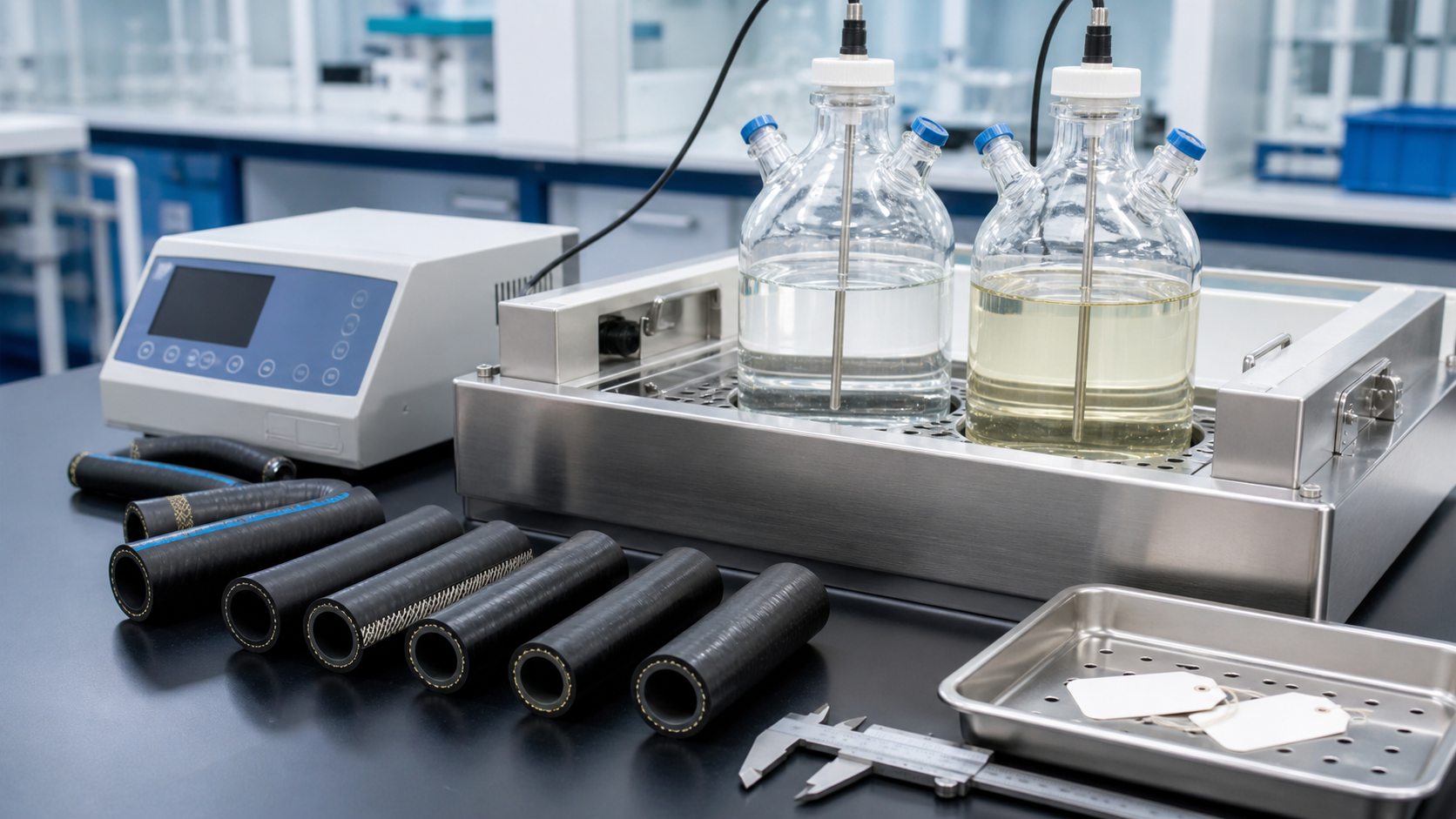
A useful evaluation may examine changes in mass, volume, hardness, tensile properties, appearance, adhesion, permeation, and pressure performance after controlled exposure. Test the actual hose construction or representative tube compound using the real fluid at relevant concentration and temperature.
Laboratory testing supports a decision but cannot reproduce every field variable. Follow it with a controlled trial when appropriate. Define inspection intervals and replacement criteria before full deployment.
Information to Send the Manufacturer
Provide a complete application record:
- chemical trade name and composition;
- concentration range and impurities;
- fluid and ambient temperatures;
- normal, peak, and upset duration;
- working pressure, surge, and vacuum;
- flow rate and frequency of use;
- static or dynamic installation;
- cleaning and sterilization chemicals;
- fitting and seal materials;
- required service life and failure consequence.
Request a recommendation tied to those conditions and keep the response with the controlled product record.
Final Compatibility Principle
Chemical compatibility is not a permanent label attached to a polymer. It is a judgment about a specific material exposed to a specific fluid under defined temperature, concentration, time, and mechanical conditions.
Use charts to screen candidates, then verify the complete assembly against the worst credible operating and cleaning cases. That discipline prevents a chart’s simple rating from becoming a costly assumption in the field.