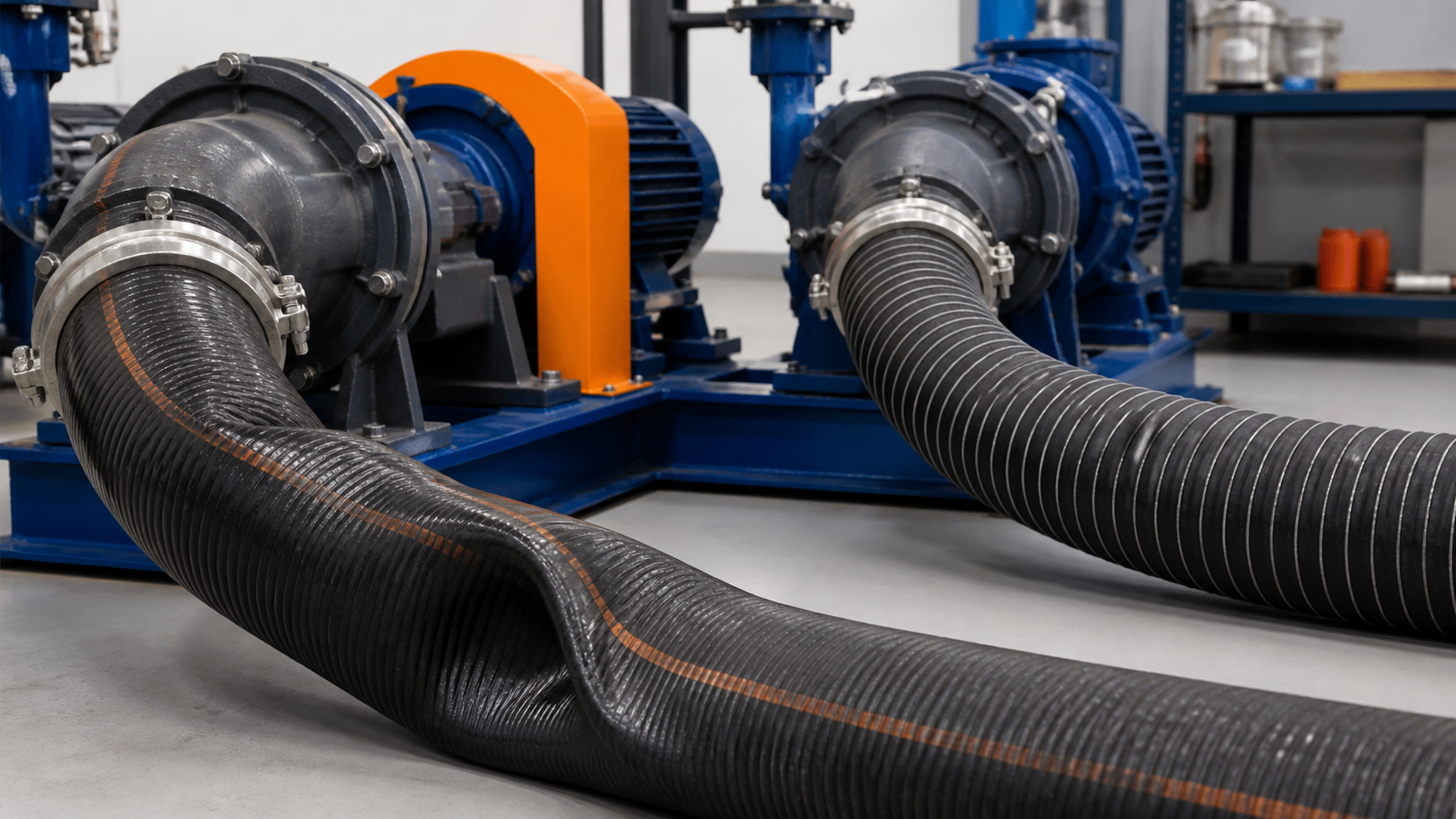
Large-bore hose carries substantial fluid volume and stored energy. A failure can release product quickly, damage equipment, interrupt production, or expose personnel. Pressure testing is therefore valuable—but only when it is planned for the exact hose, service, test medium, and assembly configuration.
An effective industrial hose pressure test checklist combines document review, external and internal inspection, safe test setup, controlled pressurization, and traceable results. It should never be reduced to “apply pressure and look for leaks.”
Safety note: Pressure testing can be hazardous. Testing must be performed by trained personnel using an approved procedure, exclusion zone, restraints, calibrated instruments, compatible media, and equipment rated above the maximum test pressure.
Define the Purpose Before Testing
The procedure depends on why the hose is being tested. Common purposes include:
- factory acceptance of a new assembly;
- receiving inspection;
- proof testing after assembly or repair;
- periodic in-service verification;
- leak investigation;
- qualification of a hose design;
- confirmation after an abnormal event.
A proof test is not the same as a burst test. Proof testing verifies integrity at a defined non-destructive pressure. Burst testing intentionally destroys a sample to characterize ultimate performance. Do not use burst pressure as a routine operating or proof-test value.
Pre-Test Checklist
| Inspection area | What to verify |
|---|---|
| Identification | Part number, size, batch, length, service history |
| Specification | Working pressure, test pressure, temperature, medium |
| Hose body | Cuts, blisters, abrasion, kinks, soft spots, deformation |
| Couplings | Movement, corrosion, cracks, bolts, clamps, welds |
| Bore | Delamination, blockage, contamination, liner damage |
| Test system | Pump, relief device, gauge, restraints, enclosure |
| Connections | Correct adapters, seals, supports, end closures |
| Documentation | Procedure, acceptance criteria, calibration status |
The inspection applies across many industrial hoses, but acceptance limits must come from the manufacturer, applicable standard, engineering specification, and service risk.
1. Confirm Hose Identity and Rating
Record manufacturer, product series, nominal bore, pressure class, length, serial or batch number, manufacturing date, coupling type, and assembly date. Compare the layline and tags with the controlled drawing or purchase order.
Verify that the proposed test pressure is valid for the exact size and assembly. Large-bore ratings can change by diameter. Temperature, aging, chemical exposure, and previous damage may also affect whether an in-service hose should be tested at all.
If the hose cannot be identified reliably, quarantine it. Passing an improvised test does not establish its original construction or suitability.
2. Review Service History
Before periodic testing, obtain the conveyed material, operating pressure, vacuum, temperature, cycle frequency, hours in service, cleaning method, storage conditions, and previous inspection results.
Ask about abnormal events: overpressure, vacuum collapse, dry running, water hammer, chemical upset, overheating, vehicle impact, dragging, sharp bending, coupling movement, or emergency shutdown.
A hose with severe visible damage should usually be removed rather than pressurized to “see if it holds.” The risk assessment should determine whether testing is appropriate.
3. Inspect the Cover and Structure
Clean the exterior sufficiently to expose defects. Inspect the full length under good lighting. Mark and photograph suspect areas.
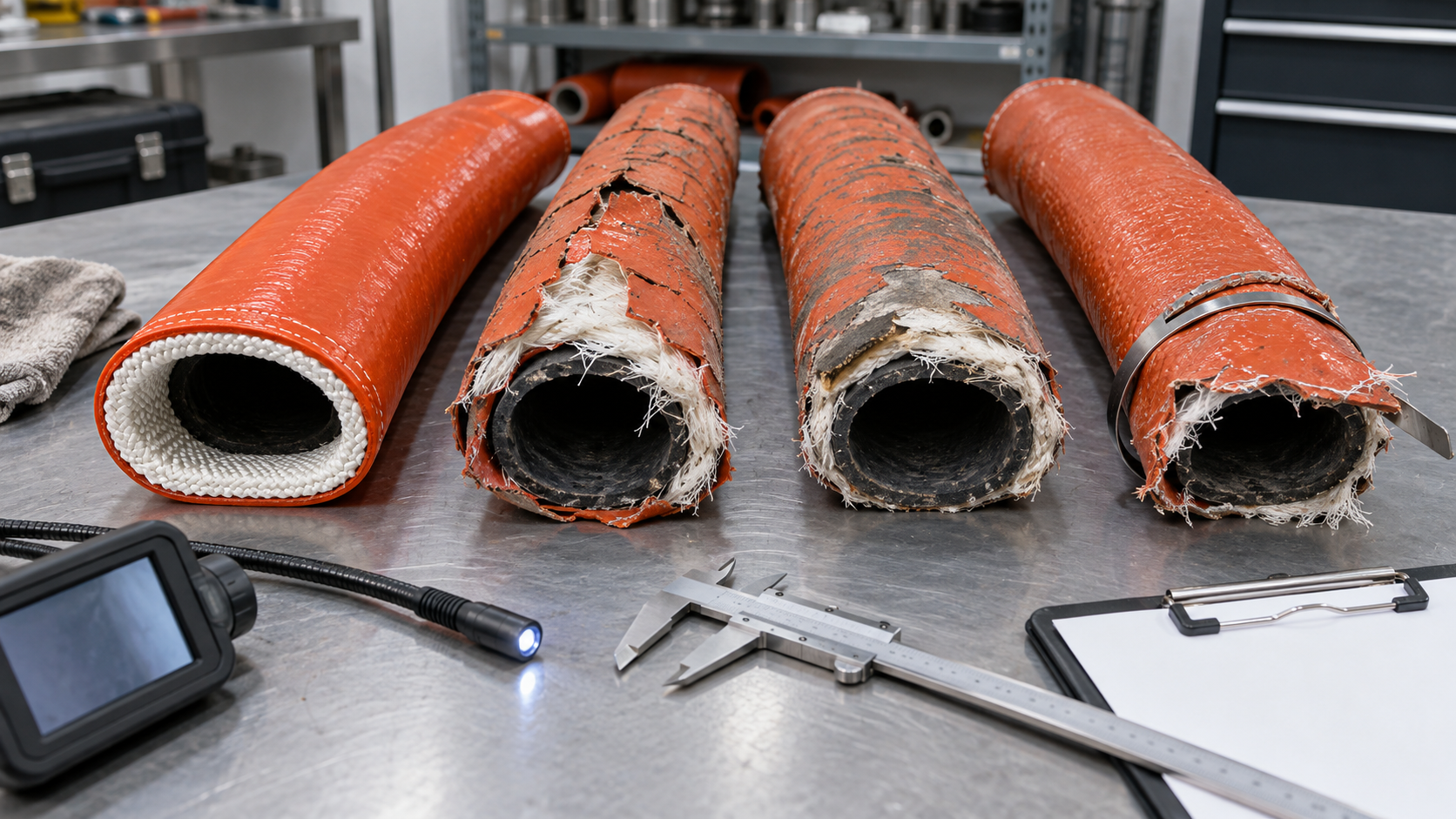
Look for cuts, cracks, blisters, exposed reinforcement, flattened sections, permanent kinks, crushed helix, cover separation, heat damage, chemical softening, hardening, and excessive abrasion. Pay attention to bends, clamp points, flange transitions, lifting locations, and areas that contact the floor or structure.
For a suction and discharge hose, check radial support and any evidence of vacuum collapse. A hose can pass positive pressure while remaining unsafe under suction.
4. Inspect Couplings and Flanges
Large fittings impose high weight and leverage. Inspect flange faces, welds, clamps, ferrules, bolts, threads, gaskets, and transition areas. Look for corrosion, cracks, distortion, leakage stains, pulled fittings, damaged bolt holes, and missing hardware.
Measure coupling position against baseline marks where available. Confirm that lifting or handling has not loaded the hose through the fittings. Replace seals using the correct material and dimensions; never stack gaskets to compensate for misalignment.
For a large dredge discharge hose, include flotation components, wear indicators, lifting points, and flange integrity in the inspection plan.
5. Examine the Bore
Make the assembly safe, drained, cleaned, and ventilated before internal inspection. Use suitable lighting, a borescope, or another approved method.
Check for liner cuts, ripples, swelling, pitting, delamination, exposed reinforcement, trapped debris, sediment, corrosion products, and localized wear. Inspect the outer radius of bends and areas downstream of reducers or fittings.
Pressure testing may not reveal a loose liner that blocks flow under vacuum. Internal condition must be evaluated separately.
6. Select a Safe Test Medium
Hydrostatic testing is generally preferred when the approved procedure allows it because liquids store less compressible energy than gas. The medium must be compatible with the tube, fittings, seals, and future service.
Control temperature and cleanliness. After testing, some applications require draining, flushing, drying, or preservation. Water left inside may corrode fittings, freeze, contaminate product, or support microbial growth.
Pneumatic testing can release much more energy and requires a specific engineered procedure. Never substitute compressed air simply because it is convenient.
7. Prepare the Test Area
Use a test bay, barricade, or enclosure suited to the hose size and pressure. Establish an exclusion zone. Keep personnel away from end closures, couplings, and the hose’s potential movement path.
Support the assembly without creating tight bends or point loads. Restrain ends using engineered devices that do not damage the hose. Install a relief valve, isolation valve, bleed point, and calibrated pressure instrumentation with suitable range and accuracy.
The test pump, adapters, manifolds, blinds, bolts, and hoses must all be rated above the intended test pressure. The weakest component controls the setup.
8. Fill and Remove Air
Position vents at high points and fill slowly. Trapped air increases stored energy and can make pressure behavior unstable. Continue venting until the approved procedure confirms that air has been removed.
Check for obvious leaks at low pressure before proceeding. Stop and depressurize if the hose shifts, twists, expands abnormally, or connections move.
9. Pressurize in Controlled Stages
Raise pressure gradually according to the procedure. Hold at intermediate stages when required to inspect the setup remotely and allow stabilization.
At the specified proof pressure, maintain the defined hold time. Monitor pressure, visible leakage, sweating, bulging, coupling movement, unusual sounds, and dimensional change. Use cameras or barriers rather than approaching an energized large-bore hose.
Do not tighten fittings, strike components, or reposition the assembly under pressure.
10. Depressurize and Drain Safely
Reduce pressure through the designated route at a controlled rate. Verify zero pressure with the gauge and a safe bleed method before entering the test area or loosening a connection.
Drain and recover the test medium. Large-bore hose can retain significant liquid in low points. Support the hose during draining so trapped fluid does not create unexpected movement.
For an industrial water hose, residual water may be compatible with service, but cleanliness, freezing, and storage requirements still apply.
Acceptance Criteria
The procedure should define pass/fail limits before testing. Depending on the hose, these may address:
- no visible leakage or sweating;
- no permanent bulging, blistering, or deformation;
- no coupling movement;
- acceptable change in length or diameter;
- stable pressure after temperature effects are considered;
- intact reinforcement and cover;
- successful post-test bore inspection;
- acceptable electrical continuity where required.
Pressure drop alone can be misleading because temperature change, trapped air, equipment compliance, or small system leaks may affect the reading.
Document the Result
Record hose identity, date, reason for test, procedure revision, test medium and temperature, pressure stages, hold time, instrument IDs, actual readings, observations, photographs, inspector, and disposition.
If the assembly fails, isolate it and investigate the failure mode. Do not patch a damaged pressure hose or repeat the test at a lower pressure to obtain a pass.
Set the Next Inspection Date
Inspection frequency should reflect service severity, hose condition, consequence of failure, manufacturer guidance, and operating history. High temperature, chemicals, abrasion, pressure cycling, vacuum, movement, and harsh weather may justify shorter intervals.
Track trends rather than treating each test as an isolated event. Increasing deformation, coupling movement, or repeated external damage can signal a routing or handling problem.
Final Testing Principle
Pressure testing is one part of hose integrity management. It confirms performance under a defined test condition, but it does not prove chemical compatibility, internal cleanliness, vacuum stability, fatigue life, or suitability for future service.
Combine controlled proof testing with identification, service history, external and internal inspection, safe handling, and documented acceptance criteria. That makes the test a useful engineering decision instead of a hazardous ritual.