
Why Hydraulic Hose Pricing Varies So Widely
When purchasing hydraulic hoses, buyers often encounter a bewildering range of prices for products that appear identical on the surface. A SAE 100R2AT hose quoted at $12 per meter by one supplier might cost $35 per meter from another. A custom order in DN16 bore can range from $8 to $45 depending on the manufacturer, certification standard, and volume ordered.
This price variance is not random. Behind every quote lies a precise calculation of material costs, manufacturing processes, quality assurance protocols, and competitive positioning. Understanding the 12 primary factors that drive hydraulic hose pricing helps procurement engineers, OEM buyers, and fleet managers make informed purchasing decisions that balance cost against reliability, performance, and total cost of ownership.
This guide breaks down each factor that influences hydraulic hose prices, provides real-world pricing context, and explains how to evaluate whether a lower quote represents genuine efficiency or hidden risk.
1. Raw Material Costs: The Largest Single Price Driver
Rubber and steel wire represent 40–60% of the total manufactured cost of a hydraulic hose. As crude oil prices fluctuate, so does the cost of synthetic and natural rubber compounds used in inner tubes, outer covers, and intermediate layers. High-tensile steel wire for braiding and spiral reinforcement follows commodity metal prices on the global markets.
A manufacturer that sources premium Indonesian or Malaysian natural rubber will pay 15–25% more per kilogram than a producer using lower-grade recovered or synthetic compounds. Similarly, high-carbon steel wire meeting SAE J517 specifications costs 20–30% more than standard industrial wire.
For buyers requesting quotes in volatile commodity markets, price adjustments are common in contracts covering orders with lead times exceeding 60 days. A hose quoted in January at $18/meter may legitimately cost $22/meter in March if crude oil prices spike. This is a transparent cost pass-through, not margin expansion.
2. Pressure Rating & Specification: The Specification Premium
A SAE 100R1AT hose (single-wire braid, 210 bar working pressure) costs approximately 30–40% less than a EN856 4SP hose (four-spiral, 350 bar working pressure) in the same bore size. The reason is straightforward: the 4SP hose requires approximately 40% more steel wire reinforcement, thicker rubber layers, and more complex braiding or spiraling equipment setup.
High-pressure specifications also demand tighter manufacturing tolerances and more rigorous testing protocols. A hose rated to 350 bar must consistently proof-test at 525 bar (150% of working pressure). A hose rated to 210 bar tests at 315 bar. The inspection equipment, test fluid disposal, and failure investigation time all add cost to higher-pressure hoses.
Pressure Rating Cost Impact
SAE 100R1AT (210 bar): Baseline = 1.0x cost
SAE 100R2AT (280 bar): +25–35% cost
EN856 4SP (350 bar): +40–55% cost
EN856 4SH (400 bar): +55–70% costThese ratios apply to the same hose bore (e.g., DN16). Larger bores reduce the relative percentage increase; smaller bores amplify it.
3. Hose Construction Type: Wire Braid vs. Spiral vs. Textile

Textile-braided hoses (R3) are the least expensive construction, costing roughly 40% less than equivalent single-wire-braided (R1) hoses because they require no high-tensile steel. However, textile braid offers lower pressure ratings and shorter service life, making it unsuitable for mobile equipment or high-duty industrial applications.
Single-wire-braided hoses (R1, R2) represent the middle price point and cover the majority of industrial and mobile equipment hydraulic circuits. Spiral-reinforced hoses (4SP, 4SH, EN857 2SC) command a premium because spiral winding requires custom tooling for each bore size and higher equipment costs, but they offer superior impulse resistance and tighter bend radii critical for high-shock applications in mining and construction.
Wire-spiral hoses with extreme pressure ratings (6, 8, 10 spirals) are custom-engineered products and can cost 200–400% more than basic single-braid hoses because they require specialized manufacturing equipment found at only a handful of global facilities.
4. Custom Design & Fitting Complexity: Non-Standard Specifications
A standard straight hose assembly with two 90-degree metric cone fittings on each end costs significantly less than a custom-bent hose with swaged ferrules, custom-ported adapters, and integrated pressure ports. Custom bending adds $20–80 per hose depending on bend complexity. Custom swaging adds $15–50 per fitting.
A hose with three bends in three different planes, requiring a custom mandrel and proprietary bending fixture, incurs tooling costs that are amortized across the production run. For a one-off custom order, that tooling cost can add $300–$1,500 to the price. For a bulk order of 100 units, tooling cost per unit drops to $3–15.
Integrated adapters and special port configurations also increase cost. A standard swaged hose fitting costs $2–8 wholesale. A custom-engineered integrated adapter with NPT, SAE, or JIC connections on both ends costs $15–40, and a complex manifold-integrated hose can cost $50–150+ per unit.
Custom Design Cost Impact Example: A simple straight 5-meter hose with standard 90° metric cone fittings: ~$35–50. The same hose with three custom bends, swaged ferrules, and integrated pressure port taps: ~$120–180. The same hose as part of a 50-unit volume order with custom bends: ~$60–85 per unit (tooling amortized).
5. Volume & Order Quantity: The Discount Cliff
Volume discounts in hydraulic hose manufacturing follow predictable tiers based on production scheduling and material bulk pricing:
| Order Volume | Pricing Tier | Typical Discount vs. Single Unit |
|---|---|---|
| 1–5 units | List price (baseline) | 0% (1.0x) |
| 6–20 units | Small order discount | 10–15% discount |
| 21–50 units | Standard production run | 20–30% discount |
| 51–200 units | Medium bulk order | 30–45% discount |
| 200+ units | Full production efficiency | 45–60% discount |
| 1,000+ units (annualized) | Preferred supplier/OEM tier | 50–70% discount |
The jump from a 5-unit order to a 50-unit order typically reduces per-unit cost by 20–30% due to material bulk purchasing, production scheduling efficiency, and reduced administrative overhead per unit. OEM customers with long-term volume commitments (500+ units annually) can negotiate supply agreements that lock in 50–70% discounts, effectively purchasing hoses at cost-plus markup.
6. Manufacturing Standards & Certifications: The Compliance Premium
A hydraulic hose manufactured to SAE J517 standard without third-party certification costs significantly less than an identical hose carrying EN 853/856 DIN certification or ISO 1402 compliance with test documentation.
The cost difference includes:
Certification Cost Breakdown
- First-party testing: Manufacturer’s internal lab work, ~$200–500 per batch
- Third-party witness testing: Independent lab certification, ~$500–2,000 per certification
- Batch documentation: Test certificates, traceability records, ~$50–200 per batch
- Compliance audit overhead: Facility inspection, process documentation, ~$5,000–20,000 annually (amortized across production)
- Equipment calibration: Pressure gauges, temperature sensors certified, ~$1,000–5,000 annually (amortized)
For a manufacturer producing 50,000 meters of hose annually, certification costs add approximately $0.50–$1.50 per meter to hoses carrying third-party test documentation. For a single-batch order with required certification, this cost can be $1,000–$3,000 added to the order.
MSHA certification for coal mining hoses (fire-resistant construction per 30 CFR 7) is the highest-cost certification tier, adding $2,000–$8,000 in compliance costs for smaller production runs.
7. Lead Time & Delivery Schedule: Expedite Premiums
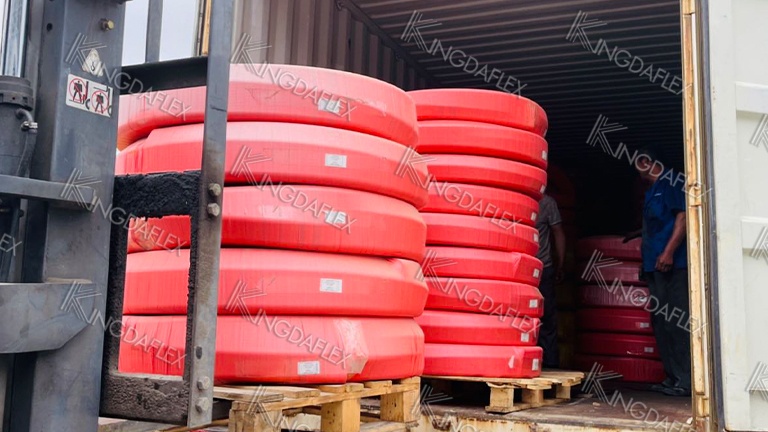
A hose with a 12–16 week standard lead time costs 5–10% less than an identical hose required in 4–6 weeks. A hose required in 1–2 weeks (expedited) carries a 20–40% surcharge. Same-day or next-day delivery adds 100%+ premiums and is typically reserved for emergency replacements.
The reason is manufacturing scheduling. Standard lead times allow the manufacturer to batch orders by bore size, specification, and fitting type, running long production cycles with minimal changeover. A single expedited order for DN25 SAE 100R2AT with metric cone fittings disrupts this schedule, requiring dedicated equipment setup and operator attention that increases labor costs per unit.
For buyers with predictable demand, negotiating longer lead times (16–24 weeks) can reduce prices by an additional 10–15% compared to standard lead times.
8. Fluoropolymer vs. Standard Rubber Compounds: The Material Premium
Hoses manufactured with PTFE (Teflon) inner tubes or fluoropolymer (FKM, Viton) elastomers for chemical compatibility cost 30–100% more than hoses with standard NBR (nitrile) inner tubes and covers. The cost premium reflects raw material expense and manufacturing complexity.
A standard SAE 100R1AT hose with NBR (nitrile) inner tube costs ~$15 per meter in DN16 bore. The same hose with PTFE inner tube for aggressive fluid compatibility costs ~$25–30 per meter. A hose with complete FKM outer cover for chemical-resistant surface costs ~$20–35 per meter.
For applications involving petroleum distillates, brake fluid, polyol ester synthetic hydraulics, or biodegradable vegetable-oil hydraulic fluids, choosing a correctly specified hose with compatible inner tube and outer cover is essential. Choosing the wrong elastomer chemistry leads to premature inner-tube swelling, outer-cover degradation, and hose failure — far more costly than paying the material premium upfront.
9. Production Efficiency & Equipment: Old vs. Modern Manufacturing
A manufacturer with Italian VP-brand spiral hose production lines and fully automated braiding equipment with CNC control can produce a standard DN16 SAE 100R2AT hose for approximately $8–12 in material and labor cost. A manufacturer with older, semi-manual equipment incurs $14–18 in labor and overhead per equivalent hose.
That $4–6 per-hose cost difference translates directly to retail price differences. Manufacturers with modern equipment can offer lower prices and still maintain healthy margins, or maintain similar prices and achieve higher profitability. Many smaller or regional manufacturers operate with older equipment and higher per-unit costs, resulting in higher prices to end customers.
This is not a criticism of older equipment — older machinery still produces compliant, reliable hoses — but it explains why quotes from manufacturers with different production technology can vary by 20–40% even for identical specifications.
10. Testing & Quality Control: Beyond Minimum Standards
Minimum SAE J517 or DIN EN 856 compliance requires 100% proof-pressure testing at 150% of working pressure and visual inspection. Beyond that baseline, manufacturers can offer additional testing that increases price:
Optional Testing & Quality Programs
- Burst pressure testing: 200%+ of working pressure on sample hoses, ~$50–150 per batch
- Impulse testing: Extended cycle testing to 500,000+ cycles per SAE J4607, ~$200–1,000 per batch
- Aging and UV resistance testing: ASTM protocols, ~$150–400 per test
- Bend radius and fatigue testing: Specialized equipment, ~$200–800 per test
- Cold-temperature flexibility testing: ASTM D2137, ~$100–300 per test
- Dimensional laser-scanning verification: Bore ID/OD/wall thickness per SAE tolerances, ~$0.20–0.50 per hose
Manufacturers offering 200% proof-pressure testing or extended impulse testing to 400,000+ cycles can charge 5–15% premiums because these programs reduce warranty claims and customer downtime. For critical applications like coal mining or offshore drilling, this premium is often justified.
11. Supply Chain & Regional Manufacturing Factors
A hydraulic hose manufacturer in China with direct access to domestic rubber compounding, steel wire mills, and chemical suppliers has a 20–30% material cost advantage over a manufacturer in Western Europe or North America. This geographic advantage translates to lower prices for equivalent quality.
However, regional shipping costs, tariff exposure, and currency exchange volatility introduce additional factors. A Chinese manufacturer’s $15/meter hose may cost $18–22/meter landed in Europe or North America after shipping, customs duties, and distributor markup. A European manufacturer producing the same hose at $22/meter ex-works may have lower total landed costs for local customers when regional shipping is considered.
Regional labor costs also matter. Manufacturing in low-labor-cost regions (Southeast Asia, India) offers 30–50% lower production costs than manufacturing in developed markets, and these savings often flow to end-customer pricing.
12. Brand & Manufacturer Reputation: The Intangible Premium
An established manufacturer with a 20-year track record, significant OEM certifications, and documented case studies in major industries can charge 10–25% premiums over unknown manufacturers offering technically identical hoses. This premium reflects brand reputation, technical support availability, warranty confidence, and risk mitigation.
For a fleet manager purchasing return hoses for a single excavator, the brand premium may not be economically justified. For an OEM integrating hoses into mission-critical equipment sold globally, brand reputation and documented quality history are essential — and worth the premium.
Reputation also extends to supply chain reliability. Manufacturers with proven on-time delivery, transparent communication, and responsive technical support earn loyalty premiums that justify 5–15% higher prices compared to lower-cost competitors with inconsistent delivery or poor communication.
Comparative Pricing: Real-World Scenarios
To illustrate how these factors combine, here are three pricing scenarios for identical baseline hoses (DN16 SAE 100R2AT, standard metric cone fittings, 5-meter straight length, standard lead time):
| Scenario | Description | Price Per Unit | Key Factors |
|---|---|---|---|
| Budget Supplier | Unbranded, minimal testing, basic material specs | $12–16 | Lowest material cost, no third-party certification, older equipment, minimal support |
| Standard Industrial | SAE-compliant, batch testing, regional brand | $18–24 | Quality-assured materials, proof testing, established reputation, technical support |
| Premium OEM Grade | DIN certified, impulse tested, specialized compounds, documentation | $28–38 | Third-party certification, extended impulse testing, premium materials, full traceability, OEM partnerships |
| Expedited + Custom (50-unit minimum) | 8-week lead time, three custom bends per unit, swaged ferrules | $45–65 per unit | Expedite premium (25%), custom tooling amortized, complex manufacturing, small volume |
Notice that “identical baseline hoses” can legitimately cost $12–65 depending on manufacturing location, testing protocols, customization, and volume. This is not price gouging — it reflects genuine differences in manufacturing processes, supply chain costs, and value-added services.
Conclusion: Price as a Proxy for Total Cost of Ownership
The lowest hydraulic hose price is not always the best value. A $12 hose from an unknown supplier that fails after 8 months of service creates downtime costs, emergency replacements, and lost productivity far exceeding the $12 savings. A $28 hose from an established manufacturer with documented impulse testing and on-time delivery may cost 2.3x more per unit but eliminate warranty claims and unplanned outages over a 3-year service life.
Smart procurement requires understanding which price factors are relevant to your specific application. Mining equipment under extreme shock loads justifies the premium for impulse-tested EN856 4SP hoses. A stationary industrial press with gentle load cycles can use budget-tier SAE 100R3 textile-braided hoses with confidence. Agricultural equipment operating in dusty, temperature-variable environments benefits from premium fluoropolymer chemistry even if initial cost is higher.
Request quotes that break down pricing components — material cost, testing fees, certification markup, delivery, and custom design charges. This transparency reveals whether price differences reflect genuine quality variations or competitive positioning. Then evaluate total cost of ownership: purchase price plus expected service life, downtime risk, and technical support reliability.
The manufacturer that can explain every cost factor with confidence, offer flexible volume discounts, and provide third-party certification is almost always a safer choice than the supplier whose only advantage is the lowest list price.