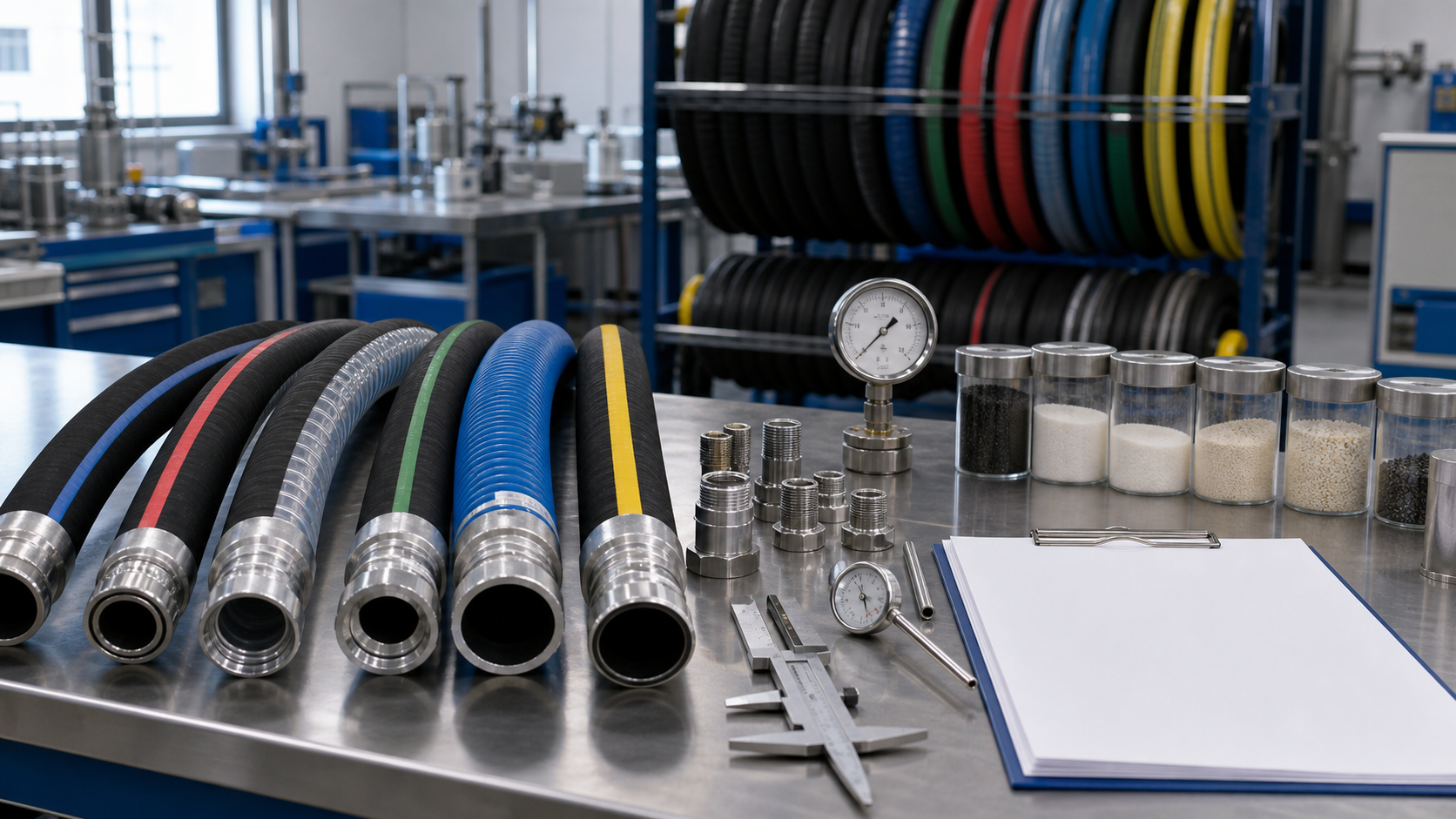
A hydraulic hose supplier audit should determine whether the factory can repeatedly produce the specified construction—not merely whether it can prepare an attractive sample. Hose performance depends on compound control, reinforcement, extrusion, braiding or spiraling, curing, testing, storage, traceability, and change management.
A practical hydraulic hose supplier audit checklist connects every observation to product risk. Buyers should review documents, walk the production flow, examine records, interview responsible personnel, and trace selected batches from raw material to shipment.
Define the Audit Scope
Before visiting, identify the products, standards, plants, processes, and customer program in scope. A factory manufacturing bulk hydraulic hose requires different capabilities from an assembly shop that only cuts hose and crimps fittings.
Request an organization chart, process flow, major equipment list, certifications, test capability, quality manual, recent audit summary, and product list. Select sample part numbers and batches to trace during the audit.
Audit Areas at a Glance
| Area | Evidence to review | Main risk |
|---|---|---|
| Quality system | Procedures, audits, corrective actions | Inconsistent control |
| Raw materials | Specifications, identity, storage | Wrong compound or wire |
| Production | Parameters and operator records | Process variation |
| Testing | Methods, calibration, reports | Unverified performance |
| Traceability | Batch records and labels | Inability to contain defects |
| Change control | Approval and notification | Unapproved substitutions |
| Packaging | Storage, caps, pallets | Damage or contamination |
Use the table to structure evidence, not as a yes/no shortcut.
Quality Management and Responsibility
Confirm who owns quality, production release, laboratory decisions, and customer complaints. Review internal audits, management review, document control, training, nonconformance handling, and corrective-action effectiveness.
Choose one recent problem and follow it from complaint through containment, root cause, action, and verification. A closed report without evidence of effectiveness is weak.
An established hydraulic hose factory should be able to explain how quality responsibilities work on the shop floor, not only show certification documents.
Raw-Material Control
Review how rubber, thermoplastic resin, reinforcement wire, textile yarn, chemicals, fittings, and packaging are approved and received. Check supplier qualification, incoming inspection, certificates, lot identification, shelf life, quarantine, and storage conditions.
Compound ingredients require accurate weighing and batch records. Reinforcement wire should be protected from corrosion and contamination. Materials should not be used after expiry without documented review.
Ask operators how they distinguish similar materials. Labels must remain linked to the batch after outer packaging is opened.
Compound Mixing and Tube Extrusion
For rubber-hose production, examine mixing instructions, equipment settings, batch identification, test sampling, and release. Review controls for hardness, density, rheology, or other defined compound properties.
At extrusion, check temperature, speed, dimensions, concentricity, surface condition, and online monitoring. Tube defects can affect fluid compatibility, fitting insertion, and adhesion.
The documented hydraulic hose manufacturing process should match actual practice. Unrecorded operator adjustments are a warning sign.
Reinforcement and Cover Application
Braiding and spiraling determine pressure performance. Review wire tension, angle, coverage, layer count, machine setup, splice control, and inspection frequency. Verify how setup changes are approved and recorded.
Cover extrusion or wrapping should control thickness, concentricity, surface quality, and adhesion. Layline content must match the approved product and remain traceable to the production batch.
Ask how the factory prevents mixed constructions when similar hoses run on adjacent lines.
Curing and Finishing
Review curing temperature, time, pressure, recipe control, chart retention, and equipment uniformity. Under-curing or over-curing can alter adhesion and mechanical properties.
After curing, inspect mandrel removal, cleaning, cutting, coiling, visual inspection, and dimensional checks. Finished hose should be protected from kinks, crushing, contamination, and excessively tight coils.
Laboratory and Product Testing
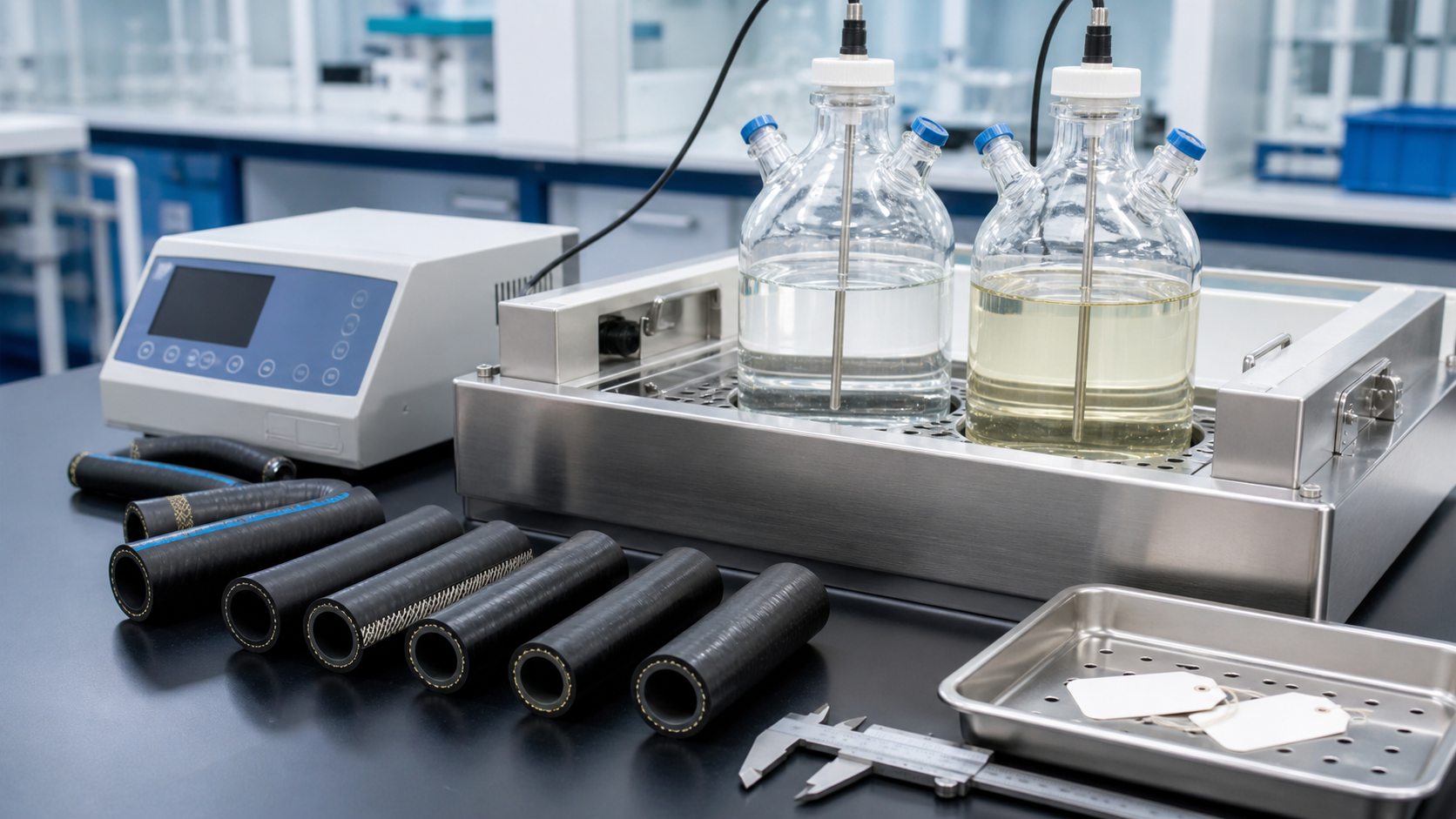
The audit should verify equipment, methods, competence, calibration, sample selection, environmental control, and report traceability. Relevant hydraulic hose testing may include dimensions, proof, burst, impulse, adhesion, leakage, change in length, cold flexibility, ozone, abrasion, and fluid aging.
Confirm whether the factory performs tests internally or uses external laboratories. For external work, review laboratory approval, sample identification, and report control.
Witness a test if practical. Check that technicians follow the current method and do not alter acceptance criteria after seeing results.
Calibration and Maintenance
Crimpers, pressure stands, impulse rigs, dimensional tools, scales, temperature sensors, and laboratory instruments require calibration or verification. Review status labels, records, out-of-tolerance response, and reference standards.
Production equipment also needs preventive maintenance. Examine recent maintenance history and how overdue work is managed. A machine can be calibrated yet mechanically unstable.
Traceability Exercise
Select a finished roll or assembly and trace backward to production date, line, operator, material batches, process parameters, inspection, and test release. Then choose a raw-material lot and trace forward to all affected finished goods.
The factory should demonstrate how it would contain a suspected batch. Traceability depth must match the buyer’s risk and contractual requirement.
Nonconforming Product
Inspect quarantine areas and disposition authority. Rejected material should be clearly identified and physically controlled. Review rework instructions, concessions, scrap handling, and reinspection.
Ask for examples of internal defects, not only customer complaints. A factory reporting no nonconformities may have weak detection or recording.
Engineering and Change Control
Review drawing approval, product qualification, formula control, tooling changes, process changes, and customer notification. Changes to compound source, reinforcement, fitting, production line, test method, or sub-supplier can affect performance.
Confirm how obsolete revisions are removed from production and how emergency substitutions are authorized. Sample approval should not permit later unannounced changes.
Assembly-Shop Controls
If finished assemblies are supplied, audit cutting, skiving, fitting identification, insertion depth, crimp settings, orientation, cleaning, capping, proof testing, and labeling. Operators should use validated hose-and-fitting combinations.
Examine crimper calibration and the management of crimp specifications. Mixed fittings or incorrect dies can create severe safety risks.
Storage and Shipping
Finished hose and fittings should be protected from UV, ozone, moisture, chemicals, dust, and deformation. Review shelf-life rules, stock rotation, coil diameter, pallet height, end protection, and container loading.
A qualified hydraulic hose supplier should preserve product condition through delivery, not only at final inspection.
Audit Scoring and Follow-Up
Classify findings by risk: critical, major, minor, and observation. Define containment and due dates. Critical issues affecting product safety or traceability may require approval to remain on hold.
Request objective evidence for closure and verify effectiveness. A revised procedure alone may not prove that operators were trained or the process changed.
Remote Audits and Follow-Up Visits
A remote audit can review procedures, records, certifications, test reports, and live video of selected processes. It is useful for preliminary qualification or follow-up, but it may not reveal material mix-ups, housekeeping, unrecorded adjustments, or the condition of quarantine and storage areas as reliably as an on-site visit.
Define which evidence must be shown live and prevent the supplier from substituting prerecorded material without disclosure. For high-risk products, use remote review to prepare the agenda, then confirm critical production and laboratory controls in person before full approval.
Final Audit Principles
A strong audit follows material and information through the factory. It tests whether documented controls work in daily production and whether deviations can be detected, contained, and corrected.
Supplier approval should combine audit evidence with product qualification, sample results, commercial capability, and ongoing performance monitoring.