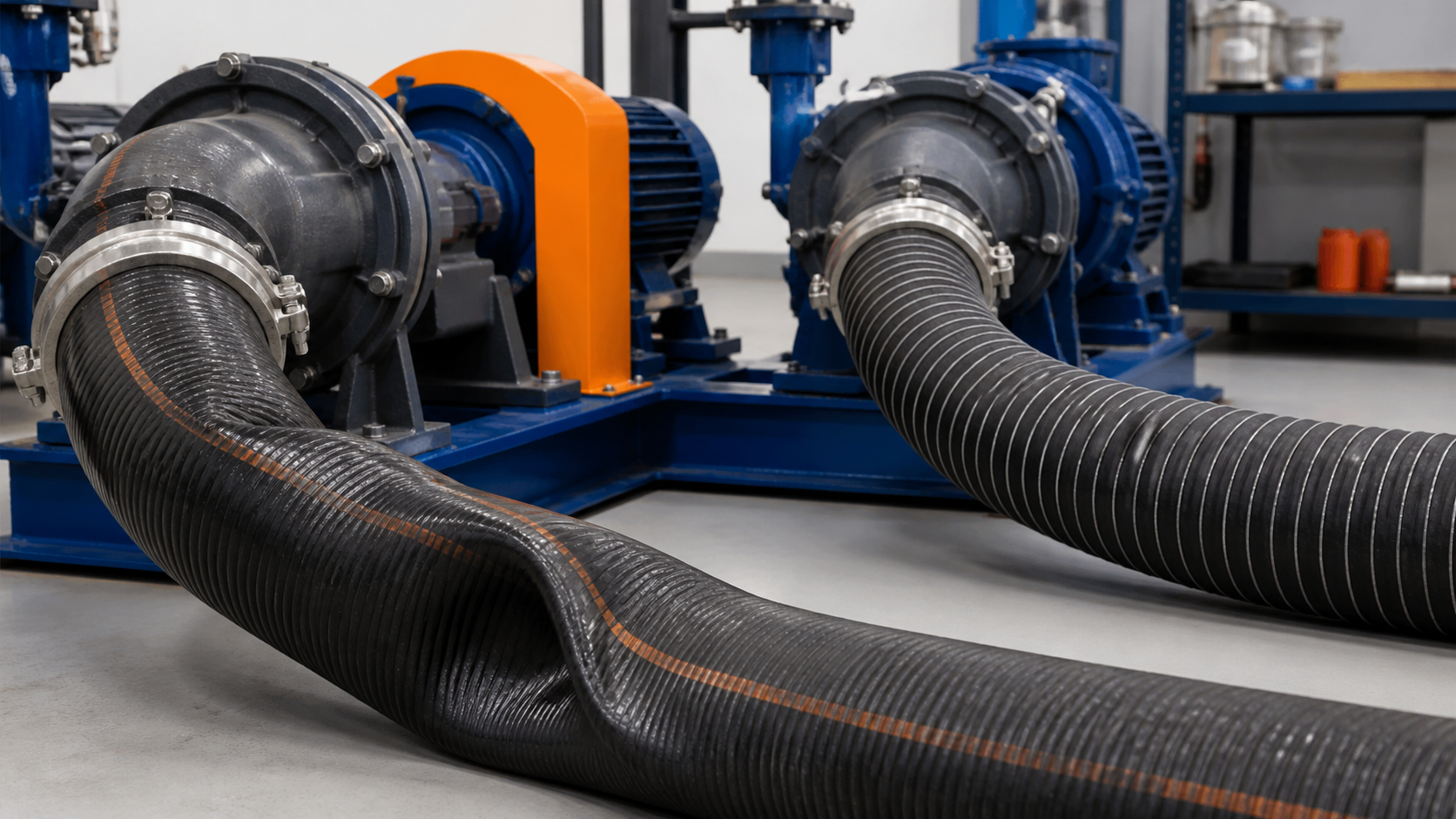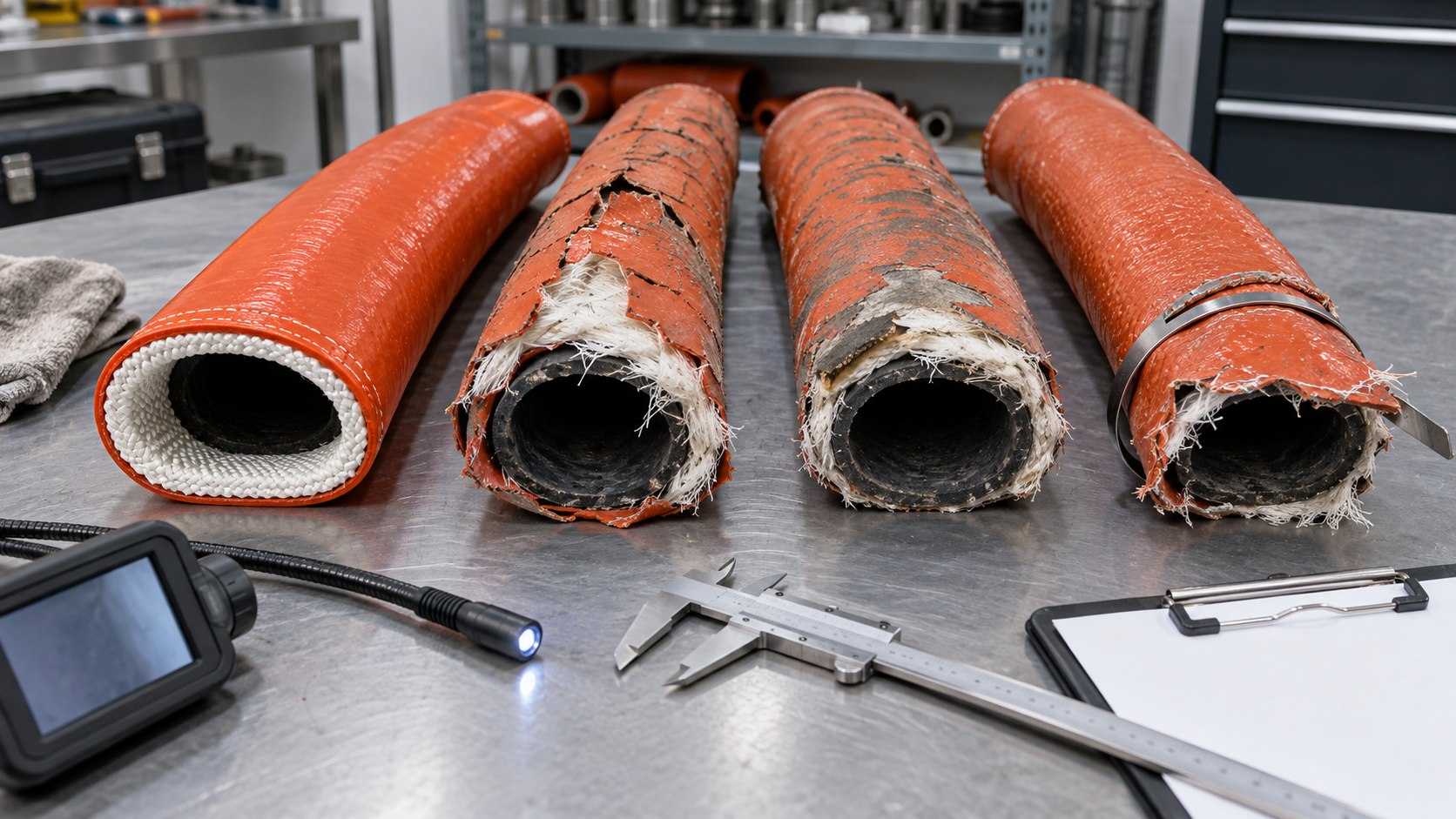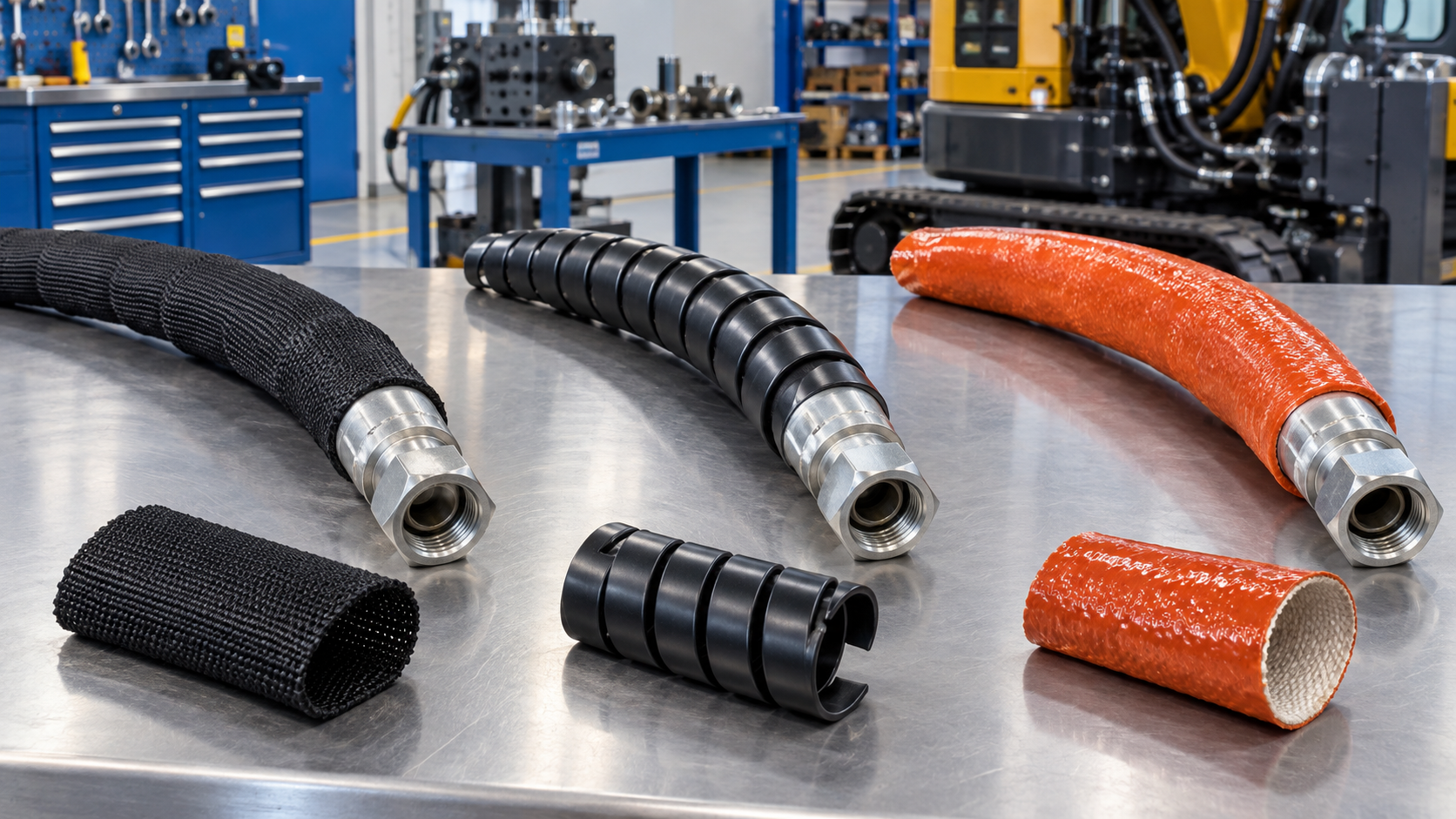
A sharp bend in a hydraulic hose is one of the most common — and most preventable — causes of premature hose failure. It does not take a major installation mistake to create one. A hose that is slightly too short, routed around a tight corner without an elbow fitting, or clamped too close to a port can all produce bends that violate the hose’s minimum bend radius. The result is reduced flow, internal damage, and eventually a hose that fails long before it should.
This guide explains why sharp bends are so damaging, how to identify when a bend has crossed the line, and the practical steps that prevent them during installation and routing.
Why Sharp Bends Cause Hose Failure

To understand why this matters, it helps to know what happens inside a hose when it is bent too tightly.
A hydraulic hose is built in three layers: an inner rubber tube, one or more reinforcement layers (steel wire braid or spiral), and an outer cover. These layers are designed to work together under axial pressure. When the hose bends, the outside of the bend stretches and the inside compresses. Within the specified minimum bend radius, the hose handles this stress without damage. Beyond it, the structure begins to break down.
The consequences happen in stages. First, the inner tube deforms and the reinforcement wires are pushed out of alignment. This creates a partial restriction in the bore — the cross-section narrows at the bend point, increasing flow velocity and generating local heat. Over time, the stressed reinforcement wires begin to fatigue and break, typically on the outside of the bend where the tensile stress is highest. The compromised wall then becomes a burst point. If the bend is severe enough to produce a full kink, the hose may collapse the bore entirely, causing immediate flow loss and a rapid pressure spike that can damage the pump, valves, and actuators downstream.
The fitting area is particularly vulnerable. A hose that begins bending immediately at the end of the crimp ferrule concentrates all the bending stress at the one point where the hose transitions from rigid to flexible. This is a very common failure location, and it is almost always caused by a hose that is too short, routed at the wrong angle, or connected to a port that requires an angled fitting.
Understanding Minimum Bend Radius
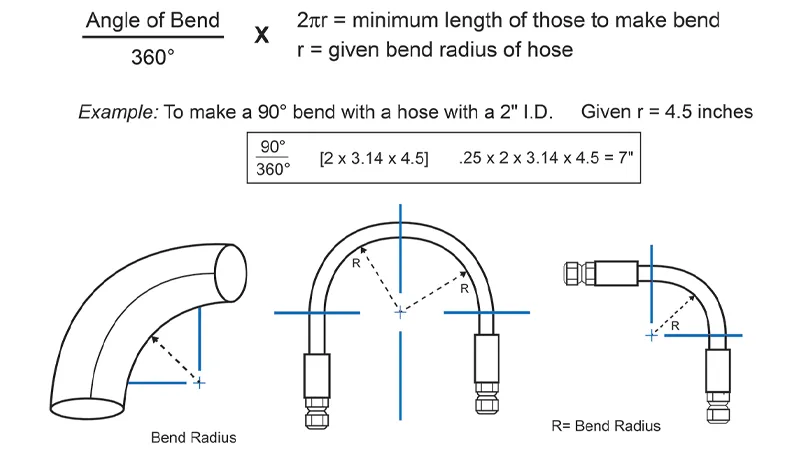
Every hydraulic hose has a published minimum bend radius (MBR) — the tightest curve the hose can follow without sustaining structural damage. This value is measured from the centerline of the hose to the inside edge of the bend and is listed in the manufacturer’s specification sheet for each hose type and diameter.
The MBR is not a conservative safety margin that can be ignored in tight spaces. It is an engineering limit derived from the hose’s construction. Two key variables drive it: inner diameter and reinforcement type. A larger bore hose has a larger MBR than a smaller one of the same construction. A spiral-wound hose (SAE 100R12, R13, R15) has a significantly larger MBR than a two-wire braid hose (SAE 100R2) at the same diameter, because the spiral reinforcement is stiffer.
There is also a distinction between static MBR and dynamic MBR. The static value applies to hoses in a fixed position. The dynamic value — used for hoses that flex repeatedly during operation, such as those on excavator booms or press cylinders — must be 30–50% larger than the static MBR to account for fatigue from repeated bending cycles. Using the static value for a dynamic application is a common mistake that leads to hose failures that seem to occur “too early.”
How to Prevent Sharp Bends: Practical Methods
1. Plan the Routing Before Cutting the Hose
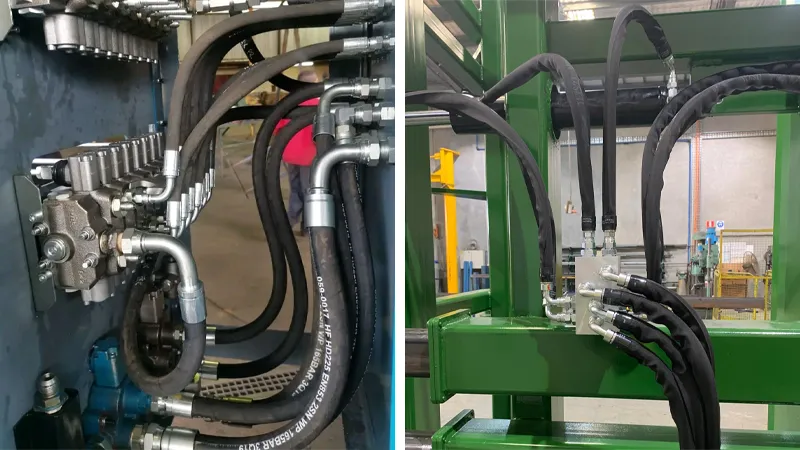
The most effective time to prevent sharp bends is before the hose assembly is made. Lay out the intended route, identify all direction changes, and determine whether each change can be handled by a gradual curve within the hose’s MBR or whether it requires a fitting solution.
A route that forces the hose to make a sharp turn immediately off a port fitting is a route that needs to be redesigned — either by repositioning a component, using an angled adapter at the port, or choosing a different path through the machine frame.
2. Use Elbow Fittings and Angled Adapters
When a direction change is unavoidable, the solution is to put the angle into the fitting rather than the hose. Elbow fittings are available in 45°, 90°, and other angles, in every standard thread form. A 90° elbow at the port allows the hose to exit in a direction that permits a smooth curve to its destination — without forcing the hose itself to bend sharply near the crimp.
This is the single most effective tool for preventing near-fitting failures. If you are regularly seeing hose failures at or just past the ferrule, the answer is almost always an angled fitting at that port.
3. Allow Adequate Hose Length — But Not Too Much
A hose that is too short will be pulled taut and forced into a tight bend to reach its connection point. This is a guaranteed failure. The rule is that a hose should never begin bending within a distance of two times its inner diameter from the end of the crimp ferrule. There must be a straight run out of the fitting before any curve begins.
At the same time, a hose that is excessively long creates its own problems — sagging loops that can kink under their own weight, and contact points with sharp edges or moving components. The correct length gives enough slack for the hose to move (if the application requires it) and to accommodate the small length changes that occur when the hose pressurizes, without being so long that it hangs freely and forms stress points.
4. Ensure Bends Stay in a Single Plane
A hydraulic hose should flex in one plane only. A bend that twists out of plane — where the hose curves in one direction and then rotates into another — creates combined bending and torsional stress that the hose is not designed to handle. This type of routing accelerates wire fatigue and dramatically shortens hose life.
If the routing geometry requires a direction change in a different plane, use two separate fittings to handle each direction change independently, rather than letting the hose itself absorb both movements.
5. Never Clamp a Hose at a Bend
Clamps and brackets are necessary to support hydraulic hoses, but they must be positioned on straight sections of hose — never at or through a bend. A clamp placed at a bend locks the hose into a fixed geometry, prevents it from responding naturally to pressure changes and movement, and concentrates fatigue stress at a single point. If the equipment vibrates (as most mobile and industrial equipment does), a clamp at a bend creates a classic fatigue failure site.
Clamp straight sections, and allow bends to remain free to flex naturally within their rated range.
6. Choose the Right Hose Construction for Tight Installations
Not all hoses have the same flexibility. If an installation genuinely requires a tighter bend than a standard hose allows, the answer is to select a hose with a smaller MBR rather than to force a standard hose into a bend it cannot handle.
Wire braid hoses (SAE 100R1, R2) are more flexible than spiral wound hoses at equivalent pressure ratings. Compact or “tight bend radius” hoses are available from most manufacturers for applications where space is severely constrained. Using a hose with an appropriate MBR for the actual installation geometry is always preferable to routing a stiffer hose too tightly.
7. Inspect Existing Installations for Hidden Bend Problems
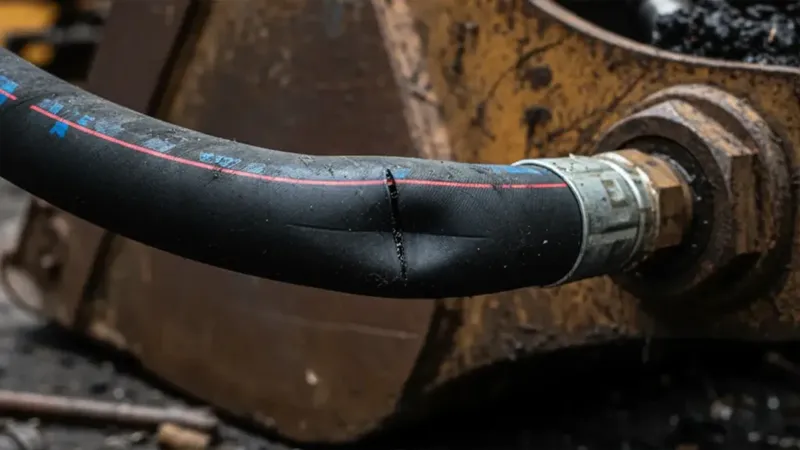
Sharp bends do not always reveal themselves immediately. A hose may be installed with a borderline bend radius and function for months before the accumulated fatigue damage causes it to fail. During routine inspections, check all hoses for:
- Any visible kink or permanent deformation along the hose body
- Bends that occur within the crimp ferrule zone
- Areas where the outside of a bend is visible and faces toward the operator (a burst at this location creates a direct injection hazard)
- Bends that appear tighter under working load than at rest (pressure causes hoses to shorten slightly and stiffen)
If any of these conditions are present, the assembly should be re-routed or replaced before failure occurs.
The Cost of Getting This Wrong
A hose that fails due to a sharp bend takes the entire hydraulic circuit offline until it is replaced. On mobile equipment, that means machine downtime. On a production line, it means lost output. The repair cost — parts, labor, lost production, and fluid cleanup — almost always far exceeds the cost of specifying the routing correctly in the first place, or adding an elbow fitting during installation.
Sharp bends are also a safety issue. A hose burst at the outside of a bend can inject hydraulic fluid at pressures above 200 bar. Hydraulic injection injuries are a medical emergency. The outside of any hose bend should never face toward an operator or service technician.
Summary
Preventing sharp bends in hydraulic hoses comes down to three consistent practices: respecting the minimum bend radius specified for each hose type, using angled fittings to handle direction changes rather than bending the hose, and allowing adequate hose length with straight exit sections from each fitting. These principles apply at initial installation and every time a hose assembly is replaced. Kingdaflex manufactures hydraulic hoses in wire braid and spiral configurations across a full range of pressure ratings and inner diameters, with published MBR values for every product in the catalog. If you are working on a routing challenge in a tight installation, contact our technical team — selecting the right hose construction and fitting angles at the design stage is far easier than diagnosing repeated failures after the machine is in service.