When most buyers specify a hydraulic or industrial hose, they focus on pressure rating, diameter, and fluid compatibility. Electrical properties rarely come up — until something goes wrong. A hose that conducts electricity where it shouldn’t can cause a fire. A hose that fails to dissipate static in a fuel transfer line can trigger an explosion. And a standard rubber hose near a live power line puts the operator at serious risk of electrocution.
The choice between a conductive and a non-conductive hose is not a subtle technical distinction. In the wrong application, it is a safety-critical decision. This guide explains what each type actually does, where each one belongs, and how to avoid the most common mistakes.
What Makes a Hose Conductive or Non-Conductive?
The answer lies in the materials used during construction — specifically the inner tube and reinforcement layers.
Standard rubber hoses with steel wire braid or spiral reinforcement are inherently conductive. The steel wire allows electrical current to pass through the hose wall. In most hydraulic applications, this is irrelevant. But it becomes dangerous whenever the hose is near a high-voltage source.
Conductive hoses designed for static dissipation take a different approach. Their inner tube is compounded with carbon black or other conductive additives, giving it a controlled, low electrical resistance. This allows static charge — generated by fluid moving through the hose at speed — to bleed off safely to ground rather than accumulate to a spark-generating level.
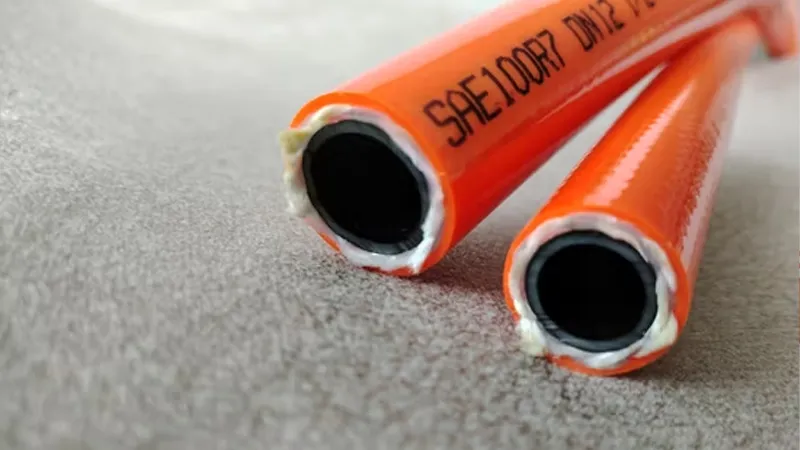
Non-conductive hoses are built to do the opposite: block electricity entirely. They use thermoplastic inner tubes (typically nylon or polyester elastomer) and synthetic fiber reinforcement (polyester or aramid braid) instead of steel wire. The result is a hose that acts as an electrical insulator. SAE J517 for 100R7 and 100R8 hoses requires leakage current below 50 microamps at 75,000 volts per foot of hose length — a standard that demands purpose-built construction and verified testing, not assumption.
An important point: a hose should never be assumed non-conductive just because it looks like it might be. Rubber formulations vary widely between manufacturers and even between production batches. Unless a hose is specifically manufactured, tested, and clearly marked as non-conductive, it must be treated as conductive.
Where Conductive (Static-Dissipating) Hoses Are Required
1. Fuel Transfer and Petroleum Dispensing
This is the most safety-critical application for static-dissipating hoses. When petroleum-based fuels move through a hose at flow rate, friction between the fluid and the inner tube generates static charge. If that charge is not continuously bled to ground through a conductive hose and proper grounding of the equipment, it accumulates until it discharges as a spark — directly into a fuel vapor environment.
Fuel delivery trucks, aviation refueling equipment, tank farm transfer lines, and portable fuel dispensing systems all require conductive hoses with verified static-dissipating inner tubes. This is not optional. It is required by industry standards and safety regulations in most markets.
2. Chemical Transfer of Flammable Solvents
Paint lines, solvent dispensing systems, chemical blending equipment, and coating application systems face the same static risk as fuel transfer. Many industrial solvents have lower ignition energy thresholds than petroleum fuels, meaning it takes even less static discharge to trigger combustion. In spray finishing booths, the combination of atomized solvent and static from hose flow is a documented cause of industrial fires. Conductive hose, properly grounded, eliminates the charge accumulation that creates this risk.
3. Sandblasting and Abrasive Media Transfer
Sandblast hoses require static-dissipating inner tubes for a different reason. The abrasive media — sand, steel shot, aluminum oxide, or other grit — moving at high velocity through the hose generates intense friction-based static. Without a conductive inner tube to dissipate this charge continuously, the hose builds up static that discharges through the operator or creates sparks near flammable materials. All properly specified sandblast hoses include a static-conductive rubber inner compound as a standard safety requirement.
4. Powder Transfer and Pneumatic Conveying
Industrial powder conveying — flour, pharmaceutical powders, plastic pellets, metal powders — shares the static generation problem. Fine particles moving through a hose create triboelectric charge just as fluids do. In environments where the powder itself is combustible (many are, including sugar, starch, aluminum powder, and many pharmaceutical compounds), static dissipation through a conductive hose and grounded system is a standard explosion prevention measure.
Where Non-Conductive Hoses Are Required
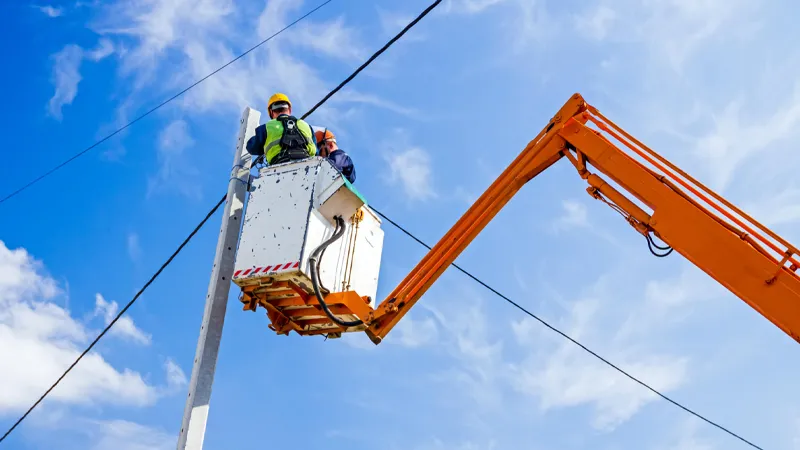
1. Aerial Work Platforms and Cherry Pickers
This is the definitive application for non-conductive hydraulic hose. Aerial lifts, bucket trucks, and boom lifts used by utility workers, telecommunications technicians, and tree surgeons routinely operate near energized power lines. The hydraulic circuit connects the upper boom — which may be meters from a live conductor — through the hose assembly to the lower frame of the vehicle.
If that hose contains steel wire reinforcement, it creates a conductive path from the boom to the operator platform and down to ground. The risk is electrocution. Non-conductive thermoplastic hoses (typically SAE 100R7 or 100R8) break that electrical path, making the hydraulic circuit itself part of the insulation system that protects the operator. This is a mandatory requirement, not an optional upgrade, and it is enforced through equipment standards in most countries.
2. Utility and Line-Work Equipment
Hydraulic tools used for live-line maintenance — insulated boom cranes, hotline tools, substations maintenance equipment — require non-conductive hydraulic hose throughout any circuit that could create a path between the energized work zone and a grounded component. Electricians and utility workers rely on non-conductive hose as part of the layered insulation system that keeps them alive.
3. Hydraulic Rescue Tools (Jaws of Life)
Emergency rescue tools — spreaders, cutters, rams — are used at accident scenes that often involve damaged electrical infrastructure. A vehicle accident near a power pole, a building collapse near an energized service entrance, or a rescue in a flooded environment with unknown electrical hazards all create situations where hydraulic hose must not conduct electricity. Non-conductive thermoplastic hose is standard on rescue tool systems for this reason.
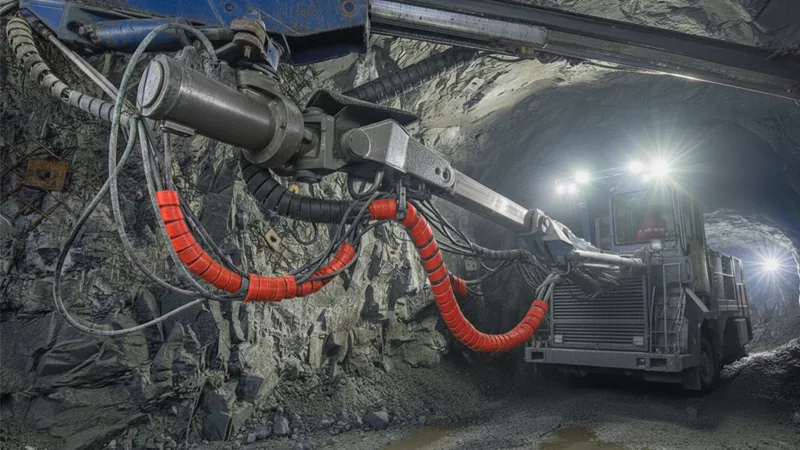
4. Mining Equipment in Electrically Hazardous Zones
Underground mining operations, particularly coal mines, operate in environments where methane gas and coal dust create explosion hazards, and where electrical systems run throughout the tunnels. Equipment hydraulic circuits that could bridge ground faults or create unintended electrical paths are specified with non-conductive hose to eliminate both shock and ignition risk. This requirement often overlaps with anti-static requirements, and some hoses in mining applications need to satisfy both: non-conductive enough to block high-voltage paths, but not so insulating that static charge accumulates without a path to ground.
5. Agricultural Equipment Near Power Lines
Tractors and sprayers working in fields with overhead power lines present a real but often underestimated electrical hazard. Tall boom sprayers, grain augers, and high-clearance equipment can contact overhead conductors. Non-conductive hydraulic hose on these machines prevents the electrical path from reaching the operator through the hydraulic controls.
Quick Selection Reference
| Application | Hose Type Required |
|---|---|
| Fuel transfer and dispensing | Conductive (static-dissipating) |
| Flammable solvent and chemical transfer | Conductive (static-dissipating) |
| Sandblasting | Conductive (static-dissipating) |
| Combustible powder conveying | Conductive (static-dissipating) |
| Aerial work platforms / cherry pickers | Non-conductive (SAE 100R7/R8) |
| Live-line utility maintenance equipment | Non-conductive |
| Hydraulic rescue tools | Non-conductive |
| Underground mining (electrical hazard zones) | Non-conductive or dual-spec |
| Agricultural equipment near power lines | Non-conductive |
| Standard industrial hydraulic systems | Standard wire-braided rubber hose |
Getting the Right Hose for Your Application
Kingdaflex manufactures both conductive and non-conductive hose assemblies for industrial, hydraulic, and specialty applications. Our non-conductive thermoplastic hoses meet SAE J517 requirements for 100R7 and 100R8, and our static-dissipating hoses are built with verified conductive inner tube compounds for fuel transfer, chemical handling, and abrasive media applications.
If you are specifying hose for an application with electrical hazards — in either direction — contact our technical team with the application details. Getting this selection right matters.