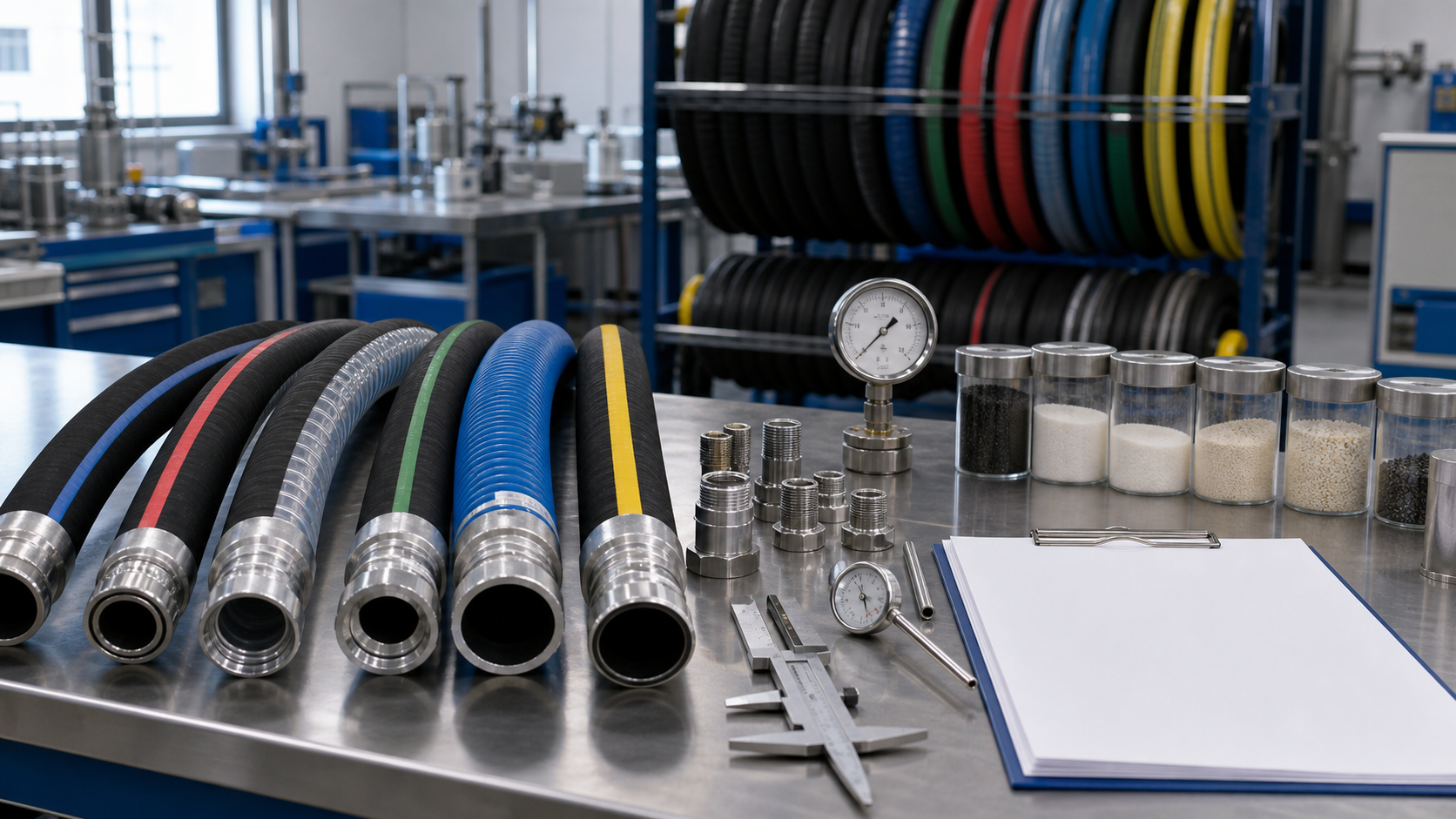
Before an OEM releases a new hydraulic hose assembly for volume production, it should confirm that the supplier can manufacture the exact design and provide evidence that the sample meets requirements. This controlled review is commonly called first article approval or first article inspection.
A strong hydraulic hose first article approval process covers the physical sample, drawing, bill of materials, dimensions, fittings, clocking, cleanliness, markings, packaging, and test reports. It prevents a visually acceptable prototype from entering production with hidden specification gaps.
When First Article Approval Is Needed
First article approval is appropriate for a new part, new supplier, new plant, new hose or fitting combination, significant drawing revision, process transfer, tooling change, or material substitution. It may also be required after a long production interruption.
The buyer’s quality plan should define which changes trigger a new submission. Without that rule, suppliers may treat a revised fitting finish or production line as a minor internal change even when the OEM expects reapproval.
What the Submission Should Contain
| Submission item | Purpose |
|---|---|
| First article sample | Confirms physical fit and workmanship |
| Ballooned drawing | Links dimensions to inspection results |
| Dimensional report | Records measured values and tolerances |
| Bill of materials | Identifies hose, fittings, sleeves, labels |
| Material evidence | Confirms approved compounds and components |
| Test reports | Demonstrates specified performance |
| Process flow/control plan | Shows production controls |
| Packaging sample | Confirms protection and identification |
| Deviation list | Makes exceptions visible before approval |
The required depth should match application risk, volume, and customer requirements.
Freeze the Technical Baseline
First article review requires a controlled drawing and specification. The package should identify part number, revision, units, hose product, size, length, end fittings, clocking, sleeves, labels, cleanliness, testing, and packaging.
Reference applicable hydraulic hose specifications precisely. Avoid notes such as “standard hose” or “high-pressure fitting” that permit multiple interpretations.
The supplier should list assumptions and deviations in writing. Silence should not be treated as approval of an undocumented alternative.
Sample Selection and Identification
Samples should be manufactured using intended production materials, equipment, tooling, operators, and process settings. A hand-built engineering sample may demonstrate fit but not production capability.
Identify each sample with the part number, revision, production date, batch, and sample number. The dimensional and test records must clearly link to the submitted parts.
If several cavities, crimpers, production lines, or plants will be used, the quality plan should state whether each source requires a sample.
Ballooned Drawing and Dimensional Report
A ballooned drawing assigns a number to every inspectable characteristic. The report uses the same numbers, reducing ambiguity.
Typical characteristics include:
- Overall or cut length
- Hose inside and outside diameter where required
- Fitting type and thread dimensions
- Flange or sealing-face features
- Clocking between angled ends
- Crimp diameter and position
- Insertion depth evidence
- Sleeve and label locations
- Bend restrictor dimensions
- Packaging coil diameter
Record specification, tolerance, measurement method, instrument, actual result, and acceptance. Do not report only “pass” when variable data is expected.
Bill of Materials and Traceability
The bill of materials should identify the exact bulk hose, inserts, ferrules, adapters, O-rings, sleeves, guards, labels, caps, and packaging. Manufacturer part numbers and material specifications reduce substitution risk.
For custom hydraulic hose assemblies, traceability should link each first article to hose and fitting lots and the crimp specification used. Define which of these details must remain traceable during normal production.
Crimp and Assembly Process Evidence
Review cutting, skiving if applicable, fitting insertion, orientation, crimping, cleaning, inspection, capping, and packaging. The supplier should show that tools and crimpers are calibrated or verified.
Crimp acceptance may include target diameter, tolerance, appearance, insertion position, and destructive validation. A correct outside crimp diameter alone does not prove the fitting system is approved or the tube is undamaged.
An experienced hydraulic hose manufacturer should maintain controlled assembly parameters and prevent operators from combining visually similar components.
Functional Fit Review
Install at least one sample on representative equipment or a validated fixture when possible. Confirm that connections mate correctly, angled fittings align, hose length provides controlled slack, bend radius is maintained, and sleeves protect the intended areas.
Move the machine through all operating, transport, and service positions. Check for twist, tension, snagging, abrasion, fitting side load, and clamp interference.
A sample can meet drawing dimensions yet fail to fit because the drawing omitted a functional requirement. Update the drawing before approval rather than relying on tribal knowledge.
Test Reports
The required hose test reports depend on the product and application. They may include proof pressure, leakage, burst, impulse, change in length, adhesion, cold flexibility, ozone, abrasion, fluid compatibility, cleanliness, conductivity, or flame performance.
The report should identify sample, method, equipment, calibration status, conditions, results, acceptance criteria, date, and approver. Clarify whether the test qualifies the hose family, the finished assembly, the batch, or the individual sample.
Do not request destructive tests on the only sample intended for installation. Plan enough samples for dimensional, functional, and destructive evaluation.
Cleanliness, Caps, and Packaging
If system cleanliness matters, specify the cleaning method, quantitative target or acceptance method, verification frequency, and approved caps. A clean sample does not prove production control unless the process is documented.
Evaluate packaging as part of the first article. Fittings should be protected, caps should stay installed, labels should remain readable, and the coil should not violate minimum bend radius.
Managing Deviations
A deviation is a proposed exception to the approved requirement. It should identify the affected characteristic, reason, risk, duration or quantity, and corrective plan. Approval should come from authorized customer functions.
Temporary deviation approval must not silently change the drawing for future orders. Permanent changes require formal revision and, when necessary, a new first article.
Approval Status
Use clear outcomes: approved, conditionally approved, or rejected. Conditional approval should list actions, quantities, and deadlines. Approval should identify the part number, revision, supplier, factory location, and effective date.
Retain the approved package and, where useful, a master sample. Production inspection plans should flow from the critical characteristics established during approval.
After Approval
Monitor early production through incoming inspection, capability data, test records, and field feedback. First article approval confirms one controlled submission; it does not replace ongoing process control.
Define supplier notification requirements for material, process, plant, tooling, sub-supplier, and test-method changes. Periodic requalification may be appropriate for critical or low-frequency products.
Managing an Approved Master Sample
A retained master sample can support visual comparison of workmanship, fitting orientation, label placement, sleeve position, and packaging. Identify it clearly, seal it from contamination, record its approval revision, and protect it from sunlight, ozone, moisture, and bending damage.
The master sample must not override the drawing. If the two disagree, stop and resolve the controlled specification rather than copying the sample. Define retention time and replacement rules, especially when rubber aging could make an old sample physically unrepresentative.
Final Approval Principles
First article approval creates the technical baseline for repeat production. Samples prove physical output, drawings define requirements, and test reports provide performance evidence.
When these elements remain linked by revision control and traceability, OEM buyers can approve hydraulic hose assemblies with fewer assumptions and manage future changes more reliably.