Snowplows, salt spreaders, de-icing trucks, municipal tractors, and airport winter-service vehicles must work when temperatures are low and roads are covered with water, salt, ice, and abrasive debris. Their hydraulic hoses power blade lift and angle functions, wings, spreader drives, dump bodies, augers, conveyors, steering, and auxiliary attachments.
Cold weather changes both the hydraulic fluid and the hose. At the same time, road salt attacks fittings, ice restricts movement, and exposed assemblies can be struck by snowbanks or debris. Selecting a cold weather hydraulic hose for snowplow equipment therefore requires a complete review of temperature, pressure, impulse, fluid, routing, abrasion, corrosion, and maintenance.
Define the Winter-Service Duty
Winter fleets include pickup-mounted plows, heavy highway trucks, airport runway equipment, loaders, compact tractors, sweepers, and combination spreader vehicles. A hose on a front blade may flex and receive road spray continuously, while a hose inside a protected power unit experiences a more stable environment.
Identify each circuit and its operating pattern:
- Blade lift, angle, wing, and trip-control functions
- Spreader motors, augers, and conveyor drives
- Dump-body and tailgate cylinders
- Steering and braking circuits
- Attachment quick-connect lines
- Return, case-drain, and suction lines
Record continuous pressure, transient peaks, flow, hose size, minimum startup temperature, warmed fluid temperature, movement, and exposure. Do not specify the entire vehicle from one general system rating.
Why Low Temperature Changes Hose Performance
Elastomers and thermoplastics can become stiffer as temperature falls. Reduced flexibility increases bending stress and can transfer more load to fittings. A hose that routes comfortably in a warm workshop may resist movement outdoors or kink when a blade reaches its full angle.
Cold hydraulic fluid becomes more viscous. This increases pressure loss in hoses, fittings, filters, and valves. Return-line backpressure and pump-inlet restriction may rise during startup, while actuators respond more slowly. Operators may command repeated movement before the system warms, creating additional pressure cycles.
Review cold-weather hose performance for the complete temperature range, not just the lowest catalog number. The minimum stated temperature should apply to the intended use and construction. Static exposure, occasional flexing, and continuous dynamic flexing may have different limits.
Rubber and Thermoplastic Options
Rubber hydraulic hose is common on mobile equipment because it combines flexibility, pressure capacity, and vibration resistance. Compound selection determines how well the tube and cover retain their properties in cold conditions.
A thermoplastic hydraulic hose may provide low weight, compact routing, and useful low-temperature flexibility in selected designs. It can be attractive for control lines or crowded attachment areas. However, thermoplastic constructions have their own bend, abrasion, permeation, fitting, and temperature characteristics.
Neither material family is automatically superior. Compare the exact hose construction at the required pressure, size, temperature, movement, and fluid. A product approved for cold static storage may not be the correct choice for repeated flexing at the same temperature.
Pressure and Impulse During Plowing
Blade impact, packed snow, frozen mechanisms, sudden valve closure, and cylinder end stops can create pressure spikes. Relief settings offer important information but may not capture every transient event.
Choose a high-pressure hydraulic hose using its rated working pressure for the selected bore. Confirm impulse performance and temperature derating. Burst pressure is a safety-related test value, not an operating pressure.
Do not overlook lower-pressure lines. Cold oil, restrictive fittings, contaminated filters, or an undersized return hose can produce significant backpressure. Suction lines must remain open under vacuum and should be generously sized to limit pump-inlet loss during a cold start.
Road Salt and Corrosion
Chloride-rich spray can remain on fittings, ferrules, clamps, and damaged hose covers. Repeated wetting and drying accelerates corrosion, especially where protective finishes are scratched or salt is trapped beneath a guard.
Specify suitable fitting materials or corrosion-resistant finishes for the service environment. Review compatibility between fittings, adapters, clamps, and surrounding metals. Wash equipment according to the vehicle manufacturer’s maintenance guidance and inspect after the season before storage.
Rust staining at a ferrule, cracked finish, or exposed reinforcement deserves investigation. Applying paint over corrosion does not restore the strength of an assembly.
Spare hoses should be clean, dry, capped, protected from UV, and stored away from de-icing chemicals. Rotate inventory so emergency replacements have not exceeded the supplier’s recommended storage period.
Routing Around Plows and Attachments
Front-mounted equipment combines articulation with exposure. Hoses must allow blade lift, angling, wing movement, vehicle turning, and attachment connection without tension, crushing, or excessive loops.
Check routing in every working and transport position. Maintain minimum bend radius, keep the first bend away from the fitting, and prevent twist. Use the layline to confirm that the hose bends in one plane rather than spiraling.
Keep hoses away from pinch points, sharp brackets, tire paths, exhaust heat, and direct contact with the road. Provide enough slack for movement but avoid loops that can catch on a snowbank or attachment frame. Quick couplings should be supported so their weight does not pull on the hose.
Ice accumulation can change the available space and restrict a hose bundle. Guards and clamps should shed water where possible and remain functional when contaminated with slush.
Abrasion and Protective Measures
Road grit, sand, frozen debris, and repeated movement can wear through the cover. Choose an abrasion-resistant construction when justified, but first correct unnecessary contact.
Spiral guards or textile sleeves can protect exposed zones. A sleeve can also help contain spray after a failure, but it should not trap salt or conceal deterioration. Inspect beneath movable protection and replace guards that have shifted or become brittle.
Near engines, exhaust after-treatment, or hot spreader components, verify the hose’s ambient-temperature limit. Cold-weather capability does not provide automatic protection from local heat.
Fluid Compatibility and Seasonal Maintenance
The tube must be compatible with the exact hydraulic fluid and its additives. Low-temperature hydraulic fluids may use different base oils or viscosity modifiers from standard fleet oils. Provide the fluid manufacturer and product name when requesting hose approval.
Mixing fluids during seasonal service can change viscosity, seal behavior, and compatibility. Follow the equipment and fluid suppliers’ procedures for draining, filling, filtration, and contamination control. Review O-rings, seals, accumulators, and quick couplings along with the hose.
Water contamination is particularly harmful in freezing conditions. It can contribute to corrosion, restricted components, and unpredictable operation. Maintain reservoir breathers and seals, and investigate cloudy fluid or repeated filter problems.
Fittings and Assembly Quality
Use an approved hose, fitting, ferrule, and crimp combination. Components that look compatible may not provide validated retention or sealing. Confirm the thread, connection standard, seal type, material, pressure class, and angular orientation.
Field-made replacements should be cleaned and capped before installation. Measure the required cut length and fitting orientation from controlled records where possible, because an old emergency hose may have been incorrectly routed.
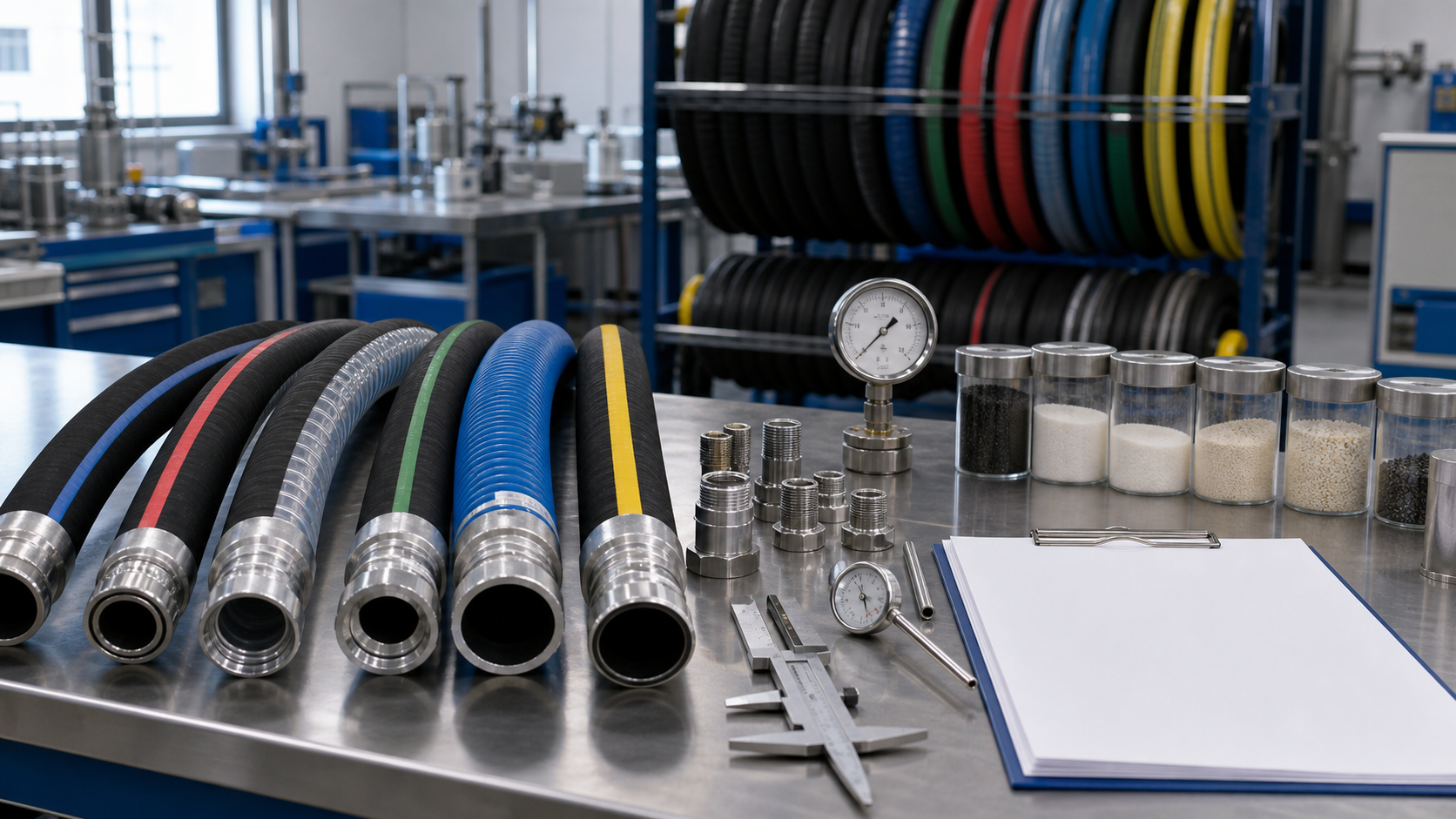
The hydraulic hose range includes constructions for different circuit duties. Procurement teams should specify the approved product and assembly details rather than order only by dash size and end connection.
Inspection During the Winter Season
Daily walk-around checks should focus on blade pivot areas, quick couplings, exposed front-frame hoses, spreader drives, dump cylinders, and clamps. Look for:
- Cracks, hardening, kinks, or flattened sections
- Cover abrasion or exposed reinforcement
- Corrosion at fittings and ferrules
- Leaks, wetness, or movement at connections
- Ice that prevents normal hose movement
- Twisted routing or a pulled protective sleeve
- Contact in full blade and steering positions
Depressurize and secure the vehicle before touching an assembly. Never use a hand to search for a pressurized pinhole leak.
Track failures by vehicle position and cause. If the same hose repeatedly fails, inspect length, routing, support, pressure spikes, and operator movement rather than installing another identical part.
RFQ and Fleet Specification Checklist
Provide vehicle and attachment model, circuit function, hose bore and length, maximum and surge pressure, flow, hydraulic fluid, minimum dynamic temperature, maximum fluid and ambient temperature, bend radius, movement, abrasion and salt exposure, fittings, orientation, guards, cleaning, testing, identification, quantity, and packaging.
A position-based hose database allows municipal and contractor fleets to standardize replacements before the next storm.
Final Selection Principles
Winter-service hoses must remain functional through cold starts, pressure cycles, articulation, abrasion, salt spray, and seasonal storage. The correct selection combines verified low-temperature performance with pressure capacity, fluid compatibility, corrosion control, routing, and an approved fitting system.
When these requirements are documented and supported by regular inspection, snowplow and de-icing fleets can reduce mid-storm failures and keep critical roads, yards, and runways in service.