Slurry hose life can vary dramatically even when two lines carry the same named material. Particle size, shape, hardness, concentration, velocity, pump behavior, hose diameter, and bend layout determine where abrasive energy is applied. A small change in routing or production rate can turn a long-lasting assembly into a frequent maintenance problem.
Effective slurry hose wear management begins with understanding the flow, not merely choosing the thickest available tube. The goal is to balance transport efficiency, resistance to settling, pressure loss, flexibility, and predictable wear.
How Slurry Erodes a Hose
Slurry combines a carrier liquid with suspended solids. Particles can slide, roll, or strike the tube. On a straight run with stable flow, wear may be relatively even. At bends, reducers, fittings, or disturbed flow, particles change direction and impact local surfaces.
The tube gradually loses thickness. If wear reaches reinforcement, pressure capability and structural integrity decline quickly. A leak may begin as a small pinhole but can expand under pressure and release a large volume of abrasive material.
The Main Wear Drivers
| Variable | Typical effect on wear |
|---|---|
| Particle size | Larger particles carry more impact energy |
| Particle shape | Sharp particles cut more aggressively |
| Mineral hardness | Hard solids abrade the tube faster |
| Solids concentration | More particles increase contact |
| Velocity | Higher speed raises impact and erosion rate |
| Bend radius | Tight bends concentrate impact |
| Hose diameter | Influences velocity and settling |
| Pump pulsation | Creates unstable movement and local stress |
| Tube compound | Controls cutting, rebound, and abrasion resistance |
| Rotation/support | Changes where wear accumulates |
These variables interact. A soft, fine slurry at moderate velocity may be easy to handle, while coarse angular ore in a tight high-speed bend can be extremely severe.
Particle Size and Shape
Larger particles have more mass and resist changes in direction. At a bend, they continue toward the outer wall and strike it with greater energy. Wide particle-size distribution can also change flow behavior as fine material fills spaces between coarse particles.
Angular crushed rock tends to cut and gouge, while rounded particles may roll and polish. Fibrous or elongated solids can catch at restrictions. Provide the hose supplier with representative particle distribution, maximum size, shape, and hardness rather than a general description such as “sand” or “tailings.”
Oversize material can enter after screen damage or a process upset. Design and inspection plans should address the worst credible solids, not only laboratory averages.
Solids Concentration
Higher solids concentration means more contact, but wear behavior is not always linear. At some concentrations, particles shield the wall or alter flow; at others, collisions and impact increase sharply. Settling behavior also changes.
Specify concentration by weight or volume and state the expected range. Include density of solids and carrier liquid. A slurry that becomes diluted during washdown may flow faster through the same pump system, changing erosion even though solids concentration falls.
Velocity: Too High and Too Low Both Cause Problems
High velocity increases particle impact energy and can accelerate tube erosion, especially at bends and fittings. It also increases pressure loss and pump energy.
Velocity that is too low allows solids to settle. A stationary bed reduces the effective bore, raises local velocity above the deposit, and can create plugging. Restarting a settled line may require high pressure and produce a sudden slug of abrasive material.
The correct transport velocity depends on particle settling characteristics, concentration, pipe angle, hose diameter, and process variability. Use slurry-system calculations and operating data rather than a universal target.
Hose Diameter
For a given volumetric flow, smaller bore increases average velocity. Moving to a larger slurry suction hose can reduce wear and pressure loss, but an oversized line may encourage settling.
Diameter changes also create turbulence. Avoid abrupt reducers where practical, particularly immediately before a bend. Use transitions designed for slurry service and consider the direction of flow.
Confirm that the pump can operate efficiently at the selected diameter and flow. A hose change that shifts the pump away from its preferred range can introduce vibration, cavitation, or unstable output.
Bend Radius and Layout
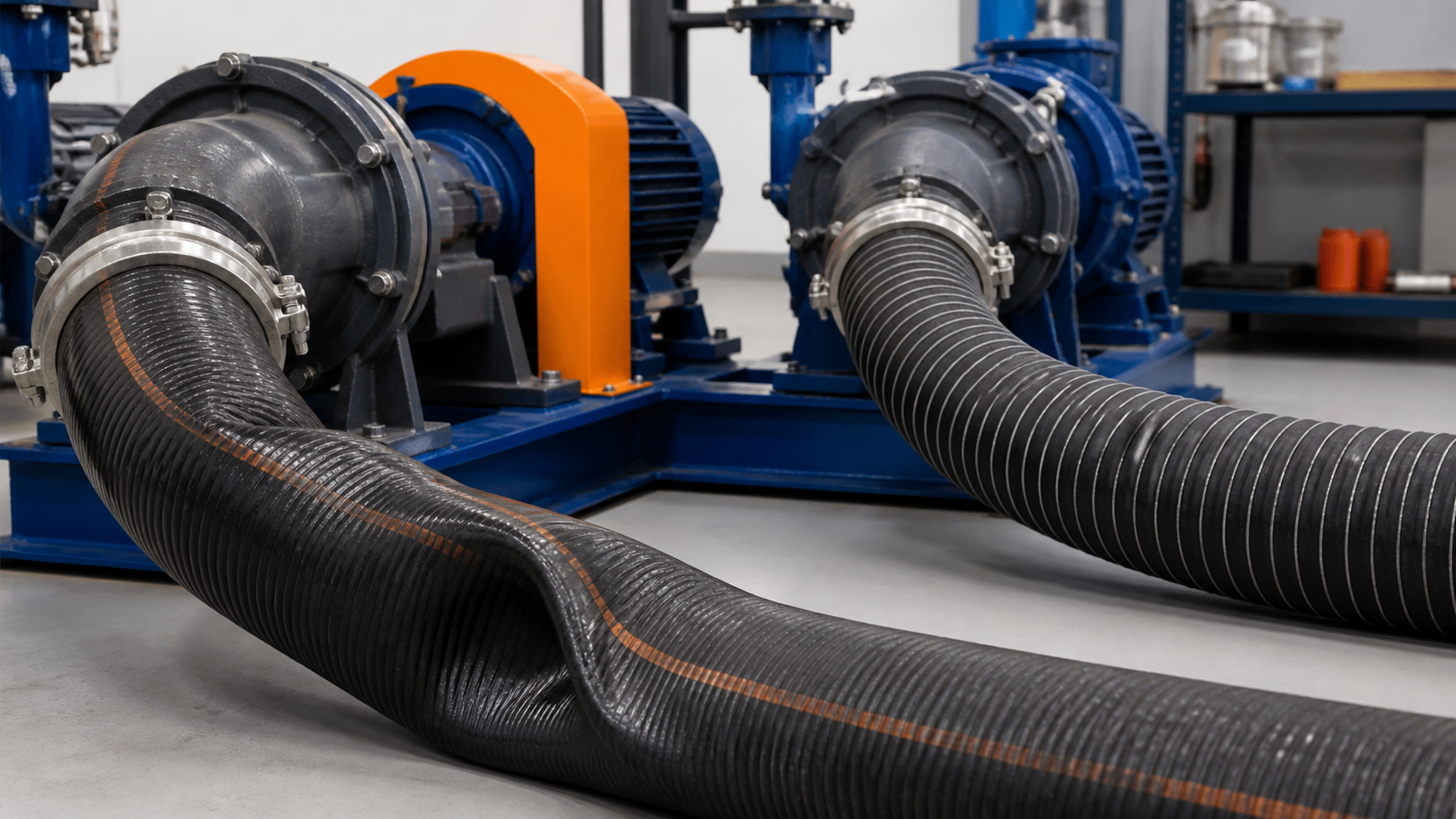
Bends are often the first wear points. Particles move toward the outer radius, producing a concentrated impact zone. A tight bend changes direction more abruptly and generally increases localized attack.
Use the largest practical bend radius and minimize the number of changes in direction. Avoid an elbow or tight hose bend directly after a pump, valve, reducer, or tee where flow is already disturbed.
Support the hose so it maintains a smooth curve when full. Slurry weight can make an initially acceptable route sag into a sharper bend. Allow movement without letting the hose rub on steelwork or the ground.
Suction vs Discharge Service
On the suction side, vacuum resistance and liner stability are essential. An unsuitable hose can flatten or delaminate, creating restriction and severe local wear. Cavitation or air ingress can further disturb flow.
On the discharge side, pressure, surge, and pulsation usually control reinforcement needs. A suitable suction and discharge hose can serve dual-direction systems when its ratings match both conditions.
Specify whether the line is always full, periodically drained, primed with water, or cleaned by reverse flow. Those operating modes affect both wear and coupling retention.
Tube Compound and Wall Design
Abrasion resistance is not defined by hardness alone. A resilient rubber may absorb impact and allow particles to rebound, while an excessively hard or brittle material can cut or crack. Heat, chemicals, oil contamination, and aging can change tube behavior.
A rubber mining hose may use a thick wear tube and heavy reinforcement for demanding duty. Select construction based on slurry and mechanical conditions rather than wall thickness alone.
Ask for relevant abrasion data, field references, permissible wear, pressure rating after expected tube loss, and recommended inspection method. Laboratory abrasion tests help compare compounds but may not reproduce the site’s particle impact pattern.
Pumps, Valves, and Fittings
Pump pulsation can make particles accelerate and decelerate repeatedly. Cavitation introduces bubbles and shock that damage both equipment and hose. Operate the pump within its intended range and investigate noise, vibration, unstable pressure, or declining output.
Full-bore valves and smooth fittings generally disturb slurry less than abrupt internal steps. Misaligned flanges, protruding gaskets, worn reducers, and partially open valves create jets that erode downstream hose.
Place sacrificial spools or replaceable wear sections at predictable high-wear locations when the system design permits.
Rotate Only Under a Controlled Plan
Rotating a straight or gently curved hose can distribute wear around its circumference. However, rotation can also move a thin area into a higher-stress position, twist the assembly, or misalign couplings.
Follow manufacturer guidance. Mark the original orientation, define rotation angle and interval, depressurize and isolate before work, inspect during rotation, and record thickness readings. Do not rotate hose with exposed reinforcement or below its rejection limit.
Measure Wear Before Leakage
Condition-based replacement is safer and more economical than waiting for failure. Establish baseline wall thickness or another approved condition measure when the hose is new.
Inspect the outer radius of bends, downstream sides of fittings, low points, pump connections, and sections exposed to external abrasion. Use a consistent ultrasonic, mechanical, or internal inspection method suitable for the construction.
Trend actual values against operating hours or tonnage. A changing wear rate is more informative than one measurement. Shorten inspection intervals after a production increase, slurry change, pump modification, route change, or unexpected reading.
Service-Life Improvement Checklist
- Characterize particle size, shape, hardness, and concentration.
- Control flow within the transport window.
- Select bore using slurry calculations.
- Use broad bends and smooth transitions.
- Support the hose in its full operating condition.
- Avoid disturbed flow immediately before bends.
- Select tube compound and thickness for the impact mode.
- Maintain pump, valves, screens, and fittings.
- Measure high-wear locations and trend results.
- Replace before reinforcement is compromised.
Procurement Information
When requesting a mining hose, provide flow range, pressure and vacuum, temperature, particle distribution, solids density, concentration, chemical composition, route, bend radius, movement, coupling details, required length, and expected operating hours.
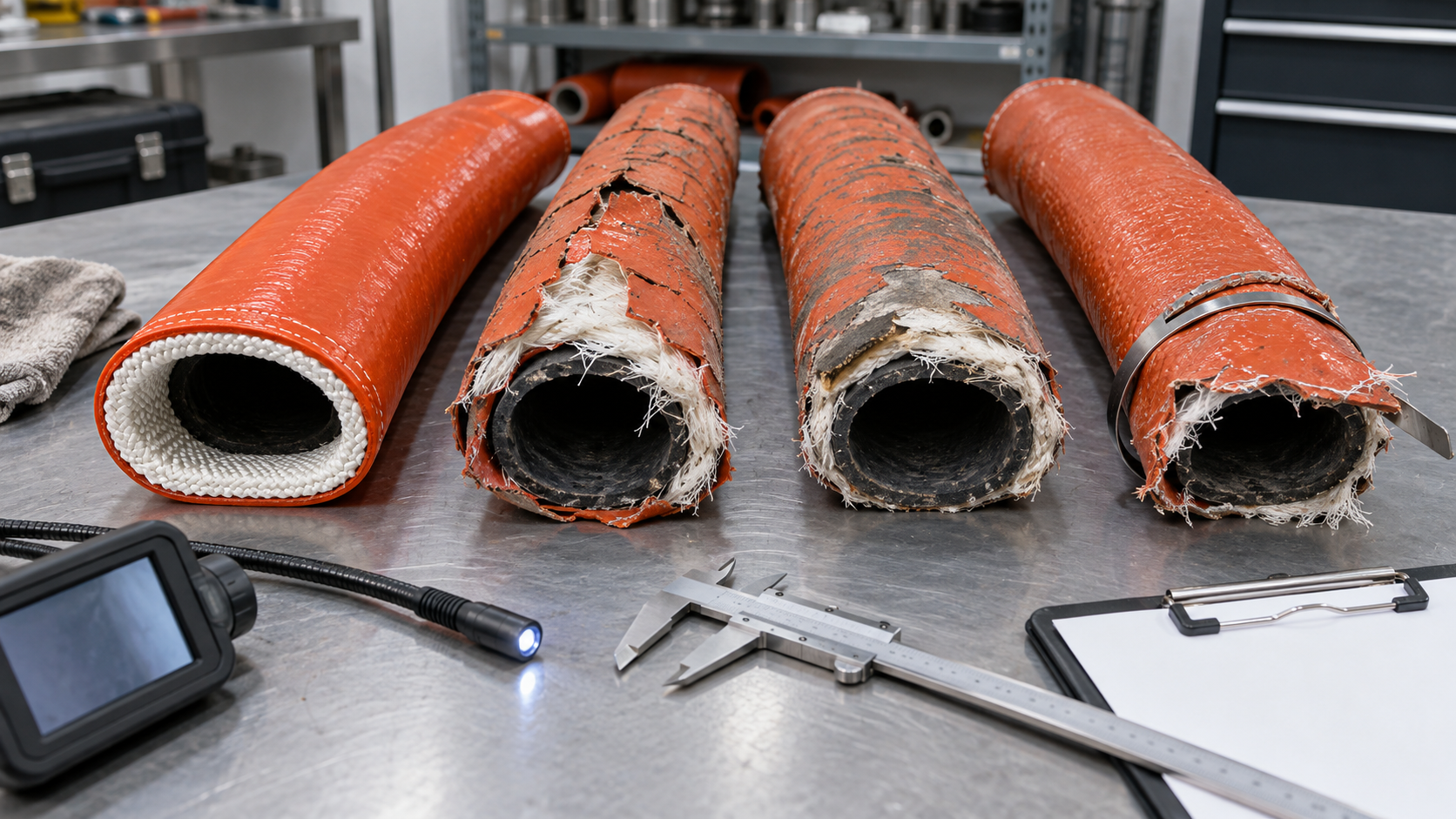
Ask the supplier to identify assumptions and recommend inspection points. If possible, share failed-hose photographs and thickness maps; they show whether the dominant mechanism is impact, sliding abrasion, external wear, chemical attack, or mechanical damage.
Final Wear Principle
Slurry hose life is governed by the energy and location of particle contact. Larger, sharper, harder solids and higher velocity usually increase severity, while tight bends focus that wear into a small area.
The most reliable strategy combines appropriate hose construction with controlled velocity, generous routing, stable pumping, and measured condition monitoring. That makes replacement predictable and prevents the first sign of wear from becoming an uncontrolled leak.