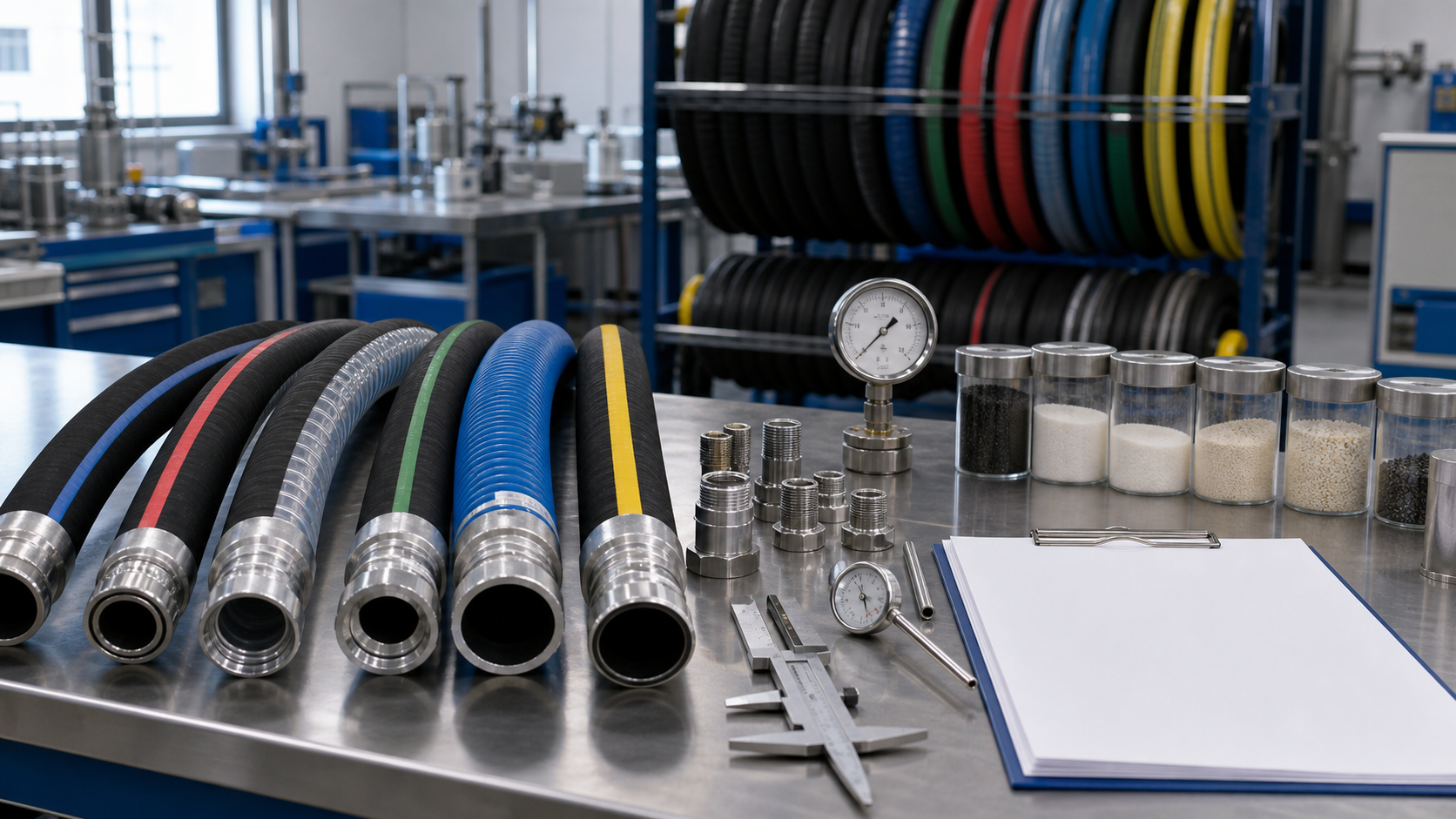
What Is A Hydraulic Hose?
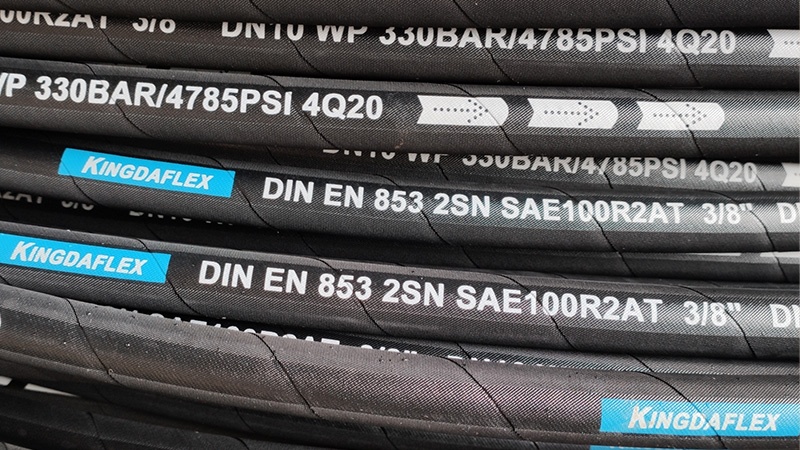
A hydraulic hose is a flexible, high-pressure conduit that carries hydraulic fluid between the components of a hydraulic system — connecting pumps, valves, cylinders, and motors while absorbing vibration and accommodating the movement of machine parts relative to each other.
Unlike rigid steel tubing, a hydraulic hose can flex, articulate, and route around obstacles. That flexibility is not incidental — it is the entire reason hydraulic hoses exist. In a machine like an excavator, the boom arm moves through hundreds of thousands of cycles over its service life. Rigid pipe cannot follow that motion. Only a properly specified, correctly installed hydraulic hose can handle continuous flexing without fatigue failure.
Every hydraulic hose is a three-layer assembly: an inner tube that contacts the fluid, one or more reinforcement layers that carry the pressure load, and an outer cover that protects the assembly from its environment. Each layer’s material is chosen to match the specific demands of the application. A hose that looks identical to another from the outside may be built from entirely different compounds engineered for different fluids, temperatures, and pressure ranges.
For a full breakdown of what each layer is made of and why it matters, see our detailed guide: What Is Hydraulic Hose Made Of?
Why Hydraulic Hose Selection Matters More Than Most Buyers Realize
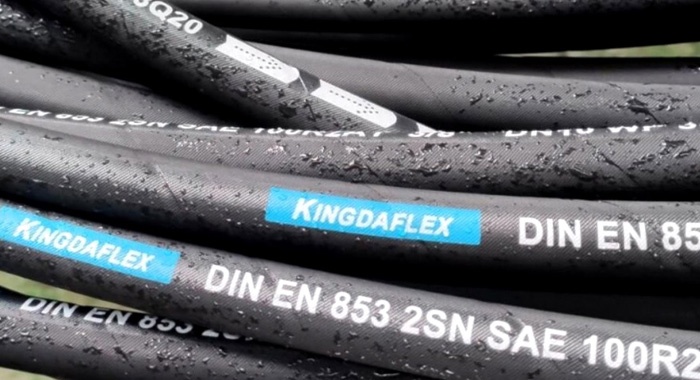
The hydraulic hose market is filled with products that look identical, carry the same SAE or EN designation on the print line, and are priced very differently. The reason that price gap exists is material quality — and the downstream cost of a failure caused by a low-quality hose always exceeds the upfront savings.
A hydraulic hose failure does not just mean replacing the hose. It means unplanned equipment downtime. It means hydraulic fluid contaminating the work environment or the soil. In high-cycle applications like construction or mining, it can mean hours of lost productivity per incident. And in the worst cases — a burst hose near a hot surface or electrical component — it means a safety incident.
Correct selection, matched to the actual operating conditions of the machine, is the foundation of a reliable hydraulic system. The sections below work through the key decisions.
Step 1: Know Your Pressure — Working, Surge, and Burst
The most common hose selection mistake is sizing to nominal working pressure without accounting for pressure surges. Every time a directional valve actuates rapidly, the hydraulic circuit generates a momentary pressure spike — a surge — that can be 1.5 to 3 times the steady-state working pressure. If the hose is only rated to the nominal system pressure, those spikes are systematically fatiguing the reinforcement wire over thousands of cycles, long before the hose shows any external damage.
The correct approach is to select a hose whose working pressure rating exceeds the system’s maximum pressure including surges, with a minimum 4:1 burst-to-working-pressure safety factor.
For standard medium-pressure applications (up to ~250 bar), a single wire braid construction like the SAE 100R1AT / EN853 1SN is appropriate. For higher pressures and more demanding duty cycles, the SAE 100R2AT / EN853 2SN double wire braid handles up to ~400 bar at smaller diameters.
For equipment with severe impulse loading — rock breakers, large excavator boom circuits, heavy-duty crane lines — spiral wire constructions like the EN856 4SP, EN856 4SH, SAE 100R12, SAE 100R13, or SAE 100R15 are engineered specifically to withstand those repetitive spikes without wire fatigue.
The difference between braid and spiral reinforcement — and when to use each — is covered in depth here: Spiral vs Braided Hydraulic Hose
Step 2: Size the Hose for Flow, Not Just for the Fitting
A widespread installation shortcut is to size the new hose to match the existing fitting or the port on the component. This works when the system was correctly designed to begin with. It fails when the original hose was already undersized, or when the system has been modified to run higher flow rates.
Hydraulic hose internal diameter (ID) determines fluid velocity. Industry guidelines recommend keeping fluid velocity in pressure lines between 2 and 4 meters per second, and under 1 meter per second in return and suction lines. Exceeding these limits generates turbulence, heat, and pressure drop — all of which accelerate wear on every component downstream of the hose, not just the hose itself.
The rule is simple: size the hose for the flow rate, then verify the pressure rating. An undersized hose that is handling more flow than it was designed for will run hot, restrict system performance, and fail earlier than its rated service life.
Hydraulic hoses are specified by dash size — a numerical designation where each unit represents 1/16 of an inch of internal diameter. A -8 hose has a ½-inch ID; a -16 hose has a 1-inch ID. The dash size is consistent across SAE, EN, and most DIN standard hoses, which is what makes it a practical universal reference for sourcing and replacement.
Step 3: Match the Hose to the Fluid and Temperature
The inner tube of every hydraulic hose is formulated for compatibility with a specific class of hydraulic fluids. Using the wrong inner tube compound causes the tube to swell, soften, or delaminate — releasing rubber particles into the hydraulic circuit and contaminating the fluid, which then propagates failure to pumps, valves, and actuators throughout the system.
The three most commonly encountered situations:
Mineral oil hydraulic fluid (the large majority of systems): Standard NBR (nitrile rubber) inner tube — used in most of Kingdaflex’s rubber hydraulic hose range, including the R1AT, R2AT, EN856 4SP/4SH, and spiral wire series. Operating range -40°C to +100°C with most standard grades.
Water-glycol or phosphate ester fire-resistant fluids: Requires EPDM inner tube. Standard NBR compounds are chemically incompatible with these fluids and will degrade rapidly. Applications include mining equipment and industrial presses where fire-resistant fluids are mandated by safety regulations.
Aggressive chemicals, very high temperatures, or food/pharmaceutical fluid transfer: PTFE (Teflon) inner tube, as found in the SAE 100R14 / Teflon Hose. Temperature range -73°C to +260°C. Compatible with virtually all hydraulic fluids and industrial chemicals.
Applications near electrical systems: Thermoplastic construction (nylon inner tube, synthetic fiber reinforcement, polyurethane cover) as in the SAE 100R7 and SAE 100R8. Non-conductive. Standard for aerial work platforms, utility equipment, and any machine that operates near live electrical infrastructure.
A complete breakdown of all inner tube, reinforcement, and cover material options is available here: What Is Hydraulic Hose Made Of?
Step 4: Account for the Installation Environment
The outer cover of a hydraulic hose is frequently an afterthought in specification — until a hose fails prematurely because the cover was inadequate for the environment. Cover material selection follows directly from answering one question: what will this hose be exposed to on the outside?
Standard environments (most mobile equipment, construction, agriculture): Neoprene cover — the industry default, providing solid abrasion, ozone, UV, and weather resistance. Used across Kingdaflex’s standard rubber hose range.
Heavy abrasion (hoses routed against rock, aggregate, or other hoses): Consider hoses with enhanced cover compounds, or add external protection. Kingdaflex’s Hydraulic Hose Sheathing and Plastic Spiral Guard are designed specifically to extend cover life in abrasive conditions.
High-temperature proximity (hoses routed near exhaust manifolds, hydraulic power units, or industrial furnaces): The cover can carbonize and crack even when the inner fluid temperature is within spec, because external radiant heat is attacking the rubber compound. Fire Sleeve provides thermal insulation and fire resistance for hose assemblies in these conditions.
Compact machine layouts where routing space is tight: Compact construction hoses like the EN857 1SC and EN857 2SC — or the SAE 100R16 and SAE 100R17 — offer equal or greater pressure ratings than standard constructions at smaller outside diameters and tighter minimum bend radii.
Step 5: Route and Install Correctly
A correctly specified hose that is incorrectly installed will fail early. Routing errors are one of the most common causes of premature hydraulic hose failure in the field, and they are entirely preventable.
Minimum bend radius is the most frequently violated installation requirement. Every hydraulic hose has a published minimum bend radius — the tightest curve the hose can make without kinking the inner tube or fatiguing the reinforcement wires. Routing a hose tighter than its minimum bend radius concentrates stress at the bend point, causing wire fatigue that cannot be detected externally until the hose fails. The minimum bend radius is always published in the hose datasheet; it must be respected in the routing design.
See: How to Prevent Sharp Bends in Hydraulic Hoses
Adequate hose length for the range of motion must be planned before installation. A hose that is the correct length when the machine is in one position may be stretched taut — transmitting tension to the fittings — at the other extreme of its travel range. Stretched hoses pull fittings loose; tension fatigue at the end crimp is a leading cause of fitting-related leaks.
Twist-free installation: A hydraulic hose must never be installed with a twist along its axis. Even a small rotational offset places the reinforcement wires at a non-optimal angle to the pressure load, reducing the effective pressure rating and accelerating fatigue failure. The paint stripe or layline printed along the hose length exists specifically to allow installers to verify that no twist has been introduced.
Protection from contact with moving parts: Any hose that can contact a moving component — a rotating shaft, a swinging arm, a reciprocating rod — must be secured away from that component with proper clamps and brackets. A hydraulic hose can wear through its cover and reinforcement surprisingly quickly when repeatedly contacted by a moving surface.
Understanding Hydraulic Hose Standards: SAE, EN, and DIN
When a hydraulic hose carries a standard designation — SAE 100R2AT, EN853 2SN, DIN 2SNK — that designation is a performance specification, not just a naming convention. It tells you the minimum construction requirements (reinforcement type and quantity), the minimum working pressure at each standard diameter, the temperature rating, and the impulse cycle performance the hose must demonstrate.
Sourcing hoses to a recognized standard from a verified manufacturer means you can replace one hose with another without retesting the assembly, because both must meet identical minimum performance requirements.
Kingdaflex manufactures hydraulic hoses to the full range of international standards, including:
- SAE J517 series: R1AT, R2AT, R1A, R2A, R3, R4, R5, R6, R7, R8, R9, R12, R13, R14, R15, R16, R17
- EN standards: EN853 1SN/2SN, EN856 4SP/4SH, EN857 1SC/2SC, EN854 1TE/2TE/3TE
- DIN standards: DIN 1SNK, DIN 2SNK
How to Inspect a Hydraulic Hose and Know When to Replace It
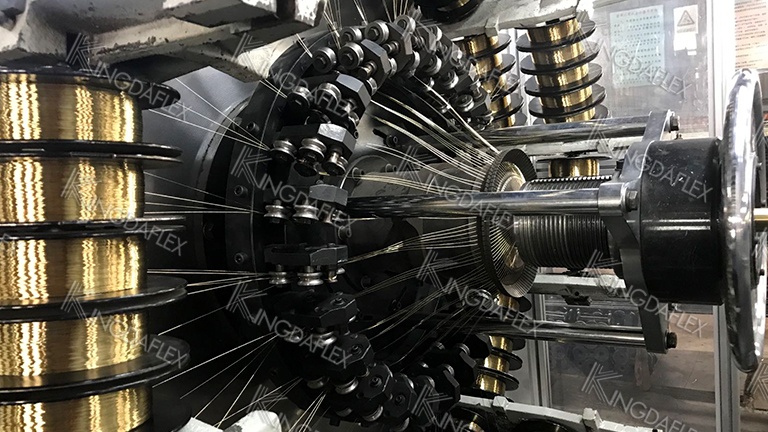
Hydraulic hoses do not last forever. In high-cycle mobile equipment applications, average service life is 2–5 years. In lower-cycle industrial circuits with cleaner environments, hoses routinely last longer. The right replacement schedule is not based on calendar time alone — it is based on regular visual inspection against objective criteria.
The following inspection points should be checked at each scheduled service interval, and any time abnormal system behavior is observed:
Outer cover condition: Any crack, cut, or abrasion that penetrates to the reinforcement wire layer requires immediate replacement. Exposed wire will corrode from moisture ingress, and the corrosion products accelerate reinforcement fatigue. A small external cut that looks cosmetic can be concealing a structurally compromised hose.
Bulging or blistering: A localized bulge in the hose body indicates that the inner tube has separated from the reinforcement layer, or that the reinforcement has been breached. The bulge is the inner tube ballooning outward under pressure. This hose is a burst waiting to happen and must be replaced immediately.
Hardness or brittleness: A correctly aged hydraulic hose remains flexible. A hose that has become stiff, hard, or shows surface cracking when flexed has experienced thermal or chemical degradation of the rubber compound. Stiff hoses crack under vibration and should be replaced before visible failure occurs.
Softness or swelling: A hose that feels softer than normal, is swollen beyond its original diameter, or feels tacky on the outer surface has likely suffered chemical attack — either from an incompatible hydraulic fluid or from external chemical contamination. Soft or swollen hoses have lost structural integrity and must be replaced.
Fitting condition: Weeping or seeping at the ferrule-to-hose interface, corrosion on fitting bodies, or any evidence of the fitting pulling back from the hose end. Fitting-related leaks rarely self-seal; they progressively worsen.
Age marking: Most hydraulic hoses are date-coded by the manufacturer. Regardless of visual condition, hoses older than the manufacturer’s recommended service life should be replaced on a preventative basis. Internal reinforcement fatigue cannot be assessed from external inspection alone.
Hydraulic Hose Fittings: Completing the Assembly
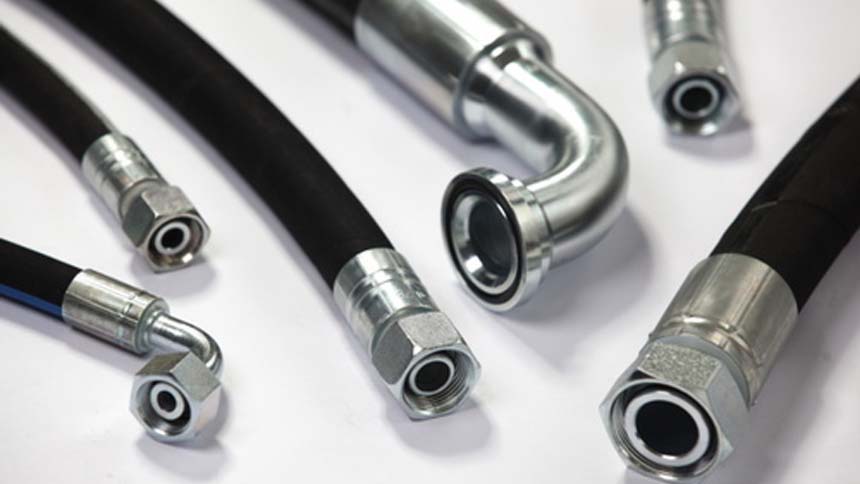
A hydraulic hose assembly is only as reliable as its end connections. The hose and fittings must be matched — not just dimensionally, but in terms of crimping specification. An under-crimped fitting will pull off under pressure; an over-crimped fitting will damage the hose end and create a stress concentration point that leads to failure at the crimp.
Kingdaflex supplies a comprehensive range of hydraulic hose fittings to complement our hose range, including Swaged Hose Fittings, Swaged Hose Ferrules, and adapters in all major connection standards — DIN, BSP, JIC, NPT, and ORFS.